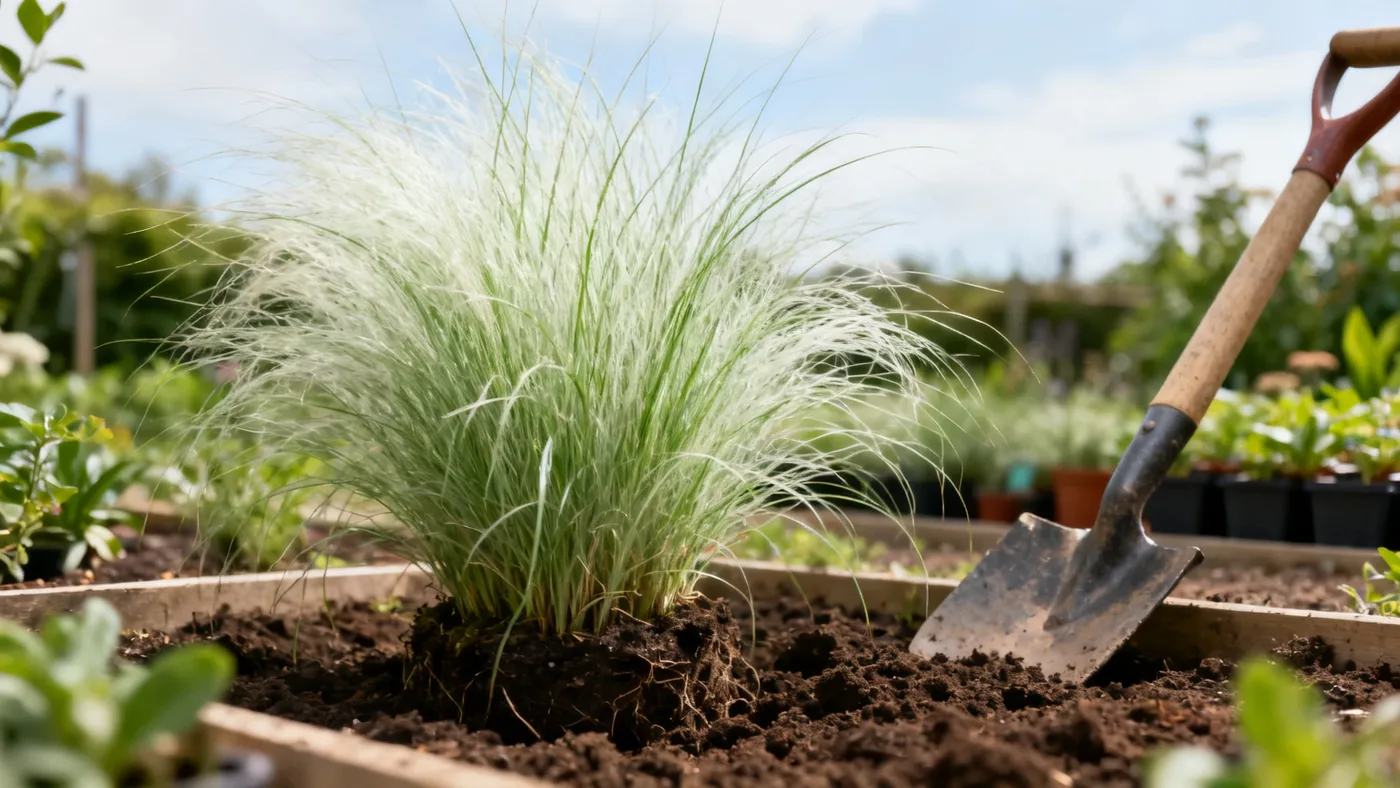
Dividing and Propagating White Cloud Muhly Grass
One mature White Cloud Muhly Grass clump is also a supply of new plants. Because this grass forms a tight basal crown that widens a little every season, an established plant can be lifted, split and replanted as two to four plants of its own, all of them genetically identical to the parent and all of them carrying the same white autumn plumes. Division is the only propagation method that guarantees that, and the timing window is narrower than most gardeners expect.
White Cloud Muhly Grass
Division works from a clump that is already three years old. If you are starting out, or you want a full mass this season rather than in 2029, our nursery-grown plants come in quart, 2 gallon and 3 gallon sizes from $39.99, shipped in their container with our planting and care guides.
This guide covers when to divide, how to cut a clump apart without losing it, how to grow small divisions on in pots, and what seed will and will not do for you. For the annual pruning that is a separate job, see when and how to cut back White Cloud Muhly Grass.
When to Divide White Cloud Muhly Grass
White Cloud Muhly Grass is a warm-season grass, and that single fact sets the calendar. Warm-season grasses stay dormant until soil temperatures climb into the 60s Fahrenheit, generally resuming growth once soil holds steadily around 60 to 65 degrees. A division made while the plant is still dormant sits in cold soil with cut roots and no capacity to replace them, which is why grasses moved during dormancy establish so poorly.
Divide in spring, after the plant has broken dormancy and new growth is roughly 3 to 6 inches tall. In zones 8 and 9 that is often March, in zones 6 and 7 it is more likely late April into May. The USDA plant fact sheet for this species puts the window at early spring and summer, with one firm exclusion: do not divide clumps during the flowering stage. Since the plumes on 'White Cloud' open even later than the pink species, that rules out roughly August through November.
Avoid fall division entirely in zones 6 and 7. A division set out in September has weeks, not months, of root growth before the soil cools past the point where this grass does anything at all, and an unrooted division is the classic winter loss.
Is Your Clump Ready to Divide?
Age matters more than size. Wait until the plant is at least three years old, which for a quart-size start usually means it has reached its mature 2 to 4 feet of width and has bloomed at least twice. A young plant split early gives you two weak plants instead of one good one.
After that, divide every three to five years if you want more plants, or when the clump tells you it needs it. The classic signal is a dead or hollow center with a ring of living growth around the outside. That is the crown outgrowing itself, and division is the cure as well as the multiplier. Dividing every few years is easier than waiting: the longer you leave it, the denser and more root-bound the center becomes.
What You Will Need
- A sharpened spade: the cutting tool for the perimeter and, on a young clump, for the split itself. Sharp matters. A dull spade crushes crowns rather than severing them.
- A pruning saw or old carpentry saw: the root mass of a mature muhly clump is dense and fibrous, and a saw cuts it far more cleanly than chopping with a spade.
- Two garden forks: inserted back to back in the middle of a lifted clump and levered apart, they split it along its own natural lines.
- Hand pruners: to shorten the foliage before you start.
- A tarp: for dragging the clump and keeping soil off the lawn or patio.
- Gloves: the wiry blades run 18 to 36 inches long and will score your forearms.
- Hose, mulch and pots: water for before and after, 2 to 3 inches of mulch for the replanted divisions, and a few 1 gallon pots for any piece too small to plant out.
Step by Step: Dividing an Established Clump
Step 1: Water the clump thoroughly one to two days ahead. Moist soil digs cleanly, holds together around the roots, and keeps the root mass from drying out in the minutes it spends out of the ground. Do not divide from bone-dry soil.
Step 2: Cut the foliage back to about 6 inches. This is not the annual pruning, it is a working cut. Short foliage lets you see the crown, reduces the water the division has to support while it re-roots, and stops the blades whipping your face while you dig.
Step 3: Cut the perimeter. Drive the spade in about 2 to 6 inches outside the visible edge of the clump, angling the blade at roughly 45 degrees toward the plant's center, and work all the way around. The root system is fibrous and concentrated in about the top foot of soil with no taproot, so a full circle at that depth frees nearly all of it.
Step 4: Lever the clump out and onto the tarp. Work a fork under one side and lift. A 3 foot clump with wet soil attached is genuinely heavy, so lift with your legs or recruit a second pair of hands. Shake or hose off enough soil to see where the living growth stops and the dead center begins.
Step 5: Split it. On a younger clump, two forks back to back in the center and pulled apart will do it. On a dense mature crown, use the saw and cut straight down through the root mass into two, three or four pieces. Cut decisively. A clean severing cut heals faster than a torn one.
Step 6: Discard the dead center. If the middle is hollow, woody or brown, it will not regrow. Cut it out and compost it, keeping only the vigorous outer sections with both live shoots and pale live roots.
Step 7: Keep each division as large as you can. Bigger divisions establish faster and bloom sooner. Aim for pieces roughly the size of a dinner plate, and treat about 5 inches across as the practical floor. Anything smaller goes into a pot to grow on rather than straight into the garden.
Replanting the Divisions
Replant promptly. Divisions are at their most vulnerable in the minutes their roots are exposed to sun and wind, so have the new holes dug before you start cutting, and keep any pieces you are not planting yet under damp burlap or in the shade.
Dig each hole two to three times wider than the division's root mass but no deeper than the root mass is tall, then set the division so its crown sits level with the surrounding soil. A crown planted low collects water and rots, which is the most common way a good division is lost. Backfill with the soil you took out, firm it in well so the division does not wobble, and water deeply enough to wet the soil 4 to 6 inches down.
Finish with 2 to 3 inches of mulch pulled back a few inches from the crown itself so air can move across it. For spacing across a bed, follow the same distances as new plants: 18 inches for a fast, dense mass and up to 36 inches to let each clump show its own shape. Our guide to spacing White Cloud Muhly Grass for hedges, borders and mass plantings has the full spacing tables.
Growing Small Divisions On in Pots
Any piece under about 5 inches across is better off in a pot for a season than competing in open ground. Use a free-draining container mix rather than garden soil, choose a pot only slightly larger than the division itself, and water whenever the top inch dries.
Keep potted divisions out of hard afternoon sun for the first week or two while the cut roots seal, then move them into full sun. A division is ready for the garden when its roots hold the shape of the pot and new blades are growing from the center, which for a spring division usually means planting out in early fall or the following spring.
Aftercare: The First Eight Weeks
A division has lost part of its root system and has to rebuild it before it can support full growth. Water whenever the top inch of soil is dry, aiming for consistently moist but never saturated soil, then taper off as growth resumes. Established plants are genuinely drought tolerant, but a fresh division is not one of them yet. Our guide to watering White Cloud Muhly Grass from new plant to established covers the taper in detail.
Do not fertilize. This grass evolved on lean soils and tolerates low-nutrient ground well, and feeding a stressed division pushes soft top growth it cannot yet support with roots. For the full reasoning, see whether you need to fertilize White Cloud Muhly Grass at all.
Expect a modest first year. Divisions typically bloom lightly or skip the first autumn, then return to full plume production the following fall. Reaching mature size again takes two to three seasons at this plant's moderate growth rate of roughly 1 to 2 feet per year.
Can You Propagate White Cloud Muhly Grass From Seed?
The species grows readily from seed, and the mechanics are well documented. Seed is collected in late fall when the plumes have matured, gathered during the warmest and driest part of the day with a comb drawn through the plume so the plant's appearance is not wrecked, then air-dried for five to ten days. No cold treatment is required for germination, though the highest recorded germination rates followed about 12 weeks of cold stratification. Sow on the surface or barely covered at about one eighth of an inch deep, keep the mix consistently moist, and expect sprouts within roughly two weeks.
Here is the catch. 'White Cloud' is a selected white-flowered form of a pink-flowering species, introduced by Superior Trees Nursery of Lee, Florida. Seed is sexual reproduction, so seedlings are a genetic reshuffle of the parent rather than a copy of it, and their plume color is not guaranteed to come out white. If white plumes are the entire reason you grow this plant, division is the method that keeps them, because a division is a clone.
Two other propagation routes do not apply here. This grass spreads by neither rhizomes nor stolons, so there are no runners to detach, and it does not root from stem cuttings the way a woody shrub does. Division and seed are the whole toolkit.
Common Mistakes When Dividing
Dividing while the plant is dormant. It looks convenient in March in zone 6, but cut roots in cold soil do not regenerate. Wait for 3 to 6 inches of new growth.
Dividing a plant in bloom. The plant is pouring its resources into plumes and has nothing spare for root repair. September looks like ideal digging weather and is the worst month for this job.
Making the divisions too small. Six tiny pieces from one clump usually yields six struggling plants. Two or three substantial ones establish and bloom years sooner.
Keeping the dead center. The woody middle of an old clump does not regenerate. Compost it without guilt.
Planting the crown too deep. Level with the soil surface, every time. Buried crowns rot after the first heavy rain.
Fertilizing to speed recovery. It produces floppy growth and fewer plumes. Water is the only input a new division needs.
Quick Reference: Dividing and Propagating White Cloud Muhly Grass
| Item | Detail |
|---|---|
| Best method for true white plumes | Division (a clone of the parent) |
| Division timing | Spring, once new growth is 3 to 6 inches tall and soil is warming |
| Never divide | During flowering (roughly August to November) or during winter dormancy |
| Minimum plant age | About 3 years, mature and blooming |
| Division frequency | Every 3 to 5 years, or when the center dies out |
| Divisions per clump | 2 to 4 from a mature 2 to 4 foot clump |
| Minimum division size | About 5 inches across; smaller pieces go into pots |
| Digging depth | Spade 2 to 6 inches outside the clump; roots sit in about the top foot of soil |
| Replant depth | Crown level with soil surface; hole 2 to 3 times wider, no deeper |
| Aftercare | Water when the top inch is dry for 6 to 8 weeks; no fertilizer |
| Seed germination | About 2 weeks; no cold treatment required; sow about 1/8 inch deep |
| Seed limitation | Seedlings are not guaranteed to produce white plumes |
| Time back to mature size | 2 to 3 seasons at 1 to 2 feet of growth per year |
Division is the cheapest way to turn one good clump into a drift, and on a five-year cycle it also keeps the parent plant young. The one thing it cannot do is work quickly: every division resets the clock by two to three seasons.
White Cloud Muhly Grass
Want the finished look now instead of in three years? Order nursery-grown White Cloud Muhly Grass in quart, 2 gallon or 3 gallon sizes, plant this spring or early fall, and divide your own clumps later as a bonus. Shipped in the nursery container with growing guides included.