
Growing White Cloud and Pink Muhly Grass Together
Start with a tape measure and a bare 30-foot strip beside a driveway. Stretch it out, drive a stake at each end, and ask the question we hear every fall: how many white plants and how many pink plants does it take to make a real show? Pink muhly grass and White Cloud are the same species, since White Cloud is the white-flowered cultivar, so they want the same sun, the same soil and the same haircut. Only the plume color differs, and that is where mixed beds go wrong.
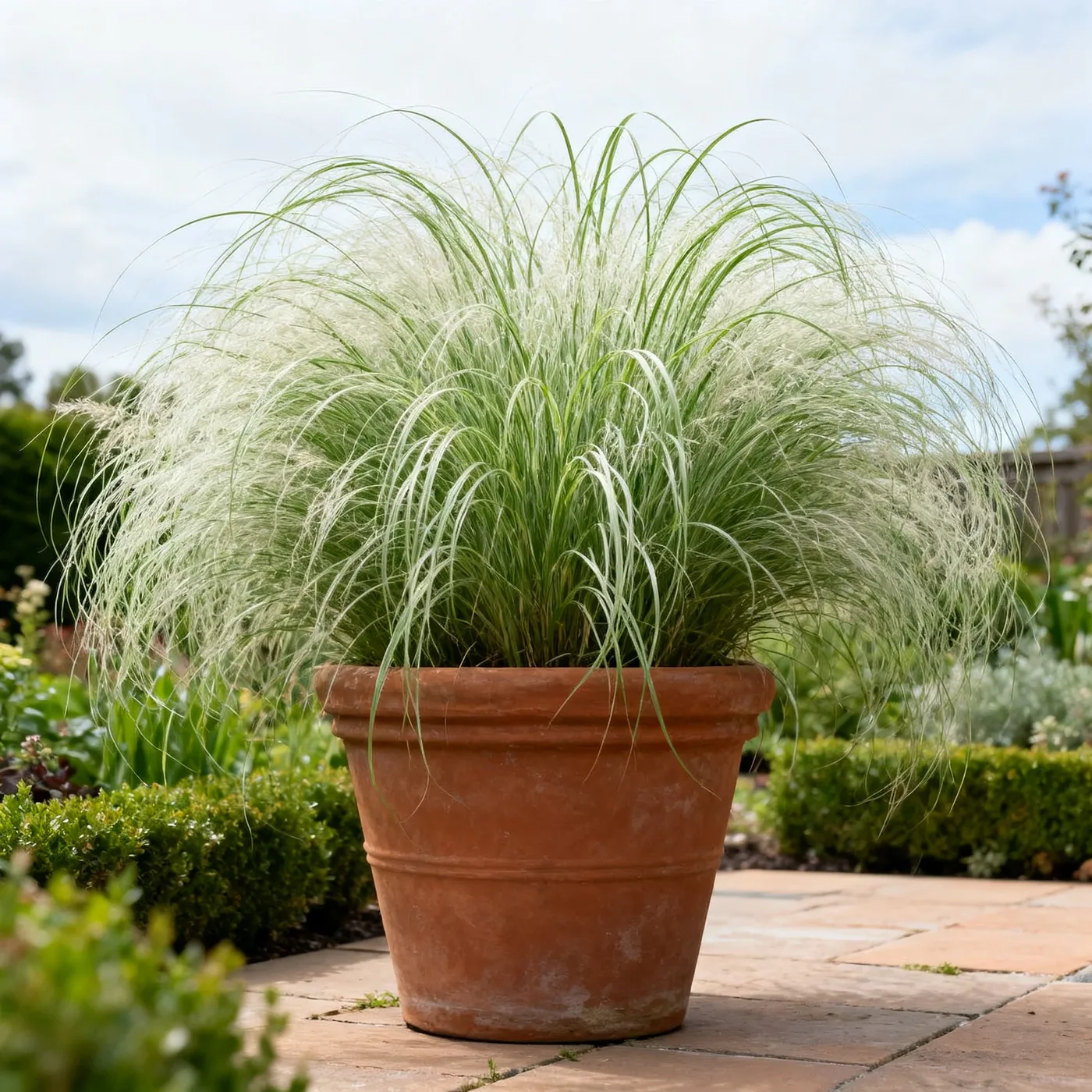
This article talks about planting both colors together and answers the questions customers ask us most. Read on to learn the ratio we use, how to sketch the drifts, where each plant goes, how to keep the white from fading beside the pink, and how to run planting day. We follow one bed from tape measure to third fall, with every number shown.
The 30-Foot Bed We Are Planting
Our example bed runs 30 feet along the driveway and is 5 feet deep from front to back. It gets full sun, which for muhly means 6 or more hours of direct light a day, and the soil is sandy loam. That soil suits these grasses well. Muhly takes a wide range of soils but does best where water drains away.
The goal is a two-tone fall show, with pink and white plumes lapping into each other when you look down the bed from the street. The two colors do not trade turns. NC State notes that White Cloud blooms after the pink form, but the bloom periods overlap for a good stretch, and that overlap is what gives you both colors at once. Our guide to when White Cloud blooms and how long it lasts covers the timing in detail.
Before you buy anything, mark the bed. Set stakes at 0, 15 and 30 feet, run string along the front edge, and pick the spot where you will usually see the bed from. Note where the late afternoon sun falls, because that decides which end gets the white. Every number below hangs on those marks, so if your strip is a different length, keep the same method and scale the counts in the spacing section.
Why White Cloud Muhly Grass Gets the Larger Share
For this bed we plant 11 white and 5 pink, 16 plants in all. The pink plume is the louder color. It is saturated and the eye goes to it first, while the white is pale and airy and needs bulk to register. Give the two equal numbers and the pink wins every time.
Here is how we get to 11 and 5. Start at an even split of 8 and 8, then move 3 plants from the pink column to the white one. That leaves about two white plants for every pink. White Cloud also looks its best mass planted, so a big white share is the way the cultivar wants to be used anyway.
Size is the other reason. Clemson lists White Cloud at 1–3 feet high and wide, while NC State says the species can reach 4 feet tall and 3 feet wide. A pink plume that stands a little taller than the white behind or beside it can bury it, so the pink should never take the front.
One of the most common questions we get is whether the white will vanish next to the pink. With too few white plants it does. If you are still deciding between the colors for a smaller space, our White Cloud and pink muhly comparison will help you choose.
Drawing Three Drifts on Graph Paper
Take graph paper and let one square equal one foot. Draw a rectangle 30 squares long and 5 deep, then mark the street end as your viewing spot. Muhly plumes glow most when the sun is low behind them, and designers like to place large groups where the flowers are backlit in the late afternoon. If your far end faces the setting sun, that end is where the second white drift goes.
We draw three drifts. The first is white and sits nearest the street, running from 0 to about 10 feet. The second is pink, from about 10 to 18 feet. The third is white again, from 18 feet to the far end, with its last stretch left a little open. Putting white at both ends frames the pink and keeps the color you chose to feature on the outside of the show.
Draw each drift as a long teardrop, not a block. Where two drifts meet, let their edges overlap by pushing one or two plants of the neighboring color into the back row, like interlocked fingers. A straight cut between colors reads as a stripe, and a ragged one reads as a meadow.
Count the plants each shape holds before you leave the paper. You want roughly 6 white, 5 pink and 5 white, and the exact slots are settled in the next section.
Spacing White Cloud Muhly Grass Along the Drifts
Space plants on 3-foot centers. Clemson gives 2 to 3 feet apart, and we go to the wide end because a clump can reach 3 feet across and the point of a drift is plumes that touch without a crush. Crowded muhly looks thinner, not fuller, since each clump needs its own room to fill in.
Plant in two staggered rows. Set the front row 18 inches back from the front edge and the back row 2 feet behind it, which leaves 18 inches behind the back row. Shift every back plant 18 inches sideways so it sits between two front plants. On 30 feet that gives 10 plants in front and 9 behind, 19 spots in all.
We then skip 3 spots: one at each join between colors and one at the open far end. That leaves 16 plants, the 11 white and 5 pink from the ratio. Our guide to spacing White Cloud for hedges, borders and mass plantings goes further on tighter and looser layouts.
A shorter bed follows the same method. This table shows the counts for the same 5-foot depth with the same staggered rows.
| Bed Length | Spots | Skipped | Plants | White / Pink |
|---|---|---|---|---|
| 30 feet | 19 | 3 | 16 | 11 / 5 |
| 24 feet | 15 | 2 | 13 | 9 / 4 |
| 18 feet | 11 | 2 | 9 | 6 / 3 |
| 12 feet | 7 | 1 | 6 | 4 / 2 |
Keeping White Cloud Muhly Grass From Vanishing Beside Pink
The two colors share every trait except the plume. The University of Florida extension calls White Cloud identical in all the features to the pink version. So you cannot fix a weak white with care. You fix it with placement, and we use three moves.
Put White in Front
Keep the front row white wherever you can, including along the pink drift. Pale plumes at eye level catch the light, and the pink behind them becomes a backdrop instead of the first thing you notice. Run the front line of the whole bed in white and the pink reads as depth.
Hold Pink Back as an Accent
In the pink drift, put three or four of the five plants in the back row and two in the front at the heart of the drift. A small pink accent drawn into a larger white field looks planned. The same pink spread evenly through the bed looks like a mistake.
Leave a Gap of Plain Foliage
At each join, leave the skipped back-row spot empty. For most of the year the grass is plain green blades, and in fall that open slot gives your eye a rest between colors so they do not blur. Do not fill it with another plant, since a third color would defeat the point.
Setting Out the Plants on Planting Day
Plan this as a half-day job with a helper if you can. The sketch is a guide, but pots on the ground tell you the truth, and a few minutes of shuffling now saves you three years of looking at a mistake. Tag every white pot with tape, because the plants are rarely in bloom when you set them out and the pots all look alike.
- Lay the pots on the bed in drift order, front row first, then the back row, using the 3-foot centers and 18-inch offset from your sketch.
- Walk to the viewing spot and look at the layout from there, squinting to blur the detail. Ask whether the white pots cover more ground than the pink.
- Swap pots, slide a plant or add an overlap, then check from the street again. Two rounds is usually enough.
- Dig each hole as wide as the pot and no deeper than the root ball, then plant one by one, tag by tag, and settle each in. Our guide on how to plant White Cloud for best results covers depth and firming.
- Water each plant in thoroughly and keep the new roots moist while they settle. Leave the empty skip spots bare.
After planting, stop fussing. Sandy loam drains fast, so water through the first season, then ease off, since established muhly is drought tolerant. Our White Cloud care guide has the routine.
White Cloud Muhly Grass and Pink in Year Three
By the third fall the clumps have grown into one another and the drifts look like drifts. The white does what the ratio promised: it holds the front line and the lit end, and the pink sits behind it as a warm patch in the middle. The far end, backlit in the late afternoon, is the best view in the bed.
Some things shift from the plan, as they always do. The pink drift tends to look bigger than five plants, because saturated color carries. In our rows, we often see the pink take the eye first even when it is outnumbered two to one, which is why we never go the other way on the ratio.
Keep the upkeep simple. In late winter, cut the clumps back to about 6 inches before new growth starts, since an earlier cut takes off the plumes. Our guide to when and how to cut back White Cloud shows the steps. Then watch the next fall and note what you would change.
One Small Tweak to Two Pink Plants
The method comes down to a few choices. Plant about two white for every pink, keep white in front, space plants 3 feet apart in staggered rows, and leave a foliage gap at each join. Do that and the pale plumes hold their own beside the brighter ones.
Our own tweak after year three is small. We move two pink plants a few feet down the bed, away from the first white drift, in late winter when we cut back, before growth starts. If your bed runs a little pink-heavy, try the same adjustment and let the white have the room.
White Cloud Muhly Grass
Nursery-grown White Cloud Muhly Grass in sizes from Quart, shipped to your door.
From $39.99
Shop Now →On our farms, White Cloud grows in bright, open rows with loose soil that drains fast, and it gets very little water or feeding. That is where the plumes stay clean and white, and it is how we raise each grass we ship, from our own rows to your door. If a mix of white and pink muhly is next on your planting list, come take a look at what we have.