White Cloud Muhly Grass vs Lindheimer's Muhly: Size and Color
Two muhly grasses get sold as "pale plumes," and we doubt that most people choosing between them have ever seen them side by side. Catalog photos are shot in low light, the copy leans on words like "silvery" and "whitish," and a search for "white muhly" returns both plants.
The mix-up costs more than a shade of color. The two differ in height, spread, foliage tone and cold limit, so the wrong pick leaves you with a gray border where you wanted white, or a big clump crowding a small bed.
Read on for plume color, foliage, size and climate for White Cloud and Lindheimer's muhly (Muhlenbergia lindheimeri), then a plain verdict on which one earns the white fall display.
Pink-White Haze or Pale Silver Wands
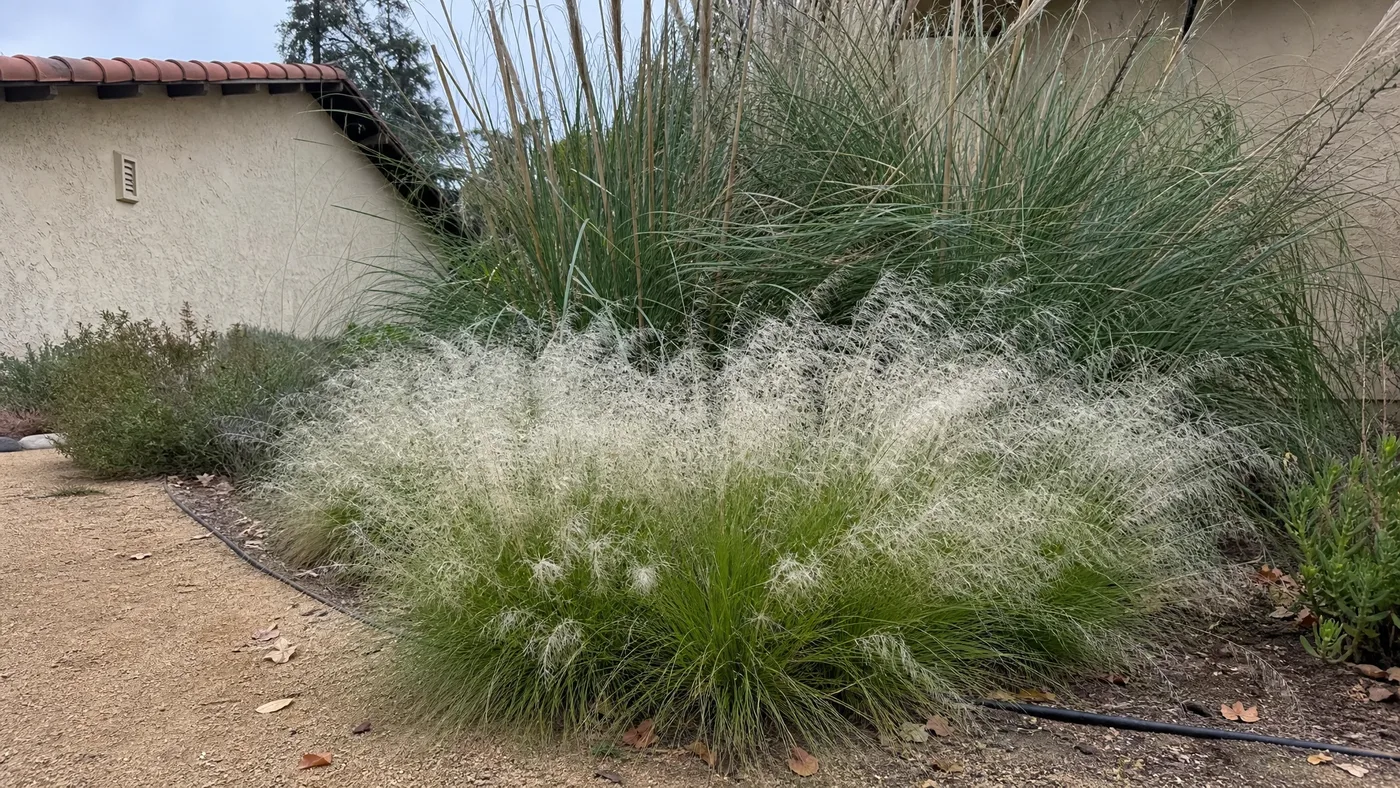
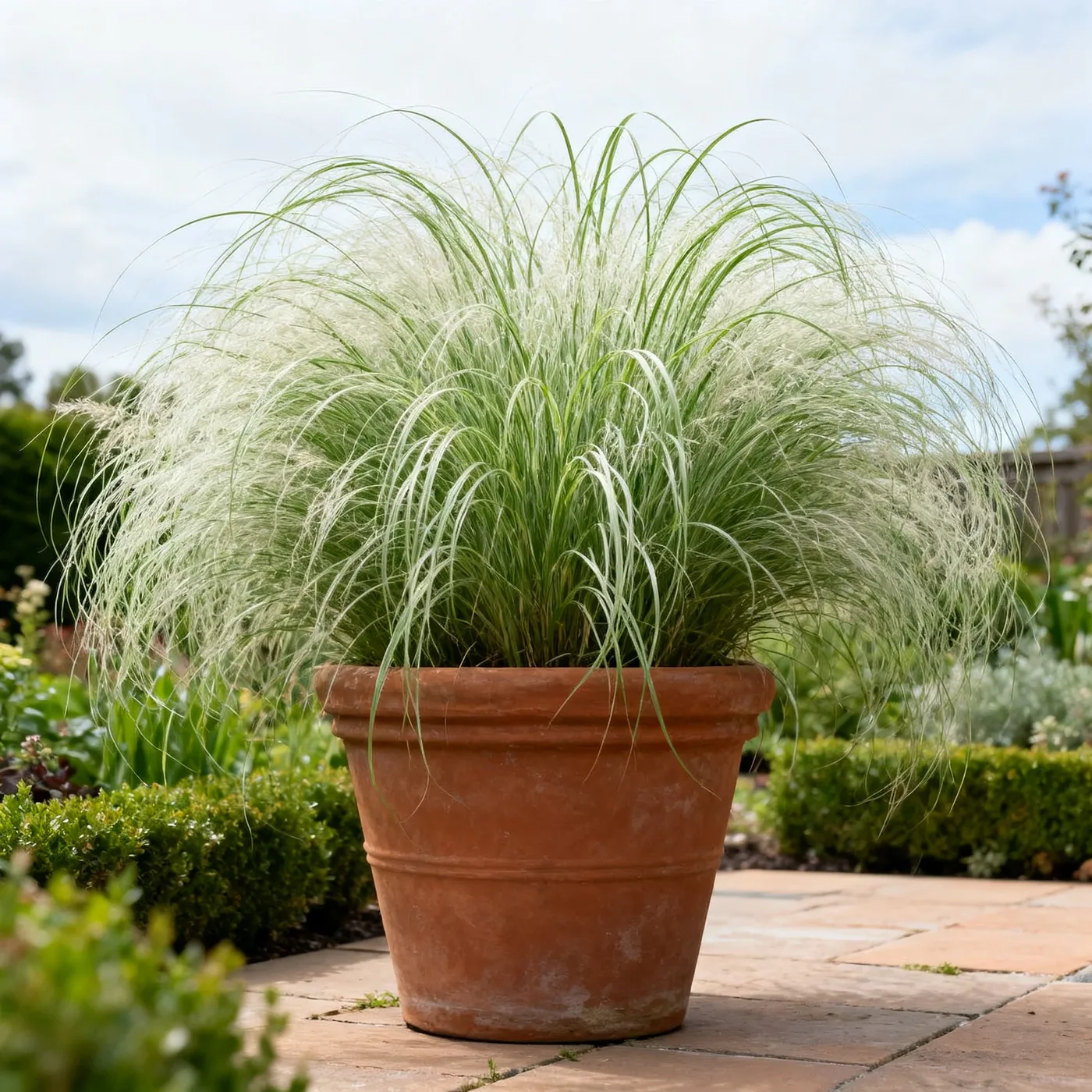
White Cloud's plumes open white and airy after the pink form of the species has finished flowering. The species itself is listed as pink, purplish red or purplish gray, and White Cloud is the white-flowered cultivar. University of Florida extension calls it identical to the pink version in all its features apart from the flower, so habit, foliage and plume shape stay the same. In a bed the plumes read as a low haze floating over the clump, not as separate spikes.
Lindheimer's carries its flowers differently. The panicles are silvery-gray, whitish-gray or lavender-gray. That is a gray with some white in it, never a clean white. Because the plumes sit on a gray-green clump, the whole plant reads as silver from across a yard.
Why Photos Mislead
Low autumn sun behind any pale plume makes it glow, and most catalog photos are taken that way. Under that light the two plants look close. Stand in flat midday light and the gap opens: White Cloud still reads white, while Lindheimer's drifts toward silver or gray.
If you cannot see the plants in person, ask for a photo taken on an overcast day. A seller who has one is usually a seller who knows the plant.
Is White Cloud Muhly Grass Really Whiter?
Yes, and the sources back it. Clemson lists the cultivar as clouds of white flowers in September. Lindheimer's flowers run across three grays. A plant whose own range is gray, whitish-gray or lavender-gray will not deliver the same white, however it is photographed.
The word "whitish" is where catalogs blur the two. A silvery plume beside blue-green leaves can look pale in a photo, and the copywriter calls it white. We would not. When a listing says "silvery" or "whitish," read it as gray and judge the plant on that.
The Timing Trap
Lindheimer's flowers from May through November. That is a long season of pale panicles with no single week that stands out. White Cloud peaks in September, and the species as a whole flowers September through November. For a display with a clear high point, the narrower window is the better one.
Reading a Plant Tag
Customers usually ask us whether the two can stand in for each other. For a white display they cannot, and three checks settle it before you buy:
- Look for the cultivar name. "White Cloud" means the white-flowered muhly, while a bare "muhly grass" tag may be the pink species.
- Look for the botanical name. Muhlenbergia lindheimeri is Lindheimer's, and it will be gray whatever the common name says.
- Look at the foliage on the plant in the pot. Dark green and wiry points to White Cloud, while a blue-gray tint points to Lindheimer's.
Fine Green Blades Against Gray-Green Tufts
Foliage sets the stage for the plumes, and here the two plants part ways more than anywhere else. The muhly species has wiry, thread-like, dark green leaves, and White Cloud keeps that look. Dark green gives a pale plume something to read against, which is a large part of why the white seems to glow. The blades are fine enough that the clump looks like a soft mound even before it flowers.
Lindheimer's foliage runs bluish-green to grayish-green, soft, fine and prickly, with an upright, fountain-like habit. Blue-gray leaves are attractive on their own, and plenty of people buy the plant for them. They also change the job the plumes do.
What That Does to the Backdrop
A gray-green clump carrying gray-white plumes gives low contrast, so the plume blends into the leaf. That can look refined in a quiet planting. It is a poor fit if you want the color to carry across a lawn or catch the eye from a window. White on dark green carries. Silver on gray-green whispers.
The table sums up the design differences.
| Trait | White Cloud | Lindheimer's |
|---|---|---|
| Foliage color | Dark green | Bluish-green to grayish-green |
| Habit | Clumping mound | Upright, fountain-like |
| Plume color | White | Silvery-gray, whitish-gray or lavender-gray |
| Contrast with foliage | High | Low to moderate |
| Main bloom | September | May through November |
A Three-Foot Mound Beside a Five-Foot Fountain
Lindheimer's is the bigger plant by a wide margin. It grows 2 to 5 feet tall and 3 to 4 feet wide. White Cloud tops out lower, at 1 to 3 feet tall and wide, and it forms a clumping mound to about 3 feet with an equal spread. Our guide on how big White Cloud really gets walks through that range.
The spread difference matters more than the height. A clump that can reach 4 feet across needs real room, and it will swallow a path edge or a smaller neighbor if you plant it where a 3-foot mound belongs. White Cloud's footprint is predictable, so it is the easier plant to tuck into a tight bed.
Where Each One Fits
Match the plant to the spot and neither one disappoints:
- White Cloud suits the front or middle of a border, the edge of a walk, and drifts where you want a low haze instead of a wall.
- Lindheimer's suits the back of a bed, a corner, or any spot where a large grass is the whole point.
- Do not use Lindheimer's as an edging plant. It will outgrow the job.
Spacing Follows Size
The usual muhly spacing range is 2 to 3 feet, which suits White Cloud. Lindheimer's needs more, and a safe rule is to space it at least as far apart as its mature width. Crowd either grass and the clumps lose their shape, which hurts the plume display most.
Winter Lows Test White Cloud Muhly Grass Differently
Lindheimer's grows in USDA zones 6a through 9b. The species that White Cloud belongs to grows in zones 5a through 9b. That puts the cold edge in White Cloud's favor by a full zone, and Penn State's extension also lists the species at zones 5 to 9. If you garden at the cold end, that single zone matters.
The sources do not agree everywhere. Clemson's rain-garden factsheet gives a warmer range of 7 to 10, and Texas Tech lists zones 6 to 9. We would not plant White Cloud in zone 5 without checking with your local extension service first. Our hardiness zone guide goes through the disagreement in detail.
Humidity and Disease
The muhly species tolerates heat, humidity, drought and poor soil, and White Cloud resists tar spot. We have no source on how Lindheimer's behaves in humid summers, so we will not claim it either way. If you garden in a humid climate, White Cloud has the documented record.
Neither plant needs much looking after once it is in the ground. Choose by zone, plant it in full sun, and leave it alone.
Planting White Cloud Muhly Grass in Front of Lindheimer's
You can grow both, and they will not fight. The best layout puts Lindheimer's behind and White Cloud in front. The taller gray-green fountain becomes a backdrop, and the white haze sits in front of it. This works better than the reverse, where the big plant hides the small one and the white never gets seen.
Leave a gap of a few feet between the two so neither clump crowds the other's foliage. Both are grasses that look best when each keeps its own outline.
Do the Colors Fight?
Not if you keep them in separate roles. White Cloud is the accent and Lindheimer's is the mass. Put them in equal numbers and the eye does not know where to land. Use one big Lindheimer's with a group of White Clouds and the pairing makes sense.
A Note on Buying
We grow White Cloud, and our plants ship with the dark green foliage you should expect from it. Our pink muhly comparison covers the other way this mix-up goes.
White Cloud Muhly Grass Wins the White Fall
For a white fall display, we pick White Cloud without much hesitation. It flowers white in September, sits in a dark green mound that makes the plumes show, and stays a manageable size. Lindheimer's gray plumes arrive over a long window and never reach the same white. Our guide to White Cloud fall color describes what to expect each autumn.
Lindheimer's is the better call in one situation. If you want a large, soft, gray-green grass for the back of a bed, and the plume color matters less than the plant's mass, it earns its place. Treat it as a structural plant and not as a white one.
If White Is the Goal, Check the Other Look-Alike
Another grass sold as white at this time of year is white fountain grass. It is a different plant with a different habit, and we compare the two in our guide on White Cloud and white fountain grass.
Choosing White Cloud Muhly Grass for a White Display
If the job is a white fall display, plant White Cloud. It has the whiter plumes, the dark foliage that lets them show, the smaller footprint, and the documented record in colder and humid climates. The one condition under which Lindheimer's should win is when you want a tall, gray-green background grass and are happy to give up clean white.
White Cloud Muhly Grass
Nursery-grown White Cloud Muhly Grass in sizes from Quart, shipped to your door.
From $39.99
Shop Now →Our White Cloud gets a bright, open spot on our farms, with loose ground that drains fast and enough space around each clump for the plumes to open clean and white. We're a small business that raises its own stock, so every grass we sell is top-quality and grown by people who know it well. Once you have decided between White Cloud and Lindheimer's, come see which plants are in stock now.