
White Cloud Muhly Grass vs White Fountain Grass: Key Differences
Squeeze a fistful of damp clay in your hand after a week of rain. If it holds a slick, sticky ball, that is what a grass crown will sit in all winter, and what the soil does next decides which pale-plumed grass lives in your yard. A muhly set in that ball can rot from the crown down. A fountain grass set in deep shade turns leafy and may never bloom.
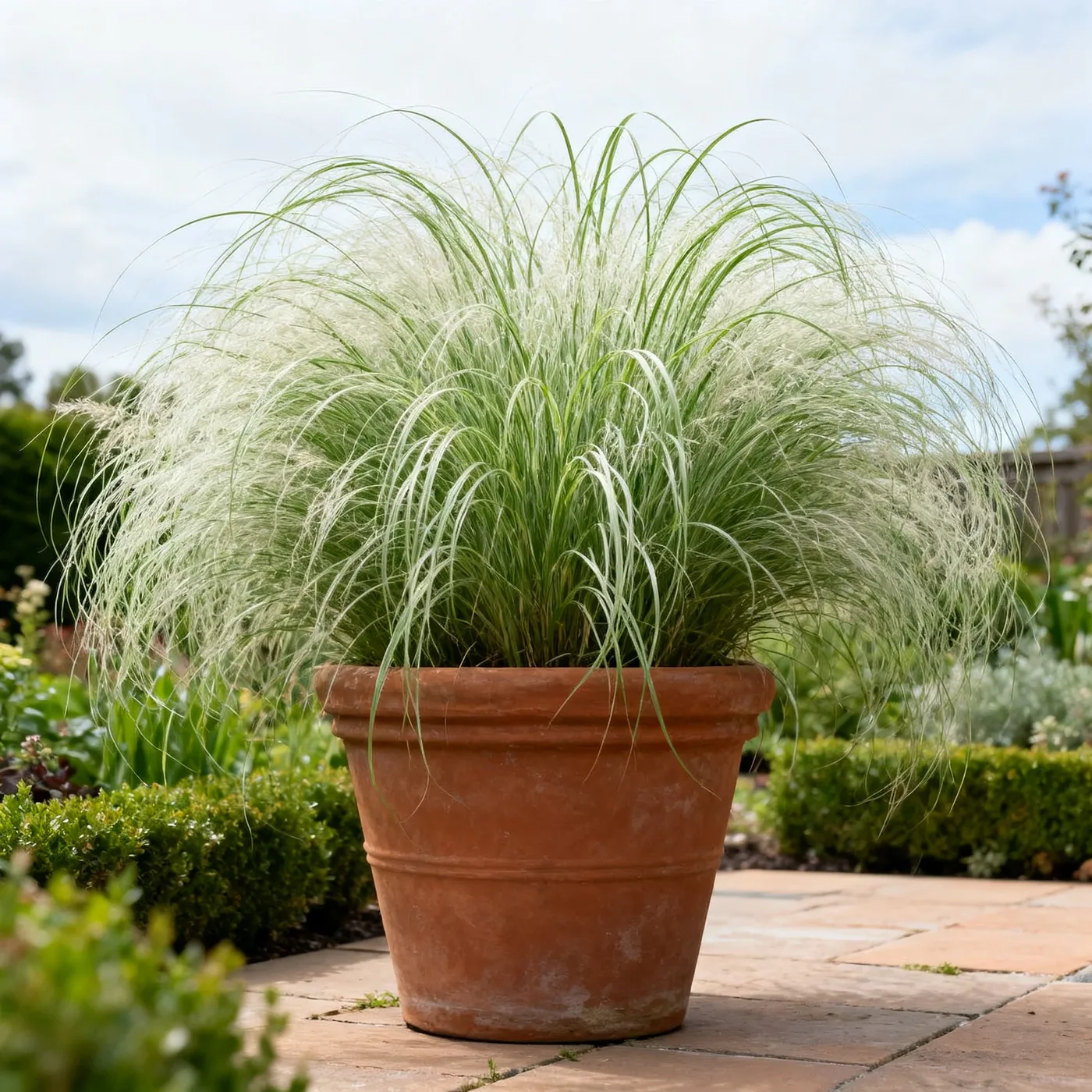
Shoppers lump White Cloud muhly grass and white-plumed fountain grass together because both put up feathery plumes in fall. Underneath, they are different plants with different roots, different habits and different appetites for water and food.
This article talks about four yard situations (a shaded side bed, a windy sandy corner, a pot on a hot deck and soggy clay) and answers the questions customers ask us most. Read on to learn how each grass handles shade, wind, containers and wet winters, and which one soil check to do before you buy either.
A Narrow Side Bed Where Fountain Grass Sprawls
Picture a strip between the house and the fence, dug over with compost years ago and fed by a downspout. The soil is dark, crumbly and always a little damp. It is the kind of ground that makes a fountain grass pour out leaf, and it is not the kind of ground a muhly needs.
What Rich Soil Does to Each Grass
Rich soil is high in nitrogen, the nutrient that drives leaf growth, and steady moisture keeps that growth going all summer. Chinese fountain grass grows in clumps 2 to 4 feet tall and wide, and a well-fed clump heads for the big end of that range. White Cloud is listed at 1 to 3 feet high and wide, and lean soil keeps it nearer the lower figures.
One of the most common questions we get is whether richer soil means bigger plumes. It means more leaf, and in a narrow bed that extra leaf is what pushes a clump over the path. Missouri State describes muhly as tolerating poor to adequate fertility, so there is nothing to gain by feeding it hard.
Shade Is the Real Limit
Shaded side beds are common, and this is where fountain grass struggles. Illinois Extension says it does poorly in shade and may not flower if too shady. Muhly sources split. NC State lists full sun only, while Clemson says full sun to light shade.
What we tell customers is to count on at least six hours of direct sun for White Cloud and treat anything less as a gamble on plumes. Our guide to missing blooms goes further into that.
Spacing in a Tight Strip
Clemson gives muhly spacing of 2 to 3 feet. In a narrow bed, plant at the wide end so mature clumps do not lean over the walkway. A fountain grass needs the full 4 feet its clump can reach, which is more than most side strips offer. For plants that sit well beside either grass, see our companion planting ideas.
White Cloud Muhly Grass on a Windy Corner Lot
Now take a corner lot with sandy soil and nothing to break the wind. Sand drains fast and holds few nutrients, so the ground stays lean and dries out between rains. That is nearly the opposite of the side bed, and it flips the result in favor of the muhly.
Lean Soil and Standing Habit
Muhly grass tolerates heat, humidity, drought, and poor soil. Poor soil keeps growth compact, which matters in wind because a short, dense clump gives the wind less leaf to grab. White Cloud's flowers are also upright, open and airy, so the plumes let air pass through rather than catching it like a sail.
A big fountain grass in the same sand will grow smaller than it would in the side bed, but its stems arch. We would expect arching stems to move more in a gale. We know of no trial that measures plume life in wind for either grass, so treat that as reasoning, not a measurement.
Wind also moves seed. Chinese fountain grass can spread rapidly by seeds carried by wind or by attaching to clothes or fur. On an open lot, that can mean seedlings in your neighbor's beds. The muhly sources we use raise no such concern.
Bloom Timing in Fall
Fountain grass flowers early. Illinois Extension notes that showy flowers emerge in mid-July, so those plumes face months of summer storms before autumn, and they open pinkish-rose and age to reddish brown, not white. White Cloud opens in September, after the pink muhly forms, and the species blooms from September through November.
That timing gives you pale plumes in the part of the year when the garden is winding down. Drought is the other half of the story. Once roots are established, White Cloud rarely needs help on a dry corner, and we cover that in our drought guide.
A Hot Deck Pot of White Cloud Muhly Grass
A big glazed pot on a hot deck is a harsh place for roots. The walls heat up in afternoon sun, the mix dries fast, and in winter the pot loses heat from every side, not just the top. Every one of those problems comes back to how much soil the roots have.
Root Volume and Drying Cycles
Root volume is simply how much room the roots have to spread and how much water that room can store. A fountain grass is built for clumps up to 4 feet wide, so its roots fill a pot quickly and then dry it out fast in summer. White Cloud tops out at 1 to 3 feet high and wide, so a pot of modest size holds it for longer between waterings.
Water deeply when the top of the mix feels dry, then let it dry again. Muhly is very drought tolerant once established, according to Clemson, but a pot is not the ground, and a plant that has just been potted needs steady water until it settles. Constant wetness is worse than a missed day.
Winter Cold in a Container
Roots in the ground are insulated by the earth around them. Roots in a pot are not, so a plant near the cold edge of its range is at more risk in a container than in a bed. Zone ratings are written for in-ground plants. Sources give muhly anywhere from zones 5 to 9 up to 7 to 10, and fountain grass is listed for zones 5 to 9, so check our zone guide and ask your local extension service how container plants fare in your area.
What we tell customers to do for a pot:
- Choose a pot with large drainage holes, and never let it sit in a saucer of standing water.
- Use a coarse, fast-draining mix, because a pot already holds less soil than a bed.
- Move the pot against a wall or into an unheated, sheltered spot once hard freezes arrive.
- Cut the clump back in late winter, before new growth starts.
On upkeep, White Cloud wins the deck. It is the smaller plant, it handles heat once established, and its yearly chore is a single cutback. A fountain grass in the same container asks for more water, more room and more attention to its plumes.
Soggy Clay Out Front Tests White Cloud Muhly Grass
Out front, the clay is heavy and spring meltwater sits in puddles. Clay is made of very fine particles, so its pore spaces fill with water and stay full. Roots need air as well as water, and in saturated clay they run short of oxygen, then the crown (the point where roots meet shoots) starts to rot.
Roots, Crowns and Winter Survival
Muhly sources lean forgiving, and clay is among the tolerated soils. But the University of Arkansas says it grows in sunny to lightly shaded sites as long as there is sufficient soil drainage, and Arizona State says it grows best in well-drained soil. Fountain grass prefers dry to moist, well-drained soil. Neither grass wants standing water.
Cold makes that worse, because a waterlogged crown that freezes has little chance of coming back. We cannot give you a number for how much wet a crown survives, since sources do not state one. That is why we treat tolerates clay as a limit to respect, not a license.
Our candid pick: White Cloud, but only if you raise the planting spot into a low mound so the crown sits above the wet. If you cannot do that, choose a different plant for that spot.
Cutback and Cleanup for Each Grass
Muhly is simple. Mississippi State says to cut the clumps back to 6 inches before spring growth starts, and UF/IFAS calls it virtually maintenance free apart from removing brown foliage in spring. Our cutback guide has the step-by-step.
Fountain grass needs a cutback before spring growth too, and because it seeds so freely, we would also pull spent plumes before they scatter. Ask your extension service for the right timing in your area. White Cloud, for what it is worth, is listed as resistant to tar spot, so there is little to clean up beyond the old foliage.
What the Four Yards Shared Underground
Each yard came down to what the roots were sitting in: how much water the soil held, how fast it drained, and how rich it was. Plume color and clump shape were secondary. Here is how the four cases line up.
| Yard | What decided it | Our pick |
|---|---|---|
| Shaded, enriched side bed | Rich soil fed leaf, shade cut bloom | White Cloud, if it gets full sun |
| Windy sandy corner | Lean, fast-draining soil suits muhly | White Cloud |
| Hot deck pot | Small root volume dries out fast | White Cloud |
| Soggy clay out front | Slow drainage rots crowns | White Cloud on a raised mound |
Fountain grass earns a place in moist soil with plenty of sun, where its early plumes are the point. But it starts pinkish-rose, not white, so read the tag before you buy one hoping for pale fall color. For the full picture on drainage and pH, see our soil guide.
The Soil Test to Run First
Drainage is how quickly water moves down through soil, and you can measure it in an afternoon. Try this before you buy:
- Dig a hole about as deep as the nursery pot you plan to plant.
- Fill it with water and let it drain away completely.
- Fill it again and watch how long it takes to empty.
- If water still stands at the end of the day, raise the bed or pick another spot.
One Trowel Test Before White Cloud Muhly Grass
White Cloud suits lean, sunny, free-draining ground and pots, while fountain grass suits richer, moister soil in full sun. Shade, wind, containers and cold all matter, but each of them comes back to what the roots are sitting in.
Before you order either grass, push a trowel into the bed you have in mind, dig a hole, fill it with water and note how fast it drains. That one check tells you more than any plume color.
White Cloud Muhly Grass
Nursery-grown White Cloud Muhly Grass in sizes from Quart, shipped to your door.
From $39.99
Shop Now →Our White Cloud sits in open sun on our farms, in loose, fast-draining ground where it gets little water or feeding. The same growers who tend those rows raise and pack every grass we sell, all of it top-quality stock. When you have run your own trowel test and know which grass suits your bed, our shop has White Cloud ready to go.