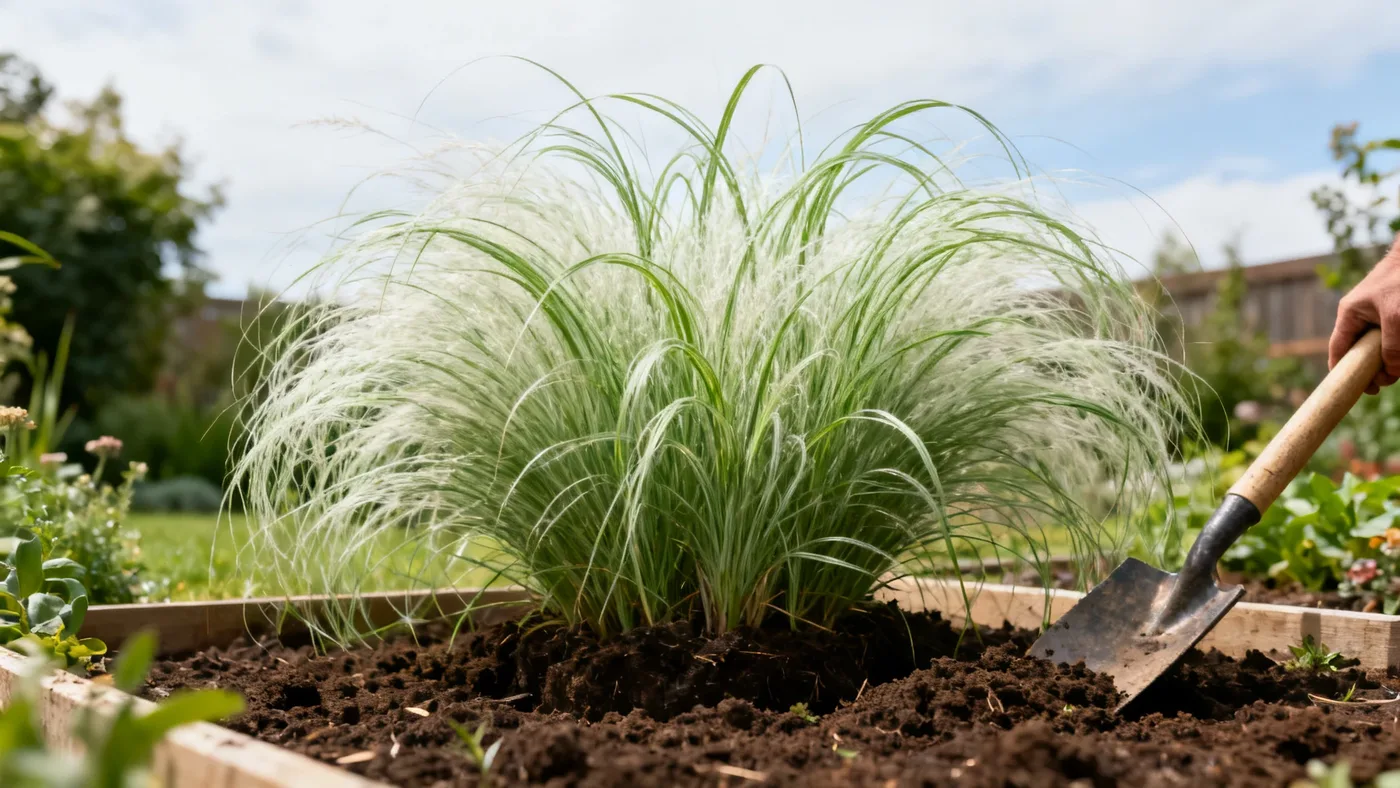
White Cloud Muhly Grass vs Switchgrass: Native Prairie Grass Showdown
Both of these are genuine North American natives, both are warm-season clumping grasses, and both are regularly specified for the same jobs: holding a bank, filling a meadow planting, feeding songbirds through winter. They part company on what they are for. Switchgrass (Panicum virgatum) is a structural, upright, 3 to 7 foot prairie grass with roots that run 6 to 10 feet deep and a documented record in erosion control and wildlife habitat. White Cloud Muhly Grass is a 3 to 4 foot ornamental selection grown for one spectacular thing: a haze of white autumn plumes that no switchgrass cultivar produces.
White Cloud Muhly Grass
If the white autumn cloud is the effect you want, switchgrass will not give it to you at any size. Nursery-grown White Cloud Muhly Grass in quart, 2 gallon and 3 gallon sizes from $39.99, shipped in its container with our planting and care guides.
The useful way to run this comparison is by goal rather than by feature list. One of these is a habitat and soil-stabilization plant that happens to look good. The other is a display plant that happens to hold soil well. Decide which sentence describes your project and the choice makes itself.
At a Glance: Quick Comparison
| Attribute | White Cloud Muhly Grass | Switchgrass |
|---|---|---|
| Botanical Name | Muhlenbergia capillaris 'White Cloud' | Panicum virgatum |
| Mature Height | 3-4 ft with plumes; foliage clump 2-3 ft | 3-7 ft including flower panicles |
| Mature Width | 2-4 ft | 2-3 ft |
| USDA Zones | 6-9 (some sources list 5-9) | 5-9 |
| Habit | Arching fountain, clump-forming | Upright columnar clump; spreads slowly by short rhizomes |
| Flower | White airy panicles to about 12 in long | Fine pink-tinged branched panicles, held above the foliage |
| Bloom Time | September through November | June through October |
| Fall Foliage | Bronze to tan cast | Yellow-orange, aging to tan |
| Root Depth | Fibrous, roughly a foot deep and as wide as the plant | 6 to 10 ft |
| Soil Moisture | Well-drained; dislikes wet winter soil | Wide range, from occasionally flooded to dry |
| Wildlife Value | Songbird seed, cover, nesting material | Larval host for skippers and Common Wood-Nymph; songbird seed; winter cover |
| Self-Seeding | Minimal | Self-seeds in good conditions; cultivars do not come true |
| Salt Tolerance | High | Slight |
The Flower Is the Real Difference
Switchgrass flowers from June through October, and the panicles are finely branched and pink-tinged when fresh, held in an open cloud above the foliage. They are handsome and they catch light, but they are a see-through veil over a strongly vertical plant. The plant reads as upright structure first.
White Cloud Muhly Grass does the opposite. Its inflorescences reach up to about 12 inches long and open all at once in September, dense enough that a mature clump looks like a solid white cloud rather than a scattering of flower stems, and they persist into November before drying to buff. The foliage below is a modest 2 to 3 foot fountain whose job is to hold the cloud up.
Practically: switchgrass gives you a long, quiet season of texture from midsummer on. The muhly gives you eight to ten weeks of an unmistakable event. Our guide to when White Cloud Muhly Grass blooms and how long it lasts has the regional timing.
Habit and Height: Vertical Versus Fountain
Switchgrass is columnar. Cultivars vary, but the species runs 3 to 7 feet tall on a 2 to 3 foot footprint, which means it occupies vertical space without taking much ground. That makes it a natural screen, a windbreak component and a back-of-border backbone. Its one habit caution is flopping: in partial shade it does not grow as tightly and can open up at the center, so full sun is not optional for a plant you want standing in December.
White Cloud Muhly Grass is an arching fountain, 2 to 3 feet of foliage spreading 2 to 4 feet wide, with plumes lifting the total to 3 to 4 feet. It occupies more ground than switchgrass and less air. In a 4 foot deep border, one muhly fills the depth; one switchgrass fills the height and leaves the ground around it open for something else.
Switchgrass also expands by short rhizomes over time, slowly, while the muhly has none at all and thickens only from its crown. Neither is aggressive, but in a formal bed the muhly holds a drawn line more precisely. Our guide on whether White Cloud Muhly Grass spreads covers the clumping habit in detail.
Erosion Control: Where Switchgrass Has the Edge
This is the one category where the answer is not close on the merits. Switchgrass roots reach 6 to 10 feet down. It is used on slopes, in gullies and along streambanks to stabilize soil, slow water and trap sediment, and it tolerates occasionally flooded ground as readily as dry ground. For a raw bank, a drainage swale or anywhere water concentrates and runs, that root depth is doing engineering work.
White Cloud Muhly Grass holds soil too, with a dense fibrous root mass roughly a foot deep and as wide as the plant, and it is a good choice for a moderate, stable slope you also want to look at. What it will not do is tolerate the saturated conditions a swale bottom sees, because its non-negotiable requirement is drainage. Our guide to White Cloud Muhly Grass for erosion control on slopes is specific about which slopes qualify and which do not.
The sensible read: use switchgrass where water is the problem, use the muhly where appearance is the point and the slope is already stable. On a large bank there is no reason not to use both, switchgrass in the wet line and muhly on the drier shoulder.
Wildlife Value Compared
Switchgrass carries the deeper ecological record. It is a larval host plant for several skipper butterflies and the Common Wood-Nymph, which means it feeds caterpillars, not just adults passing through. Its seeds are eaten by songbirds and small mammals through winter, and the dense standing clumps provide year-round cover and nesting material. It is one of the signature species of the tallgrass prairie, native from the Atlantic to the Rockies and from southern Canada into northern Mexico.
White Cloud Muhly Grass is native to the central and eastern United States and provides year-round cover, seed for songbirds and small mammals, and nesting material. It is wind-pollinated, so it is not a nectar plant, and it is not a documented larval host in the way switchgrass is.
If the planting is being done for habitat credit or for a certified wildlife garden, switchgrass earns more of it. If the planting is a residential border that you also want birds in, the muhly delivers seed and cover while looking like a designed plant rather than a restoration.
Soil, Water and Climate Range
Switchgrass runs zones 5 to 9 and takes clay or sand, moist, occasionally flooded, occasionally dry. It is close to unfussy, and it is slightly salt tolerant.
White Cloud Muhly Grass runs zones 6 to 9, with the species listed to zone 5 by some sources, and adapts to clay, loam or sandy soils across acid, neutral and alkaline pH. Its limit is drainage, especially over winter: standing wet at the crown in cold weather is the most common way to lose one. In exchange it is highly salt tolerant, which is why it shows up in coastal and roadside plantings where switchgrass would be marginal.
Both are warm-season grasses, so both are late to green up in spring and both get cut back in late winter rather than fall. Neither needs fertilizer in reasonable soil, and both are drought tolerant once established.
Maintenance and Seedlings
Both want the same annual treatment: cut the clump back to a few inches in February or March, before new growth pushes, leaving the dried structure standing through winter for interest and cover.
The difference is what happens afterward. Switchgrass self-seeds in good growing conditions, and because named cultivars do not come true from seed, volunteers show up with different foliage color than the parent. In a meadow that is a feature. In a formal border it means pulling seedlings to keep the planting uniform. White Cloud Muhly Grass produces few enough volunteers that most gardeners never deal with them, and as a selected white form of a pink-flowering species, any seedling it does throw is not a reliable copy either, which is another reason to start from nursery plants rather than seed.
Both can show rust in humid southern summers when air circulation is poor. Our guide to rust and fungal diseases in White Cloud Muhly Grass covers identification and spacing fixes.
Pros and Cons
White Cloud Muhly Grass
Pros:
- White autumn plumes that no switchgrass cultivar can match for display value.
- True clumping habit with no rhizomes, so it holds a designed line.
- Highly salt tolerant, which suits coastal and roadside sites.
- Highly deer resistant.
- Minimal self-seeding, so no seedling patrol in a formal bed.
- Fits a mid-border at 3 to 4 feet without overwhelming what sits behind it.
Cons:
- Needs good drainage and will not take wet winter soil.
- Shallower roots than switchgrass, so less capable on an unstable bank.
- Not a documented butterfly larval host.
- Less cold hardy, starting at zone 6 rather than zone 5.
Switchgrass
Pros:
- Roots 6 to 10 feet deep, making it a serious erosion-control plant.
- Tolerates occasionally flooded ground as well as dry ground.
- Larval host for skipper butterflies and the Common Wood-Nymph.
- Strongly upright, useful as a screen on a narrow footprint.
- Hardy to zone 5 and native across most of the continent.
- Yellow-orange fall foliage color the muhly does not produce.
Cons:
- Flower panicles are a subtle veil, not a display event.
- Can flop and open at the center in partial shade.
- Self-seeds, and cultivar seedlings do not come true.
- Spreads slowly by short rhizomes, so it does not hold a crisp edge indefinitely.
- Only slightly salt tolerant.
Best For: Use Cases
Choose White Cloud Muhly Grass if you:
- Want a fall display that stops people on the sidewalk.
- Are planting a designed border and need the clump to stay exactly where you drew it.
- Garden on the coast or anywhere salt reaches the bed.
- Need a mid-border plant at 3 to 4 feet rather than a 6 foot screen.
- Want cover and winter seed for songbirds without the planting reading as a restoration.
- Have deer pressure and need a grass they consistently leave alone.
Choose switchgrass if you:
- Are stabilizing a bank, a gully or a streambank where water concentrates.
- Have ground that sits wet part of the year.
- Are planting for habitat and want a documented butterfly larval host.
- Need a tall, narrow screen rather than a wide fountain.
- Garden in zone 5, below the muhly's comfortable range.
The Verdict
These two are complements more often than competitors, and the honest split is by purpose. Switchgrass is the better engineering plant: deeper roots, wetter tolerance, colder hardiness, more documented habitat value. White Cloud Muhly Grass is the better garden plant: a real autumn event, a habit that stays put, salt tolerance, and a scale that fits an ordinary border.
For most home landscapes the question is not which grass is more virtuous but what the bed is for. A front bed, an entry planting, a mass along a drive or a moderate slope you look at every day is muhly territory, and no switchgrass cultivar will produce the white cloud that makes the plant worth growing. A back property line, a wet swale or a habitat corner is switchgrass territory.
Planning a mass planting? See our guide to spacing White Cloud Muhly Grass for hedges, borders and mass plantings for the distances that give a solid sweep.
White Cloud Muhly Grass
A mass planting is where this plant earns its keep, and a group set out this season blooms its first autumn. Order nursery-grown White Cloud Muhly Grass in quart, 2 gallon or 3 gallon sizes, shipped in its nursery container with growing guides included.
Quick Reference
| Factor | White Cloud Muhly | Switchgrass | Advantage |
|---|---|---|---|
| Autumn display | Dense white plume cloud | Fine pink-tinged veil | Muhly |
| Height | 3-4 ft | 3-7 ft | Switchgrass for screening |
| Habit | Arching fountain | Upright columnar | Depends on the role |
| Root depth | About 1 ft, fibrous | 6-10 ft | Switchgrass |
| Wet soil | Needs drainage | Takes occasional flooding | Switchgrass |
| Salt tolerance | High | Slight | Muhly |
| Butterfly host | No | Skippers, Common Wood-Nymph | Switchgrass |
| Songbird seed | Yes | Yes | Even |
| Holds a formal edge | Yes, no runners | Creeps slowly by rhizomes | Muhly |
| Cold hardiness | Zones 6-9 | Zones 5-9 | Switchgrass |
| Annual maintenance | Late-winter cut-back | Cut-back plus seedling removal | Muhly |