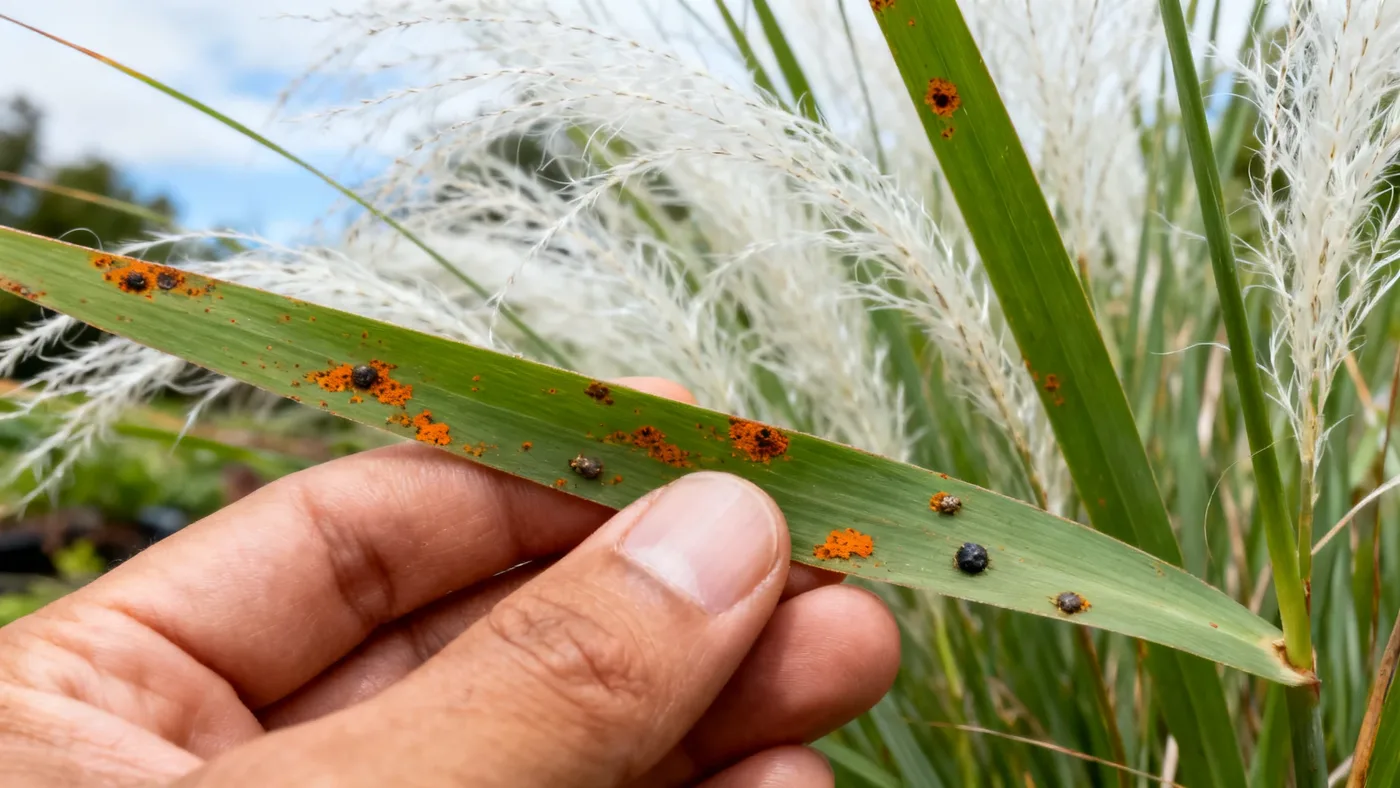
Rust and Fungal Diseases in White Cloud Muhly Grass
Fungal disease is uncommon on this plant. Extension records for Muhlenbergia capillaris list no serious insect or disease issues, and the standard advice for ornamental grasses is that rust, when it appears at all, is usually shrugged off once the clump is cut back. But two fungal problems do turn up on muhly grass, they look nothing alike, and the treatment differs. Rust is a powdery orange pustule that rubs off on your fingers. Tar spot is a hard, shiny black spot embedded in the blade that does not rub off at all. Telling them apart is the whole job, because one is cosmetic and seasonal and the other can drive real dieback.
White Cloud Muhly Grass
'White Cloud' is reported to be more resistant to tar spot than the pink-flowered species, which makes it the sensible choice if fungal spotting has been a problem in your garden. Nursery-grown White Cloud Muhly Grass in quart, 2 gallon and 3 gallon sizes from $39.99, shipped in its container with our planting and care guides.
This guide goes deep on the fungal category specifically. For the broader troubleshooting list, including flopping, bloom failure and root rot, start with common White Cloud Muhly Grass problems and how to fix them.
Identify It First: The Rub Test
Before you treat anything, take a white tissue out to the plant and wipe a spotted blade.
- Colored powder comes off on the tissue: rust. Rust produces raised pustules packed with spores, and those spores transfer to skin or paper as orange, yellow or rust-colored dust. That single test is the most reliable field diagnosis there is.
- Nothing comes off and the spot is hard, raised, black and glossy: tar spot. Tar spot forms melanized structures fused into the leaf tissue, typically 2 to 4 millimeters across, oblong to spindle-shaped, present on both sides of the blade and often ringed by yellowing tissue. It looks exactly like a drop of tar because it is a solid body, not a spore mass.
- White and cottony, and it squashes: not a fungus at all. That is muhly grass mealybug, an insect. See the look-alikes section below.
- Uniform bronze or copper color across the whole clump in October: not a disease. That is the species' normal autumn foliage color, and it is part of what the plant is grown for. Our guide to White Cloud Muhly Grass fall color shows what is normal.
Rust: What It Is and How It Gets In
Rust on ornamental grasses shows first as yellow, orange or reddish flecks, usually on the lower and interior blades where humidity sits longest and air moves least. Turn a blade over and you find the raised pustules. In an advanced infection, as the fungus switches to producing its overwintering spore stage, the pustules darken to brown and black lines and dots, which is why late-season rust can look like a different disease entirely.
Two facts about the infection process explain every piece of advice that follows.
It needs free water on the blade. Rust spores germinate in a film of water from rain, dew or irrigation, and the wet period required is short: research on rust diseases of ornamental crops puts germination and infection at six to eight hours of leaf wetness or less. An evening sprinkler that leaves blades wet overnight supplies that window every single night.
It is airborne and it comes back from debris. The repeating spore stage is windborne and enters through the stomata, which means the fungus arrives whether or not you have ever had it before. It survives the winter as thick-walled resting spores in plant debris and in the crowns of perennials, so last year's uncleared thatch at the base of the clump is the inoculum for this year's outbreak.
Tar Spot: The One Named on Muhly Grass
Tar spot is caused by fungi in the genus Phyllachora, and unlike rust it is specifically documented as a problem of muhly grass, where it can cause decline and dieback rather than just cosmetic spotting. The conditions that favor it are the same triad that favors almost every foliar disease on this plant: crowded plantings with poor air circulation, hot and humid weather, and excessive fertilization.
Here is the part that matters if you are choosing a plant rather than treating one. The pink-flowered species is the one that suffers; 'White Cloud' is reported to be resistant to tar spot, and growers who have watched both side by side report that tar spot has not been a problem on this cultivar. That is a genuine, practical reason to plant 'White Cloud' where the pink form has declined, and it is one of the more useful differences between the two. Our comparison of White Cloud Muhly Grass vs pink muhly grass covers the rest.
Resistant is not immune. If hard black spots do appear, the response is cultural: thin dense stands to get air moving, cut affected plants back, and get the debris out of the garden rather than leaving it on the soil to reinfect.
Look-Alikes That Are Not Fungal Disease
Muhly grass mealybug. The insect that has become the real pest of this plant in the Southeast, Stemmatomerinx acircula, is about an eighth of an inch long, roughly twice as long as wide, and coated in bright white wax filaments that give it the look of a small loose cotton swab. Infestations become noticeable from late May through June and stay active into late fall, and a heavy one can delay or wipe out the fall bloom, which is the entire point of the plant. Mealybugs squash; tar spots do not. Management is inspection before purchase, removing and bagging infested foliage, and horticultural oil or a systemic on light infestations per the label.
Aphids in the plumes. USDA records note aphids infesting the blooms during the early stages of seed development. Encouraging predators such as ladybug beetles is the recommended natural control, and a strong jet of water dislodges them.
Winter dieback and spring thatch. Brown foliage in December is the plant being dormant, not diseased. See does White Cloud Muhly Grass die back in winter.
Crown and root rot. A soft, mushy, blackened crown and a clump that collapses as a whole is a soil problem, not a foliar one, and no fungicide fixes it. That belongs in the drainage conversation in our guide to the best soil for White Cloud Muhly Grass.
Treatment: Do These Four Things, in This Order
1. Take out the infected tissue, but not too much at once. Pinch or cut off spotted blades and get them out of the garden; do not drop them at the base of the clump, where the spores overwinter. The limit that matters is a third of the foliage in one session, because stripping more than that stresses a plant that then has fewer leaves to recover with. Bag the clippings rather than composting them, unless your compost genuinely runs hot.
2. Change how you water. This is the highest-value change available, because it removes the leaf wetness the fungus needs. Water at the soil with a drip line or soaker hose. If you must use a sprinkler, run it early on a morning that will be sunny and breezy so blades dry within a couple of hours, and never in the evening. An established clump barely needs watering anyway; our guide to watering White Cloud Muhly Grass from new plant to established has the taper.
3. Open up the planting. Fungal disease on this plant is largely a symptom of stagnant air. Thin or divide overgrown clumps, and space new plants so air moves between them: 18 to 36 inches depending on the effect you want, at the wider end if you have had disease. Our guide to spacing White Cloud Muhly Grass covers the trade-off, and dividing and propagating White Cloud Muhly Grass covers the split. Full sun also matters: disease on ornamental grasses tends to follow low light.
4. Stop feeding it. Excess nitrogen makes ornamental grasses more susceptible to disease as well as floppy, and over-fertilization is named as a condition that favors tar spot. This plant does not need fertilizer; see do you need to fertilize White Cloud Muhly Grass.
Where Fungicide Fits, Which Is Rarely
Understand what a fungicide can and cannot do here. These products protect healthy tissue from new infection; they do not cure the spots you already have, and nothing will make an existing pustule or tar spot disappear. On a plant that gets one hard cut back a year, the cut back is usually the more effective intervention: infected foliage is removed wholesale in late winter and the clump regrows clean, which is exactly why rust on ornamental grasses is regarded as a problem plants recover from quickly.
If an outbreak is severe and spreading year after year in the same spot, the active ingredients extension guidance lists as most effective against rust in ornamental plantings are myclobutanil and azoxystrobin, with chlorothalonil and thiophanate-methyl offering partial protection; sulfur and copper products are the traditional option. Two conditions before you buy any of them: the label must list ornamental grasses or the site you are treating, and you must apply to healthy tissue early rather than as a rescue. Follow the label rate and interval exactly. And be honest about whether the underlying problem is shade, crowding, feeding or overhead irrigation, because a spray does not fix any of those.
Prevention Calendar
| When | What to do |
|---|---|
| February to March | Cut the clump back hard before new growth starts and remove every scrap of the old residue from the bed. This is the single biggest sanitation step of the year. |
| Spring, at planting or division | Site in full sun with air movement, space generously, set the crown at grade, do not amend the backfill on sandy soil. |
| Late May to June | Part the foliage and check for the white cottony wax of muhly grass mealybug, which becomes noticeable now. |
| Through summer | Water at the soil, in the morning, only when genuinely needed. No fertilizer. Pull weeds that crowd the base. |
| Any time spots appear | Run the tissue rub test, remove up to a third of affected foliage, bag it, and correct the condition that caused it. |
| Autumn | Leave the plumes for winter interest, but note any clump that spotted badly so you can prioritize its cut back and consider dividing it in spring. |
Quick Reference: Symptom to Diagnosis
| What you see | What it is | First action |
|---|---|---|
| Orange or yellow powder that rubs off | Rust | Remove affected blades, switch to soil-level morning watering |
| Hard shiny black spots, 2 to 4 mm, will not rub off | Tar spot (Phyllachora) | Thin the stand, cut back affected growth, remove debris |
| Brown or black spots with a yellow halo | Leaf spot, occasional on grasses | Same cultural fixes: air, light, less water on the blades |
| White cottony clusters that squash | Muhly grass mealybug (insect) | Bag infested foliage; horticultural oil per label |
| Insects clustered in the flower heads | Aphids | Water jet; encourage ladybug beetles |
| Whole clump uniformly copper in autumn | Normal fall color | Nothing |
| Soft, black, mushy crown; clump collapses | Crown or root rot | Drainage problem; fungicide will not help |
| Dark lines and dots late in the season on previously orange spots | Rust producing overwintering spores | Prioritise a thorough late-winter cut back and debris removal |
The pattern behind all of it is simple: this grass gets fungal disease when it is crowded, shaded, fed, or kept wet on the leaves, and it stays clean when it is none of those things. Get the site right and the calendar above takes about twenty minutes a year. For everything else the plant asks for, see our complete White Cloud Muhly Grass care guide.
White Cloud Muhly Grass
If tar spot has taken down a pink muhly planting, 'White Cloud' is the reported-resistant alternative. Order nursery-grown plants in quart, 2 gallon or 3 gallon sizes, shipped in the nursery container with growing guides included, and space them for air movement from the start.