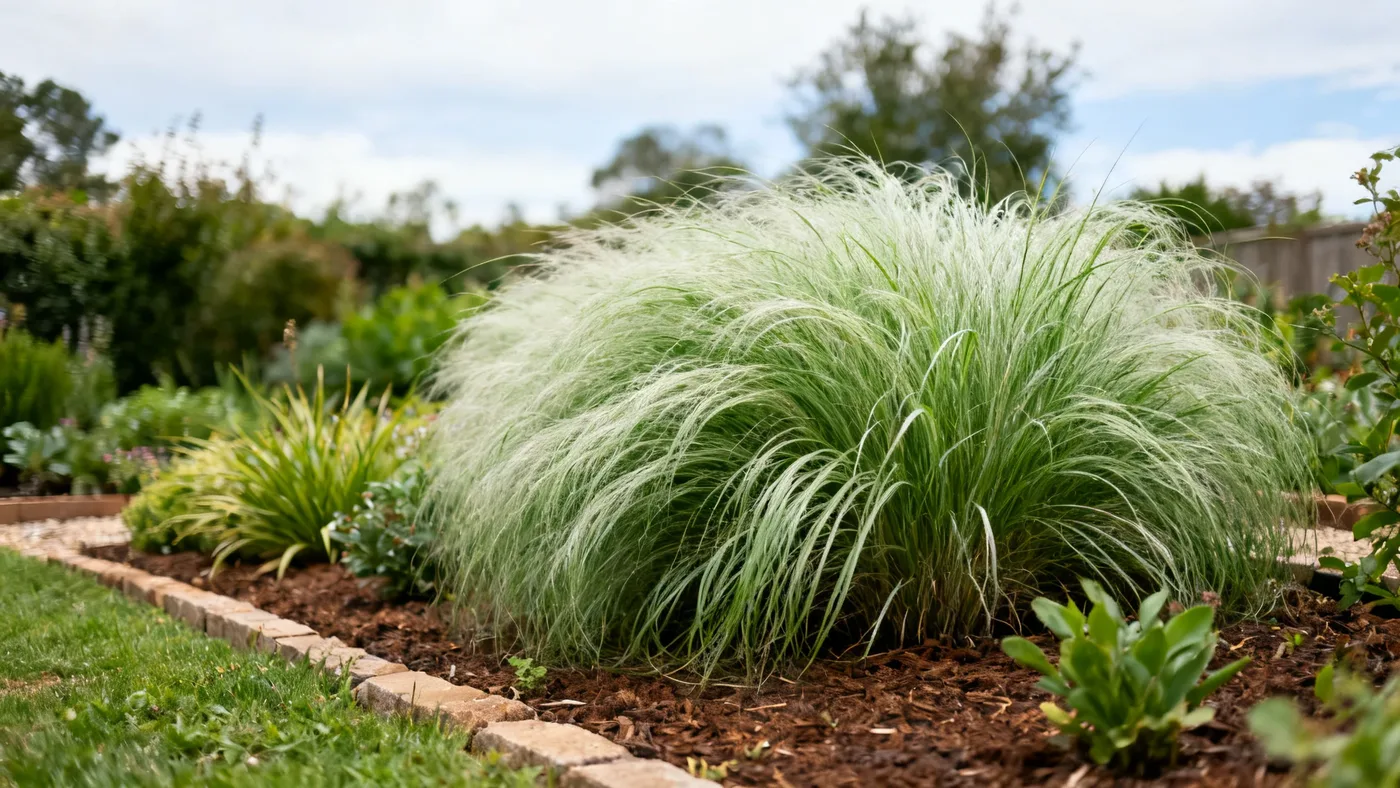
Is White Cloud Muhly Grass Invasive? Does It Spread?
No. White Cloud Muhly Grass is not invasive, and the reason is structural rather than a matter of opinion: it has no mechanism for running. The USDA plant fact sheet for the species states plainly that hairawn muhly "clumps but does not spread through above or underground stems (stolons or rhizomes)," and the Missouri Botanical Garden record for 'White Cloud' repeats it in four words: does not spread by rhizomes. A grass with neither runners nor creeping roots can only expand outward from its own crown, a few inches a year, or arrive somewhere new as seed.
White Cloud Muhly Grass
A clumping native selection that stays where you plant it. Nursery-grown White Cloud Muhly Grass in quart, 2 gallon and 3 gallon sizes from $39.99, shipped in its container with our planting and care guides.
The worry is reasonable, because plenty of ornamental grasses have earned it. This guide separates the two questions that get tangled together: will it take over your bed, and will it seed itself around your garden. The answers are different.
Clumping Versus Running: Why Habit Settles the Question
Ornamental grasses spread in one of two ways. Running grasses produce rhizomes underground or stolons above ground, horizontal stems that travel out from the parent and send up new shoots some distance away. That is how a grass crosses a bed edge, appears in a lawn, and resists removal: severing the top does nothing to the network below.
Clump-forming grasses have no such stems. All their growth originates at a single basal crown, so the plant gets wider the way a tree gets thicker, by adding growth at its own perimeter. Muhlenbergia capillaris is a textbook clumper with a fibrous root system, no taproot, and roots that sit in roughly the top foot of soil. There is no underground front advancing on your other plants.
The practical consequence: after you plant it, the footprint it occupies in year five is the footprint it occupies forever, give or take a few inches, unless you divide it. The ornamental grasses that have earned invasive listings in the United States are, with few exceptions, the running ones: species whose rhizomes resist a shovel and whose cultivars still set heavy seed. Neither description fits a muhly.
Where This Grass Is Native
The straight species is native across a wide swath of the eastern and central United States, found in prairies, pine barrens and open woodlands from Massachusetts west to Kansas and south to Florida and Texas. 'White Cloud' is a white-flowered selection of that native species, introduced by Superior Trees Nursery of Lee, Florida.
In other words, across most of the country where this plant is sold, it is not an introduced species at all. It is a garden form of a grass that already grows in the region's remnant prairies and flatwoods, and the seedlings it might produce are seedlings of a local native.
Is It Listed as Invasive or Noxious Anywhere?
The USDA fact sheet's environmental concerns section reads, in full: no concerns at this time. The species is not a federally listed noxious weed.
The listings that do exist run in the opposite direction. Hairawn muhly is recorded as an endangered species in Connecticut, Indiana, Maryland and New Jersey, as extirpated in Pennsylvania, and as presumed extirpated in Ohio. At the northern edge of its range this is a grass conservation agencies are trying to hold onto, not contain. NatureServe rates the species globally secure, which is the reassuring version of the same picture: abundant across its core range, scarce at the margins.
If you are planting well outside the native range, in the arid West or the Pacific Northwest for instance, it is worth a call to your local extension office, which is the right habit for any ornamental grass. Within the eastern and central states, there is nothing on the books.
So Will It Self-Seed?
This is the real question, and the honest answer is that it depends on your climate, with a genuine split in the record.
The Florida Native Plant Society reports that the species readily self-seeds, and notes specifically that seeds landing in pavement cracks and rock crevices tend to establish well there. That matches how the plant behaves in zones 8A through 11B, where its long warm autumn lets seed ripen fully and its winters never interrupt germination. Growers in colder gardens report close to the opposite, with very few volunteers or none at all.
The mechanism behind the split is straightforward. Seed has to mature before it can germinate, and the plumes do not even open until September through November. 'White Cloud' blooms a little later than the pink species it was selected from, which pushes seed maturity later still. In zones 6 and 7, frost routinely arrives before that seed finishes ripening, so most of what looks like seed on a winter plume never had the season to become viable. In zones 8 and 9, it does.
One factor cuts the other way: the seed needs no cold stratification to germinate, so viable seed that reaches bare soil is not waiting a year for permission. It can come up within about two weeks in warm, moist conditions.
What Volunteers Actually Look Like, and How Easily They Pull
Volunteers show up where seed meets bare, open ground: gravel drives, mulch thinned by rain, paver joints, the gaps between newly planted perennials. They do not appear in dense turf or in a thickly mulched bed, because the seed needs soil contact and light.
A first-year seedling is a small tuft of fine blades with a shallow root system, and it comes out with a gentle pull from damp soil. That is the key difference from a running grass: there is no fragment left behind to regenerate. The seedlings that matter are the ones you leave for two or three years, by which point you are removing a 2 foot clump with roots a foot deep, which takes a spade.
How to Get Zero Volunteers If You Want Them
- Cut the plumes before the seed matures. The reliable method, and the expensive one: removing the plumes in late fall costs you the winter interest that is half the reason to grow this plant. Most gardeners decide the trade is not worth it.
- Bag your cuttings at the annual pruning. If you leave the plumes standing through winter and cut back in late February or early March, the cut material is full of seed. Collect it on a tarp and bag it rather than shaking it out over the bed or adding it to an open compost pile. See when and how to cut back White Cloud Muhly Grass for the full pruning routine.
- Keep mulch at 2 to 3 inches. Seed that cannot reach soil does not establish. A maintained mulch layer is the single most effective passive control.
- Watch the hard surfaces. Paver joints, gravel and rock crevices are where seed does best. A quick walk in spring and a pull or two handles a year's worth.
- Avoid deadheading if you want the birds. Songbirds and small mammals eat the seed, and the clumping habit makes good winter cover, so seed heads left standing feed wildlife through the lean months.
How Much Wider Will One Plant Get?
Mature spread is 2 to 4 feet, reached in about two to three seasons at a moderate growth rate of roughly 1 to 2 feet per year, with total height of 3 to 4 feet once the plumes are up. The flowering stems rise about a foot above the blue-green foliage clump.
After that it effectively stops widening and starts thickening, which eventually produces the hollow or dead center typical of mature clump grasses. That is not spread, it is congestion, and it is the signal to divide. Dividing and propagating White Cloud Muhly Grass covers the timing and technique, and how big White Cloud Muhly Grass really gets has the full size expectations.
Places It Will Not Go
Because there are no rhizomes, a few common fears simply do not apply. It will not creep into a lawn from an adjacent bed. It will not travel under steel or plastic edging. It will not lift pavers from below or invade a neighbor's yard through the fence line. It does not sucker, and it will not colonize the way bamboo or a running fescue does.
The one caution worth respecting is not about spread at all: it is heat and humidity at the far southern end of the range, and poor drainage anywhere, both of which shorten the plant's life rather than lengthen its reach.
Quick Reference: Spread and Invasiveness
| Question | Answer |
|---|---|
| Invasive? | No. USDA environmental concerns: none at this time |
| Spreads by rhizomes or stolons? | No. Neither. Clump-forming only |
| Federal noxious weed listing | None |
| State conservation listings | Endangered in CT, IN, MD, NJ; extirpated in PA; presumed extirpated in OH |
| Native range | Massachusetts to Kansas, south to Florida and Texas |
| Self-seeding in zones 8 to 9 | Can be free; seed establishes well in pavement cracks and crevices |
| Self-seeding in zones 6 to 7 | Usually minimal; frost often arrives before seed ripens |
| Seed cold treatment needed | No; germination in about 2 weeks in warm, moist conditions |
| Mature footprint | 2 to 4 feet wide, 3 to 4 feet tall with plumes, in 2 to 3 seasons |
| Best passive control | Maintain 2 to 3 inches of mulch; bag pruning cuttings |
| Removing volunteers | Hand-pull seedlings from damp soil; no fragments regrow |
Judged by the standard that matters, whether the plant can leave the space you gave it without your help, White Cloud Muhly Grass is one of the better-behaved ornamental grasses available. In the warm, humid Southeast it may hand you a few seedlings; everywhere else the clump you plant is the clump you keep. For the wider picture on where it thrives, see White Cloud Muhly Grass hardiness zones.
White Cloud Muhly Grass
A native clumping grass, no runners, no rhizomes, no listing anywhere as a noxious weed. Order nursery-grown plants in quart, 2 gallon or 3 gallon sizes and plant in spring or early fall. Ships in its nursery container with growing guides included.