
Is There a Dwarf White Cloud Muhly Grass?
A wild stand of muhly on a roadside in October is tall, loose and a little untidy, with plumes leaning in every direction. Plenty of shoppers look at that and picture a tidier, smaller version in white, a dwarf White Cloud that tucks in beside a mailbox or a front step. That plant does not exist, and the number that matters is 3 feet, the top of the 1 to 3 foot height and spread range for White Cloud.
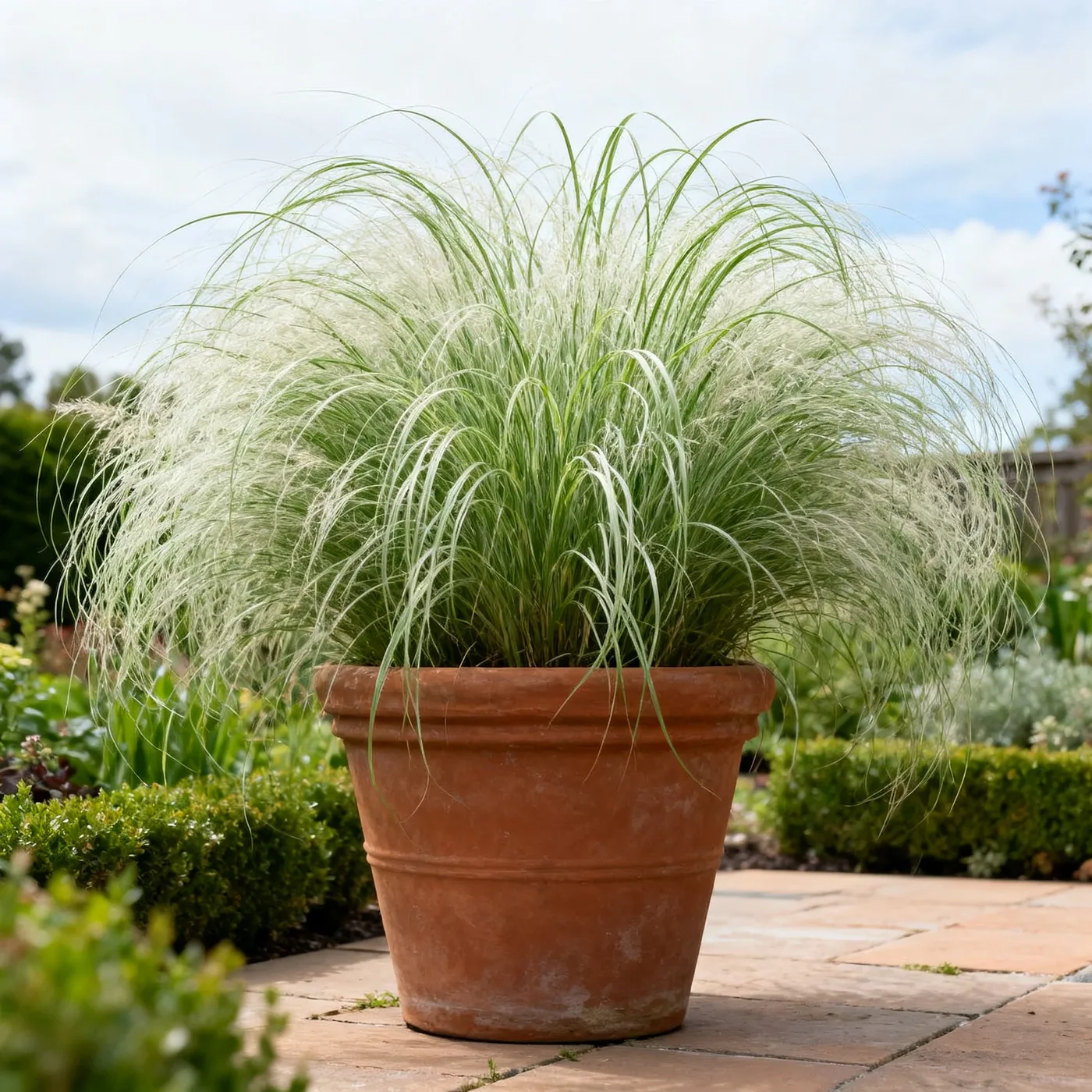
We'll walk you through the registries and catalogs, the dwarf pink muhly that started the rumor, pruning, poor soil and small pots, then show you how to place and space the plant you can actually buy. Get it wrong and you crowd a walkway or wait years for a shrunken plant that never arrives. Get it right and you get a September cloud that asks for very little.
The Belief That a Dwarf White Cloud Muhly Grass Exists
We looked first at the registries and catalogs, because a dwarf cultivar leaves a paper trail. The NC State plant database lists 'White Cloud' only as a white-flowered selection with airy blooms that open after the pink ones and resist tar spot, and it names no dwarf cultivar. The same entry says the species can reach 4 feet tall and 3 feet wide, so the species is not a small plant to begin with.
The confusion has a source. A rain-garden planting guide puts 'White Cloud' at 1 to 3 feet high and wide, and a shopper's eye lands on the 1. We read that as a range for one plant across different sites and ages, because no source describes a separate compact selection. Most other sheets put the clump at about 2 to 3 feet across.
A real dwarf selection carries its own name on the tag, and it shows up in extension lists and grower catalogs as a distinct entry. Nothing like that turns up for white. When a listing says "dwarf White Cloud" with no second name, you are looking at the standard plant with a hopeful adjective.
One of the most common questions we get each fall is whether we grow a smaller White Cloud. We don't, because there is no compact White Cloud to grow. What reaches you is the standard plant, and it is a good one once you plan around its real size.
Does Dwarf Pink Muhly Grass Have a White Twin?
The rumor has a real parent. A dwarf selection of pink muhly grass is sold commercially at roughly 2 to 3 feet, and a shopper who knows that plant reasonably assumes white has a matching one. The guess is fair, but it fails on how cultivars come about. Someone has to find a naturally compact plant, propagate it and bring it to market. That happened for the pink form, not for 'White Cloud'.
The two plants share a species, and University of Florida extension describes White Cloud as a white flower-head cultivar identical in all the features to the pink version. Size is not a trait the white form broke away from. If you want a compact pink grass, the dwarf pink is the real answer. If you want white, you plan for the standard clump.
Notice, too, that the dwarf pink's 2 to 3 feet sits close to the 2 to 3 foot height of the ordinary species. The gap between dwarf and standard is narrower than the word suggests. Our guide to growing White Cloud and pink muhly together covers how the two sit side by side, starting with the fact that white opens after pink.
The Claim That Pruning Keeps White Cloud Muhly Grass Short
Common advice says to cut ornamental grasses hard to keep them compact. With muhly it backfires. A cut resets the clump to stubble, but it does not change the size the plant is built to reach, and the clump grows back to full size. The one cut that suits this plant comes in late winter, when Mississippi State University Extension says to cut the grass clumps back to 6 inches before spring growth starts.
Timing decides the plumes more than height does. The same source warns against cutting earlier because you remove the dry flower heads that move in the wind and shelter wildlife. University of Florida extension notes that muhly flower stalks can reach up to 5 feet, taller than the foliage clump. A summer shearing meant to hold the height would cut into the very growth those stalks rise from, and it still would not make a dwarf.
Watch a clump through winter and you see why we leave ours standing. The plumes fade from color to a pale tan, yet they keep their shape and keep giving cover until the late winter cut. For the steps and tools, see when and how to cut back White Cloud.
The Idea That Poor Soil Stunts White Cloud Muhly Grass
This idea says muhly is a tough native, so starve it and it will stay small. The sources describe tolerance, not stunting. Muhly grass tolerates heat, humidity, drought and poor soil, and Missouri State calls it soil-tolerant, wet or dry, low or high pH, poor to adequate fertility. Tolerating a thin soil means the plant survives there. None of those entries says it shrinks.
Look at where the species lives. It is native to the central and eastern United States and south to Mexico and Guatemala, and USGS notes that it ranges throughout the eastern United States. Across that much ground it meets sand, clay and loam, acid and alkaline pH, and the National Park Service describes it growing in full sun to partial shade and in moist to dry conditions. A plant built for that spread does not depend on lean ground to behave.
The practical side is simple. Poor soil will not buy you a smaller plant, and rich feeding is not needed to get a full one. The University of Georgia says it prefers a mildly acidic organic soil, and an Arizona State source says it grows best where drainage is good, so drainage matters more than richness. Plant in ordinary, well-drained ground and skip the experiment. Our soil and drainage guide goes deeper.
Small Pots Sold as Dwarf Plants
A one-gallon White Cloud in spring looks like a dwarf beside a mature clump, and some listings lean on that with words like compact or patio size. Pot size measures roots and age, not genetics. The plant inside is the same cultivar that heads for 1 to 3 feet high and wide. NC State and the Clemson demo garden rate its growth as medium, while the Clemson factsheet says fast, and either way a young plant keeps filling out.
Customers usually ask us why the gallon they planted last spring looks so much bigger now. It is simply doing what the cultivar does. Reading a listing carefully saves you from paying for a size that was never on offer.
- Look for the full name, Muhlenbergia capillaris 'White Cloud', with no second cultivar name attached.
- Treat "dwarf," "compact" or "mini" on a White Cloud listing as marketing unless it points to a selection you can verify.
- Find the stated mature size and expect about 3 feet across, not the size of the pot.
- Compare pot sizes only as a measure of how established the roots are, and see our container size guide for what to look for.
Living With a Three-Foot White Cloud Muhly Grass
Plan for a clump roughly 2 to 3 feet tall and wide, with flower stalks that can climb higher in fall. That makes it a mid-border plant, not an edger, and it suits a spot where a loose, airy mass is welcome behind lower plants. Give it room and it needs almost nothing from you, which is the whole appeal of a native grass bred for white plumes instead of a smaller frame.
Siting and Spacing
Choose full sun, which means six or more hours of direct sun. It will take light shade, though we would not count on it for a good show. Space plants 2 to 3 feet apart, because muhly plants need their individual space to achieve a filled-in mass look. Crowd them closer and you fight the clump for years. Our spacing guide covers hedges and drifts.
A smaller space does not call for a smaller plant. It calls for fewer plants, or a different one. One well-placed clump beats a row squeezed to fit.
Dividing an Aging Clump
If a clump outgrows its spot, size control is a matter of division, not pruning. Aging plants can be lifted in early spring and divided to create new plants. Each division starts small and fills out again, so you gain extra plants for another bed, but you never end up with a permanently dwarf form.
Wildlife Through the Fall
White Cloud blooms in September, and the species runs from September through November. Once the color fades, the standing dry plumes become habitat for wildlife, which is one more reason to wait for the late winter cut. The grass is also highly resistant to deer grazing, so the clump rarely becomes a meal while it shelters smaller visitors.
The species is hardy in zones 5 to 9, so most of the eastern half of the country can host a clump. Check with your local extension service for how it behaves at the cold edge of that range.
What the Evidence Leaves Standing
Here is how each belief fared once we set it against the sources. Four are settled as false, and two survive because the sources support them.
| Belief | Verdict | Why |
|---|---|---|
| A dwarf White Cloud exists | False | No source or database lists a compact White Cloud |
| White should have a dwarf twin like pink | False | The dwarf pink is its own selection and size does not transfer |
| Pruning keeps it short | False | The clump regrows, and early cuts remove the plumes |
| Poor soil makes it smaller | False | Sources describe tolerance of poor soil, not stunting |
| A late winter cut to 6 inches suits it | Survives | Best done before spring growth |
| It is easy and tolerant | Survives | Drought, heat, deer and a wide range of soils are all supported |
The two survivors share a theme. White Cloud rewards a plain, hands-off approach, and every false belief on the list was an attempt to manage it into a size it does not come in.
Plan Around the White Cloud Muhly Grass You Can Buy
There is no dwarf White Cloud, so the useful question is where the real plant belongs. Give it full sun, well-drained ground and 2 to 3 feet of room, cut it to 6 inches in late winter, and leave the soil and the pot size out of the size debate.
Come back to that roadside stand in October. The wild grass stands tall and a little untidy in its natural clump, and it earns every inch of it. Choose the placement, not a size that is not for sale.
White Cloud Muhly Grass
Nursery-grown White Cloud Muhly Grass in sizes from Quart, shipped to your door.
From $39.99
Shop Now →Our White Cloud grows in open, sunny rows where the ground drains freely. Every White Cloud we ship is potted and packed by our own growers as the standard plant it is, so it comes ready to plant. Browse our shop if a full-size White Cloud has a place in your yard.