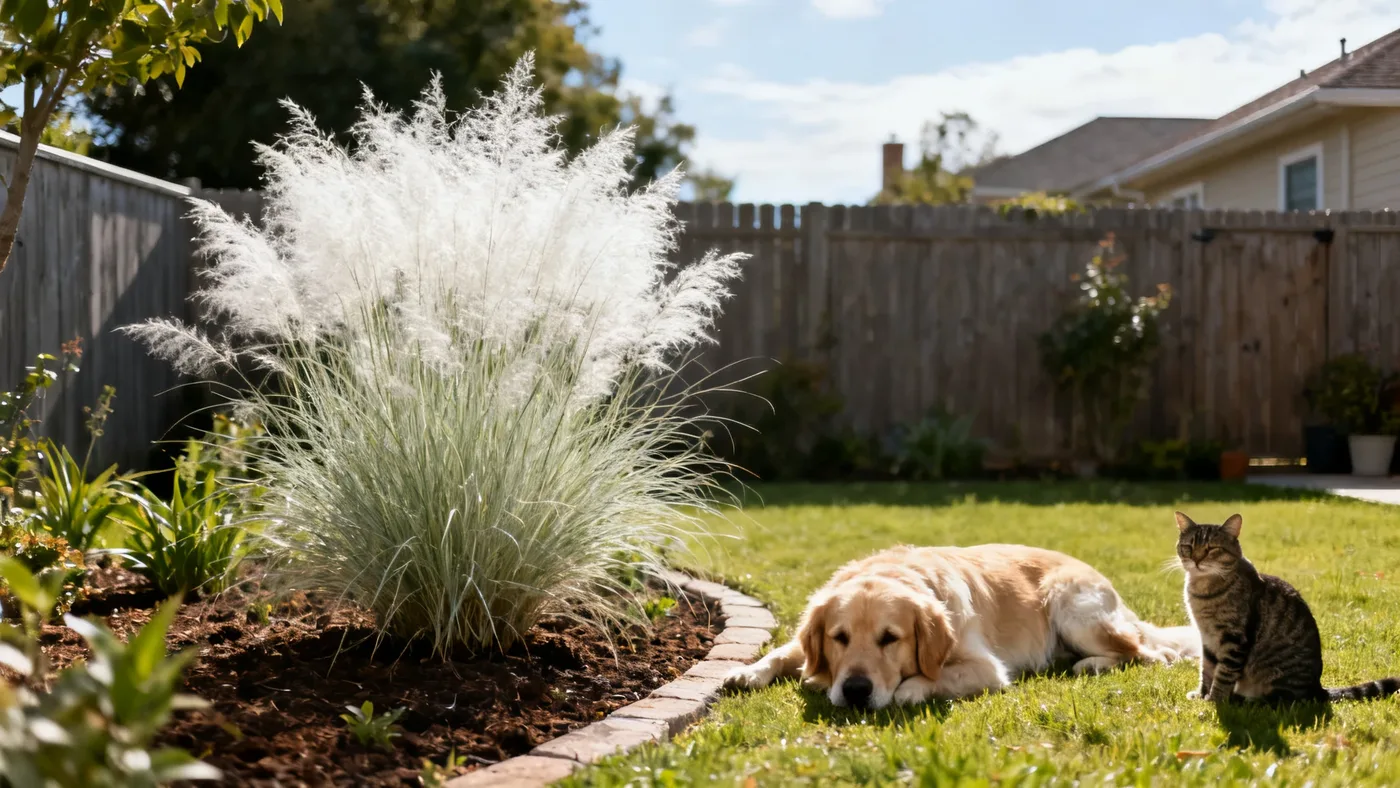
Is White Cloud Muhly Grass Toxic to Dogs and Cats?
No. White Cloud Muhly Grass is not a toxic plant. Muhlenbergia capillaris does not appear on the ASPCA's list of plants that are poisonous to dogs, cats or horses, and the North Carolina Extension Gardener Plant Toolbox record for the species lists no poisonous parts and no toxicity to people or animals. Ornamental grasses as a group are among the safest plant families to put in a yard that dogs and cats use, and this one is no exception. If your dog has just chewed a mouthful of plumes, there is no poison to worry about.
White Cloud Muhly Grass
A non-toxic ornamental grass that needs no fertilizer and no routine spraying is about as low-risk as a pet yard planting gets. Nursery-grown White Cloud Muhly Grass in quart, 2 gallon and 3 gallon sizes from $39.99, shipped in its container with our planting and care guides.
That is the short answer, and it is the answer most people came for. The longer answer is more useful, because the real questions behind "is this plant safe" are usually not about poison at all. They are about seed awns in a dog's paw, about a cat that throws up after eating grass, and about what you spray or spread around the plant. Those are the parts worth getting right.
What "Non-Toxic" Actually Covers
Non-toxic means the plant contains no compound known to poison a dog or cat that eats it. It does not mean a pet can eat unlimited quantities with no effect. Any animal that eats a large volume of any fibrous plant material can vomit or pass loose stool afterward, simply because the gut is dealing with indigestible cellulose it did not expect. That is mechanical irritation, not poisoning, and it resolves on its own.
So the honest framing is this: there is nothing in White Cloud Muhly Grass that can hurt your pet chemically. There are two ways a plant in a pet yard can still cause a problem, and both are worth five minutes of thought before you plant.
The Seed Awn Question, Answered Properly
This is the concern that deserves a real answer, because the species' official USDA common name is hairawn muhly, and "awn" is a word that makes experienced dog owners nervous.
The awns that cause veterinary emergencies are a specific structure: stiff, sharply pointed bristles with backward-facing barbs. Because the barbs only allow movement in one direction, the seed ratchets forward into skin, paw webbing, ear canals and nostrils and cannot back out, and it keeps migrating. The grasses responsible are named in every veterinary warning on the subject: foxtail barley, wall barley, cheatgrass, bristlegrass, rip gut brome and Canada wild rye. These are weeds, not ornamentals, and they are what "foxtail" means in a veterinary context.
Muhly is not built that way. The USDA plant fact sheet describes the seed as a small oblong tan or brown grain less than half an inch long, and the awns and the paired teeth flanking them as setaceous, meaning hair-like or bristle-like rather than stiff and barbed. That fine, hairy quality is exactly what produces the airy cloud effect the plant is grown for: a plume you can see through is not a plume full of rigid barbed spears. White Cloud Muhly Grass does not appear on any veterinary list of foxtail-type risk grasses, and there is no mechanism by which a hair-like awn ratchets into tissue the way a barbed one does.
The sensible level of caution is the level you should already apply in autumn regardless of what you planted: after a dog has been running through any tall dried grass, run your hands over the feet, between the toes, around the ears and along the belly. That habit protects against the weed grasses in the unmown strip at the back of the property, which are the genuine hazard.
Cats, Grass Chewing and Vomiting
Cats chew grass, and a cat that chews grass sometimes vomits. If your cat throws up after visiting a muhly clump, the plant did not poison it.
Worth knowing about the texture: muhly blades are wiry and thin, described in the USDA record as 18 to 36 inches long and thread-like, and they are tough rather than tender. This is not a soft, sappy blade like the wheat or oat seedlings sold as cat grass, and most cats lose interest quickly. Plant it because it is safe and beautiful, not as something for a cat to graze. If you want a chewing plant for an indoor cat, that is a separate purchase.
Dogs generally ignore it for the same reason. The species is rated highly resistant to deer grazing, which is a reasonable proxy for how unappealing the foliage is to a browsing mammal. Our guide to whether White Cloud Muhly Grass is deer and rabbit resistant goes into why the wiry texture works as a deterrent.
The Real Pet Risk Is What You Apply, Not the Plant
In a garden with pets, the hazard inventory is usually dominated by products rather than plants: fertilizers, systemic insecticides, snail bait, and certain mulches. This is where White Cloud Muhly Grass genuinely earns a place in a dog yard, because a correctly sited clump needs almost none of them.
- No fertilizer. This grass performs best on lean soil, and feeding it produces soft, floppy growth and fewer plumes. That means no granular fertilizer sitting on the mulch where a dog can eat it. See do you need to fertilize White Cloud Muhly Grass for the full reasoning.
- No routine spraying. Extension records for the species note no serious insect or disease problems. There is no calendar spray program for this plant. If muhly grass mealybug does show up, the standard responses are removing and bagging infested foliage or a horticultural oil application, and the label tells you how long to keep pets off treated foliage. Our guide to common White Cloud Muhly Grass problems and how to fix them covers identification.
- Watch the mulch, not the grass. Cocoa bean shell mulch is the one common landscape mulch with a real toxicity issue: the shells contain theobromine and caffeine, the same methylxanthines that make chocolate dangerous to dogs, and the ASPCA Animal Poison Control Center advises against using it around unsupervised dogs or dogs that eat whatever they find. Pine straw, pine bark and shredded hardwood carry no such warning. Our guide to the best mulch for White Cloud Muhly Grass compares them on horticultural grounds, and the pet-safe choices happen to be the ones that also perform best here.
Surviving the Dog, Not the Other Way Around
The more likely casualty in a dog household is the plant. A mature clump reaches 2 to 3 feet of foliage and 2 to 4 feet across, and the growing point sits at soil level in the middle of that clump. Blades snap back from being run through, but a crown that is trodden on repeatedly or dug at does not recover well, and a crushed crown in damp soil is an invitation to the crown rot that kills more of these plants than anything else.
Three practical moves keep both parties happy:
- Plant off the running line. Dogs patrol fences and take the same route every day. Site the clump where that route is not, rather than expecting the route to change.
- Mass rather than dot. A single specimen in open lawn is an obstacle to run through. Three or more clumps planted as a group reads as a block to go around. Use the spacing in our guide to spacing White Cloud Muhly Grass for hedges, borders and mass plantings.
- Keep the crown clear and visible. Do not bury the center of the clump under mulch, so you can see damage early and so the crown stays dry.
If Your Pet Has Already Eaten Some
Nothing in this plant requires emergency action. Vomiting once or passing a soft stool after eating plant material is ordinary and usually over within a day. What warrants a call to your veterinarian is any of the following, because it points at something other than a mouthful of grass: repeated vomiting, refusing food, lethargy, obvious abdominal pain, or persistent pawing at one ear, licking one foot or sneezing repeatedly, which are the signs of a foreign body rather than a digestive upset. Take a photo of the plant if you are going in, and bring the name: Muhlenbergia capillaris 'White Cloud'.
Quick Reference: White Cloud Muhly Grass and Pets
| Question | Answer |
|---|---|
| Toxic to dogs | No; not listed as toxic by the ASPCA and no poisonous parts recorded |
| Toxic to cats | No |
| Toxic to horses or livestock | Not listed as toxic; the species has been evaluated for forage use |
| Barbed foxtail-type awns | No; awns and teeth are fine and hair-like, seed under half an inch |
| Vomiting after chewing | Possible with any grass, mechanical rather than toxic |
| Suitable as cat grass | No; blades are wiry and tough, not a grazing plant |
| Fertilizer needed | None, so no granular product in the bed |
| Routine pesticide needed | None; no serious insect or disease problems recorded |
| Mulch to avoid nearby | Cocoa bean shell mulch, per ASPCA guidance on dogs |
| Main risk to the plant | Crown damage from trampling or digging, then crown rot |
| Best placement in a dog yard | Massed in a bed, off the daily patrol route, crown left uncovered |
Judged the way pet owners actually need plants judged, this is a strong choice: no toxins, no barbed seed, nothing that needs spraying, and nothing that needs feeding. For the rest of the growing routine, see our complete White Cloud Muhly Grass care guide, and if you are still weighing this against the pink species, our comparison of White Cloud Muhly Grass vs pink muhly grass covers the differences that matter.
White Cloud Muhly Grass
Order nursery-grown White Cloud Muhly Grass in quart, 2 gallon or 3 gallon sizes, shipped in its nursery container with growing guides included, and plant a group of three or more so the mass reads as a bed rather than an obstacle course.