Best Mulch for White Cloud Muhly Grass
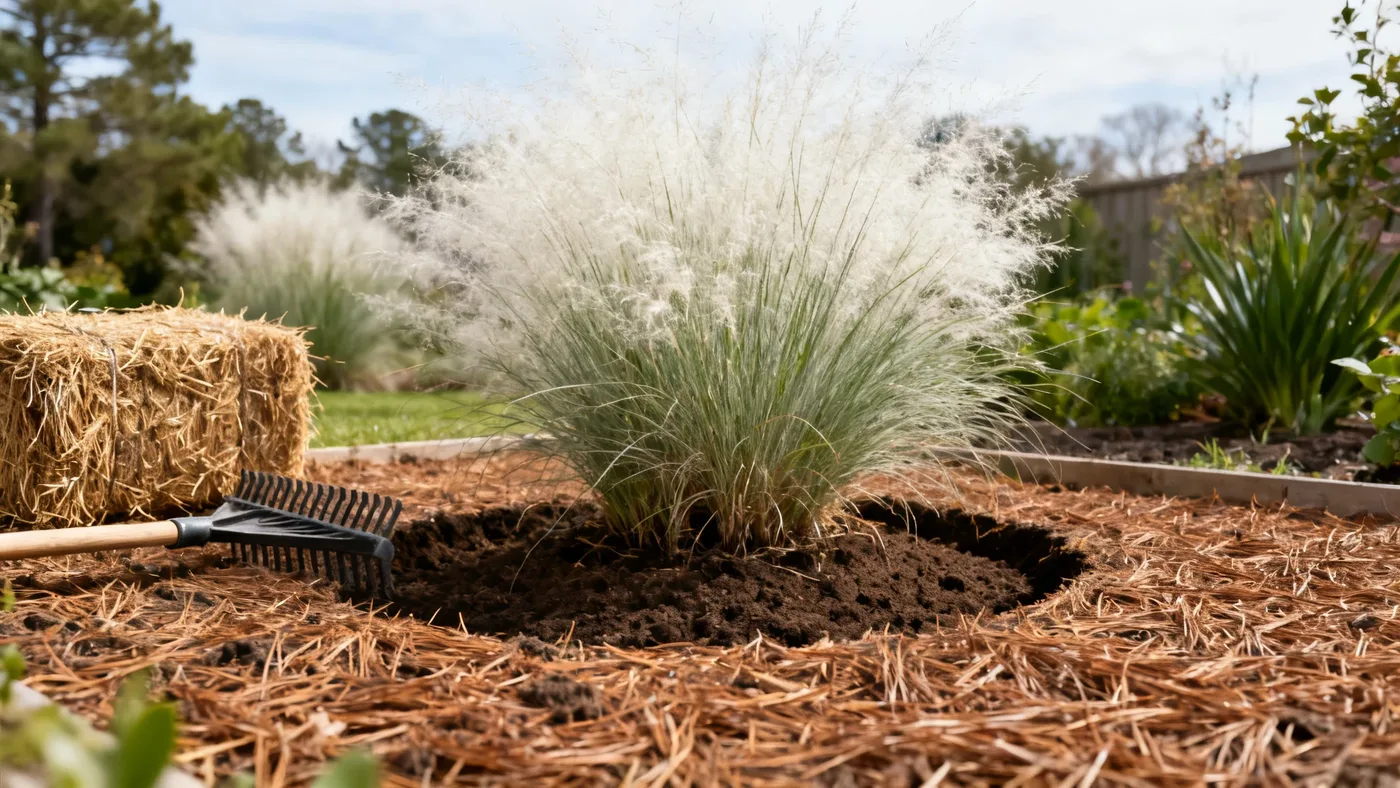
Pine straw is the best mulch for White Cloud Muhly Grass, and the reasons are specific rather than a matter of taste. It stays put on a slope, it lets air and water pass straight through to the soil instead of forming a mat, it lasts two to four years, and it leans the soil slightly acidic, which suits a plant that prefers neutral to slightly acidic ground and has a low tolerance for high pH. Coarse pine bark nuggets are a close second for the same airflow reason. The mulch depth is 2 to 3 inches measured over open bed soil, and the number that matters more than the depth is the gap: keep every bit of it 3 to 4 inches clear of the crown.
White Cloud Muhly Grass
Mulch is easiest to get right at planting, before the clump is wide enough to hide the crown. Nursery-grown White Cloud Muhly Grass in quart, 2 gallon and 3 gallon sizes from $39.99, shipped in its container with our planting and care guides.
Mulch does three jobs in a muhly planting: it suppresses the weeds that compete with a young clump, it moderates soil temperature and moisture through establishment, and it keeps rain from splashing soil onto the lower blades. It is also one of the two most common ways gardeners accidentally kill this plant, the other being planting it too deep. Both mistakes bury the crown.
Why the Crown Gap Is the Real Rule
On a tree you are told to keep mulch 2 to 3 inches back from the trunk. On a clumping ornamental grass, the equivalent structure is the crown: the compact zone at soil level where every new shoot originates. It is not bark, it is living meristem tissue, and it is exactly the tissue that crown rot destroys.
Pile mulch into the middle of a muhly clump and you hold constant moisture against that tissue, cut off air movement, and create the warm, damp, dark conditions that rot and fungal entry need. It is the same failure as a mulch volcano around a tree trunk, which traps moisture against bark built for air until the tissue decays and fungal and insect entry points open up. Since crown and root rot is the single most common way this grass dies, the crown gap is not a fussy detail. It is the point.
So mulch the bed, not the plant. Spread 2 to 3 inches across the open soil where weeds would otherwise germinate, then pull it back into a clear ring 3 to 4 inches out from the crown on all sides. After the late-winter cut back is the perfect moment to do this, because the clump is 3 inches tall and you can see exactly what you are doing. Our guide to when and how to cut back White Cloud Muhly Grass has that timing.
Mulch Types, Ranked for This Plant
Pine straw (pine needles). The first choice. Extension comparisons give it a two to four year service life, rate its slope retention as excellent, and note that it allows air, water and nutrients to penetrate easily to the soil surface, which is the property that matters most for a plant that will not tolerate a soggy crown. Pine and pine-family litter also helps acidify soil, which points the right direction for a species that tolerates acid to neutral ground well and high pH poorly. It looks appropriate too: a fine, loose, needle texture under a fine-textured grass.
Pine bark nuggets. A strong second. Coarse-textured, so air moves freely, and the coarseness is why extension guidance allows nuggets up to 4 inches deep where finer materials must stop at 2 to 3. Two cautions: nuggets can float and redistribute in heavy rain, so they are a poor choice on a slope or anywhere water sheets across the bed, and the larger grades leave gaps that weed seed finds. Pine bark mini-nuggets are the useful compromise.
Shredded hardwood. Fine if you manage it. Two to four year life, good weed suppression, slower to break down than wood chips. The risk is texture: fine and shredded materials mat together over time into a water-repellent crust that sheds irrigation instead of admitting it. Cap it at 2 to 3 inches, and if water starts beading on the surface, break the matted layer apart with a rake or a claw cultivator. Never let fine-textured wood or bark mulch exceed 3 inches, because excessive depth suffocates roots and shows up as yellowing foliage and poor growth.
Gravel and decorative stone. Situational. Permanent, never needs replacing, and visually right in a gravel or xeriscape planting, which is how muhly is frequently used. Two trade-offs: stone radiates heat, and rock can add alkaline elements to the soil over time, which is the wrong direction for a species with low tolerance for high pH. In an arid-style bed, 2 inches of stone with a clean crown gap works well. See xeriscaping with White Cloud Muhly Grass for how that bed is put together.
Wood chips. Acceptable, short-lived. Roughly two years before they need topping up, faster decomposition, and they can attract termites, which is a reason to keep any mulch 6 to 12 inches away from the walls of a building rather than a reason to avoid chips in an open bed.
What Not to Use
- Grass clippings or shredded leaves more than 2 inches deep. They mat together and restrict the water and air supply to the soil. A thin scatter is fine; a pile is not.
- Anything piled against the crown. Covered above, and worth repeating because it is the mistake that costs plants.
- Sour mulch. Mulch that has gone anaerobic in storage drops to a pH of roughly 1.8 to 2.5 and smells of vinegar or ammonia. It damages plants on contact. If a delivery smells sharp, spread it in the open and water it before it goes anywhere near a plant.
- Cocoa bean shell mulch, if you have dogs. The shells contain theobromine and caffeine, and the ASPCA Animal Poison Control Center advises against using it around unsupervised dogs or dogs that eat what they find. Our guide to whether White Cloud Muhly Grass is toxic to dogs and cats covers the pet side of the bed in full.
- Plastic sheeting under the mulch. It blocks the gas exchange that this plant's shallow, fibrous root system depends on and turns the soil surface into a moisture trap. Where you need a weed barrier on a slope, use a biodegradable natural fiber fabric instead.
Depth: Reconciling Two Correct Numbers
You will see 2 to 3 inches recommended for ornamental beds, and you will also see advice to keep mulch light or skip it altogether around established ornamental grasses. Both are right, because they are measuring different things.
2 to 3 inches is the bed number. That is the depth over open soil between and around plants, where the job is weed suppression and moisture retention, and it is the depth at which fine and medium mulches work without suffocating roots. Coarse nuggets can go to 4 inches; fine materials must not.
Thin to nothing is the crown number. Immediately around the base of the clump, mulch has no weed-suppression job to do, because the clump itself occupies that ground, and it has a real cost, because it holds moisture on the crown. So the profile across a muhly bed is not flat: it is 2 to 3 inches out in the bed, tapering to bare soil in a 3 to 4 inch ring around each clump. Our guide to whether White Cloud Muhly Grass is drought tolerant makes the same point from the watering side.
The one exception is deliberate winter protection, which is a different job with different timing: a thicker layer applied after the ground has frozen, to hold the soil frozen rather than to keep the plant warm, and pulled back in spring. That belongs to winter care for White Cloud Muhly Grass, not to routine bed mulching.
When to Apply It
Early spring is the standard timing: as plants begin growing and before weed seeds germinate. On this plant that maps neatly onto the February or March cut back, so the sequence for an established clump is cut back, weed, mulch, and then leave the bed alone.
At planting, mulch immediately after you have watered the new plant in, so the mulch goes onto moist soil rather than dry. Our guide to how to plant White Cloud Muhly Grass for best results covers where mulch falls in the planting sequence.
Do not re-mulch to a full depth every year out of habit. Check the existing depth first, rake it to break any crust, and top up only to 2 to 3 inches total. Annual blind re-application is how beds end up 6 inches deep with a buried crown.
How Much to Buy
The arithmetic is simple and worth doing before you go to the yard, because bagged mulch is expensive in the quantities a bed needs.
- A cubic yard is 27 cubic feet. At 3 inches deep, that covers about 108 square feet. At 2 inches, about 162 square feet.
- A standard 2 cubic foot bag covers about 8 square feet at 3 inches, or 12 square feet at 2 inches.
- A bed of three clumps spaced 30 inches apart in a border occupies roughly 30 to 40 square feet including working room, so think four to five bags, or a half yard if you are also mulching elsewhere.
Subtract the crown rings from your estimate rather than adding to it. You are not mulching the footprint of the plants.
Quick Reference: Mulch for White Cloud Muhly Grass
| Item | Detail |
|---|---|
| Best choice | Pine straw: excellent slope retention, free air and water movement, slightly acidifying |
| Strong alternative | Pine bark mini-nuggets, for airflow; avoid on slopes, nuggets float |
| Workable | Shredded hardwood at 2 to 3 inches, raked if it mats; gravel at 2 inches in xeriscape beds |
| Avoid | Grass clippings or leaves over 2 inches, sour mulch, plastic sheeting, cocoa shell around dogs |
| Depth over open bed soil | 2 to 3 inches for fine and medium mulches; up to 4 inches for coarse nuggets |
| Clearance from the crown | 3 to 4 inches of bare soil, all the way around, always |
| Best time to apply | Early spring, right after the late-winter cut back and weeding |
| Service life | Pine straw, pine bark and shredded hardwood roughly 2 to 4 years; wood chips about 2 |
| Distance from building walls | 6 to 12 inches, to keep mulch from bridging treated soil |
| Coverage | 1 cubic yard covers about 108 square feet at 3 inches deep |
| Maintenance | Rake to break any water-repellent crust; top up to depth, do not re-mulch blindly |
Get two things right and mulch becomes an advantage rather than a risk on this plant: a material that breathes, and a crown that is never covered. For the rest of the growing routine, see our complete White Cloud Muhly Grass care guide, and if drainage is the underlying worry, start with the best soil for White Cloud Muhly Grass.
White Cloud Muhly Grass
Order nursery-grown White Cloud Muhly Grass in quart, 2 gallon or 3 gallon sizes, shipped in its nursery container with growing guides included, and set the crown level with the soil so the mulch ring is easy to keep clear from day one.