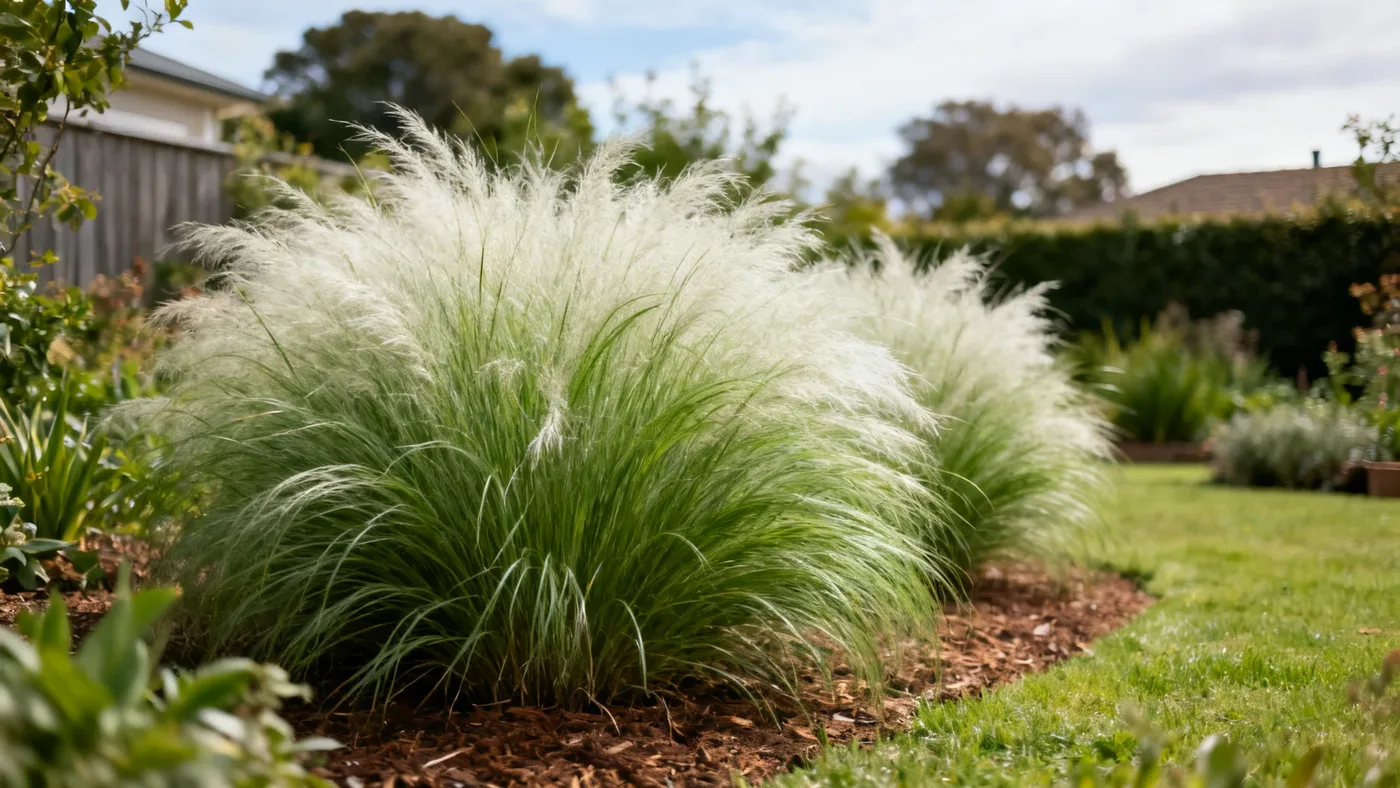
White Cloud Muhly Grass vs Japanese Forest Grass for Shade
This comparison has a definite answer, and it is not a matter of taste. White Cloud Muhly Grass needs six or more hours of direct sun to produce the white autumn plumes that are the only reason to grow it. Japanese forest grass (Hakonechloa macra) is a shade plant that burns in full sun in hot climates. If the bed you are standing in front of is shaded by a tree canopy, a fence or the north side of the house, planting a muhly there will give you a mound of thin green leaves that never flowers. Match the plant to the light and both of these are excellent. Get it backwards and one of them fails outright.
White Cloud Muhly Grass
Every property has a sunny side, and that is where this plant belongs. Nursery-grown White Cloud Muhly Grass in quart, 2 gallon and 3 gallon sizes from $39.99, shipped in its container with our planting and care guides.
The useful thing this article can do is help you read your own light honestly, since most shade problems come from measuring in April before the trees leaf out. Everything below assumes you have actually counted the hours of direct sun the spot gets in July.
At a Glance: Quick Comparison
| Attribute | White Cloud Muhly Grass | Japanese Forest Grass |
|---|---|---|
| Botanical Name | Muhlenbergia capillaris 'White Cloud' | Hakonechloa macra |
| Light | Full sun, 6+ hours; flowering drops sharply in shade | Light to heavy shade; burns in full sun in hot climates |
| Mature Height | 3-4 ft with plumes; foliage clump 2-3 ft | 12-20 in, mounding |
| Mature Width | 2-4 ft | To about 24 in, often wider than tall |
| USDA Zones | 6-9 (some sources list 5-9) | 5-9; the species is hardy to zone 4 |
| Habit | Upright arching fountain, clump-forming | Cascading mound; creeps slowly by rhizomes, not invasive |
| Grown For | White autumn plume display | Foliage color and cascading form |
| Soil Moisture | Well-drained; drought tolerant once established | Evenly moist, rich in organic matter |
| Soil pH | Acid, neutral or alkaline | Prefers acidic |
| Growth Rate | Moderate; full size in 2-3 seasons | Slow; takes a while to establish |
| Winter | Dies back; tan structure stands until cut | Dies back completely; no winter interest |
| Deer Resistance | High | Not favored by deer |
How to Read Your Light Before You Buy Anything
Full sun means six or more hours of direct, unobstructed sunlight per day during the growing season. Not bright, not open sky, direct sun on the spot.
Check it in mid-summer, not early spring, because a bed under a deciduous tree can read as full sun in March and deep shade in July. Look at the spot three or four times across a day, at mid-morning, midday, mid-afternoon and early evening, and note whether the ground is in direct light or in shadow each time. Add up the hours.
Six or more hours: plant the muhly. Two to five hours, or all-day dappled light through a high canopy: plant Hakonechloa. Under four hours of weak light, most flowering plants underperform, and the muhly in particular will keep making foliage while producing few plumes or none.
Our guide to sun requirements for White Cloud Muhly Grass walks through the audit in detail, and why a White Cloud Muhly Grass stops blooming covers insufficient light as the most common cause by a wide margin.
What Happens If You Plant Either One in the Wrong Light
Muhly grass in shade does not die dramatically. It persists, and that is what makes the mistake expensive: the plant looks alive, so people wait another year, and another. What it does instead is put its energy into leaves. The foliage stays green, the clump slowly widens, and every September it produces a handful of thin plumes or none. There is no amendment or fertilizer that substitutes for light. The fix is to move it, and our guide on transplanting an established clump covers doing that in spring without setting it back a season.
Japanese forest grass in full sun fails more visibly. In hot climates the foliage burns, and even in cool climates full sun bleaches the variegated forms to a washed-out creamy white rather than the gold they are sold for. It also needs evenly moist soil, especially during spring growth and hot weather, so a sunny spot compounds the problem with drought stress.
The colors are worth knowing if you are choosing a cultivar for a shaded bed: the gold-variegated forms are brightest in partial or dappled shade, fade toward lime green in deep shade, and bleach in sun. There is a light level that produces the color on the tag, and it is in the middle.
What Each Plant Looks Like Through the Year
Japanese forest grass makes cascading mounds 12 to 20 inches tall, often wider than tall, with foliage that spills over rocks, down a slope edge or out of a container. It is a slow grower that creeps gently on short rhizomes without becoming invasive. Its flowers are small airy spikes in mid to late summer and are not the point. In fall the foliage takes on orange, bronze or reddish tones before turning light brown, and then the plant dies back completely. It provides no winter interest.
White Cloud Muhly Grass is a 2 to 3 foot upright arching fountain that reaches 3 to 4 feet in bloom. It is green and unremarkable through summer, then opens panicles up to about a foot long in September, holding the white cloud into November. The foliage turns bronze to tan, the plumes dry to buff, and the whole clump stands through winter as pale structure before being cut to a few inches in February or March.
So both are deciduous, but only one leaves something standing. If winter bareness in a shaded bed matters to you, Hakonechloa will not solve it.
Water and Soil: Opposite Requirements
These two want different soil, which matters if you were hoping to run one planting mix across a whole bed.
Japanese forest grass wants soil rich in organic matter, on the acidic side, kept evenly moist, particularly through its spring growth flush and during hot weather. It is not a plant for a dry shade bed under a maple where tree roots take all the water. That is a real distinction, because dry shade and moist shade are different conditions and this plant only handles one of them.
White Cloud Muhly Grass wants drainage above all, adapts to clay, loam or sandy soil and to acid, alkaline or neutral pH, and once established is drought tolerant enough to need essentially no supplemental water in most regions. Standing wet at the crown over winter is the most common way to lose one. Our guide to best soil, drainage and pH needs covers how to test and fix a bed that holds water.
Maintenance Compared
Both get cut back in late winter or early spring before new growth starts, and neither needs much else.
Japanese forest grass has almost no insect or disease problems and deer do not favor it. Its one recurring job is division every two to three years in spring to keep clumps vigorous, and it is slow to re-establish afterward because it is a slow grower generally.
White Cloud Muhly Grass needs no scheduled division, no fertilizer in reasonable soil, and one hard cut-back a year. It is highly deer resistant. Its problems are situational rather than routine: rust in humid weather when clumps are crowded, and crown rot in soil that stays wet.
Pros and Cons
White Cloud Muhly Grass
Pros:
- White autumn plumes from September into November, a display no shade grass offers.
- Drought tolerant once established, needing little or no supplemental water.
- Adapts to clay, loam or sand and to any common soil pH.
- Standing tan winter structure instead of a bare patch.
- Highly deer resistant and highly salt tolerant.
- Reaches full size in two to three seasons and holds for years.
- No scheduled division and no fertilizer needed in decent soil.
Cons:
- Will not flower without six or more hours of direct sun.
- Too large at 2 to 4 feet wide for a small shaded pocket.
- No notable foliage color from spring through August.
- Needs good drainage, especially over winter.
Japanese Forest Grass
Pros:
- One of the few ornamental grasses that genuinely thrives in shade.
- Cascading habit that suits container edges, slope tops and low walls.
- Gold, variegated and green cultivars for different shade intensities.
- Orange, bronze or reddish fall color before it dies back.
- Slow spreading, well behaved and not invasive.
- Almost no insect or disease problems, and deer do not favor it.
- The species is hardy to zone 4, colder than the muhly tolerates.
Cons:
- Burns in full sun in hot climates, and bleaches even in cool-climate sun.
- Needs evenly moist, organic, acidic soil; not a dry shade plant.
- Slow to establish, so a new planting takes a few years to look like the photos.
- No meaningful flower display and no winter interest at all.
- Needs division every two to three years.
- Stays under 20 inches, so it cannot give a bed height.
Best For: Use Cases
Choose White Cloud Muhly Grass if you:
- Have a spot with six or more hours of direct summer sun.
- Want an autumn flower display rather than season-long foliage texture.
- Are planting a dry, well-drained or gravel-mulched bed.
- Need height in the middle or back of a border.
- Have deer pressure or a coastal, salt-exposed site.
- Want a plant that reaches full size quickly and then needs almost nothing.
Choose Japanese forest grass if you:
- Are planting under a tree canopy, on a north-facing wall or in any bed with under five hours of sun.
- Have moist, organic, acidic soil rather than dry shade.
- Want a cascading form to spill over a container edge, a wall or a step.
- Are after foliage color, including gold and variegated forms.
- Garden in zone 4 or 5, below the muhly's comfortable range.
The Verdict
There is no contest here, only a sorting rule. These plants occupy opposite ends of the light spectrum, and the only real mistake is putting either one on the wrong side of it.
Count the hours of direct summer sun on the spot. At six or more, White Cloud Muhly Grass will give you a white cloud every autumn, hold its own in drought, ignore the deer and ask for one cut-back a year. Below about five, Hakonechloa is the correct plant and the muhly will only disappoint you, slowly, over several seasons.
Most properties have both conditions. The shaded side of the house is a Hakonechloa bed; the sunny strip along the drive, the open front bed and the corner that bakes all afternoon are where the muhly earns its place. If your sunny spot is a patio rather than a bed, our guide to growing it in pots and containers long-term covers doing it in a container.
White Cloud Muhly Grass
Once you have found the sunny side of the property, this is what goes in it. Order nursery-grown White Cloud Muhly Grass in quart, 2 gallon or 3 gallon sizes, shipped in its nursery container with growing guides included.
Quick Reference
| Factor | White Cloud Muhly | Japanese Forest Grass | Advantage |
|---|---|---|---|
| Full sun bed | Thrives and blooms | Burns in hot climates | Muhly |
| Shaded bed | Survives but barely flowers | Thrives | Japanese forest grass |
| Height | 3-4 ft in bloom | 12-20 in | Depends on the role |
| Flower display | White plume cloud, Sept-Nov | Small, insignificant spikes | Muhly |
| Soil moisture | Well-drained, drought tolerant | Evenly moist, organic | Muhly for dry sites |
| Dry shade | Not suitable | Not suitable | Neither |
| Growth rate | Moderate, full size in 2-3 years | Slow | Muhly |
| Winter interest | Standing tan plumes and foliage | None; dies back completely | Muhly |
| Division needed | No set schedule | Every 2-3 years | Muhly |
| Cold hardiness | Zones 6-9 | Zones 5-9; species to zone 4 | Japanese forest grass |