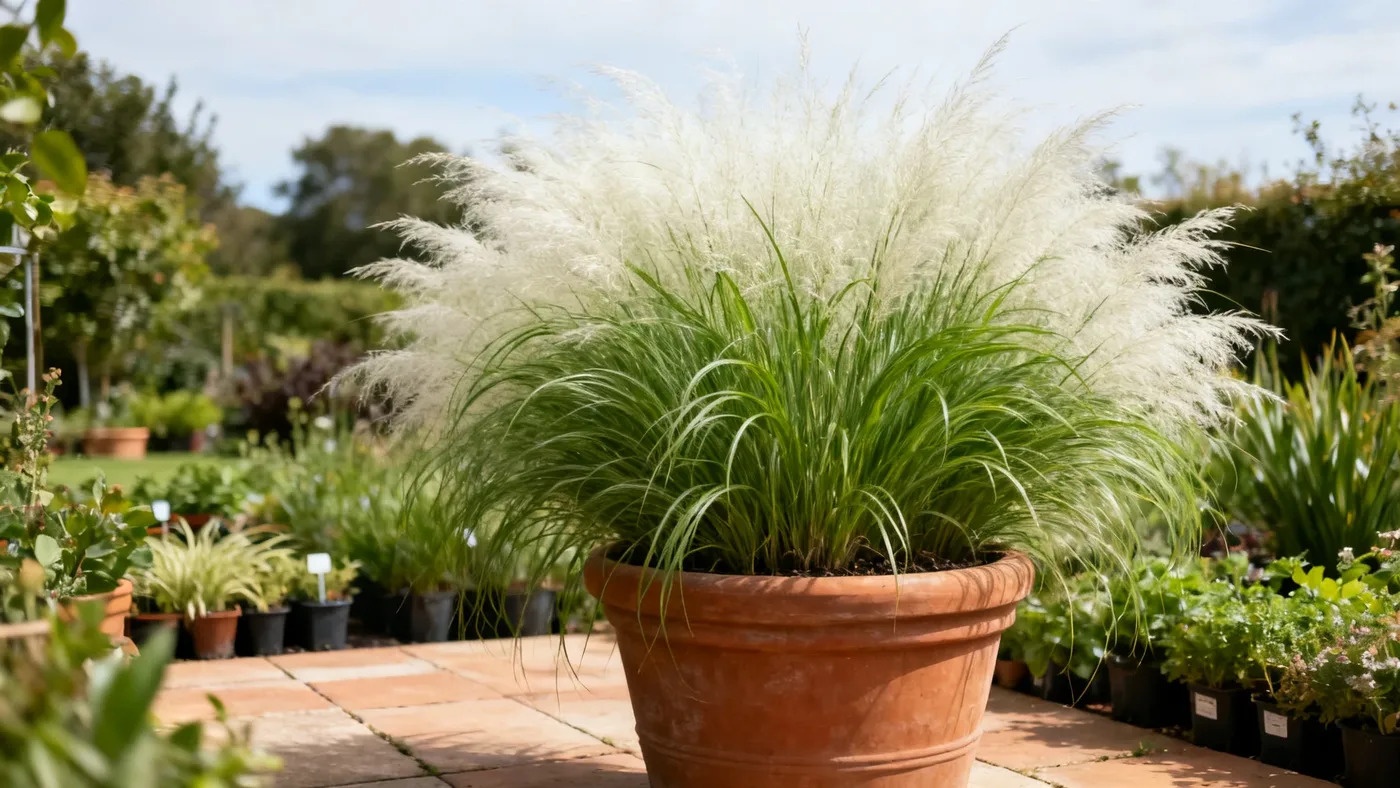
Growing White Cloud Muhly Grass in Pots and Containers Long-Term
White Cloud Muhly Grass makes an excellent container plant, and it will keep doing it for years rather than a single season, but only if you treat the pot as a growing system rather than a decoration. A clump that reaches 2 to 4 feet wide with roots about a foot deep in open ground has to fit those same ambitions into a fixed volume of mix, which changes how you water it, how often you repot it, and above all how it survives winter.
White Cloud Muhly Grass
Quart plants are the economical way to start a container and can be moved up as they grow; 2 gallon and 3 gallon plants give you a full pot in the first season. Nursery-grown, from $39.99, shipped in the container with our planting and care guides.
This guide covers the long game: sizing the pot now and in three years, the mix, watering and feeding a container grass differently than a bed, reading root-bound signals, and the overwintering methods that actually work. For choosing a plant at the nursery, see buying White Cloud Muhly Grass: container sizes and what to look for.
What Changes When the Roots Are in a Pot
Four things, and every piece of container advice below follows from them.
- Root volume is capped. In the ground this grass builds a fibrous root system roughly a foot deep and as wide as the clump. In a pot it fills the available volume and then circles.
- It dries out fast. A full root ball in a sunny spot in July can use its entire reservoir in a day. The drought tolerance this plant is famous for belongs to established in-ground plants, not to pots.
- The root ball tracks the air temperature. Research on containerized perennials shows that the root ball in an unprotected container can approach ambient air temperature, while soil in a bed buffers the same weather by many degrees. Roots are also less cold-hardy than shoots to begin with.
- Nothing escapes. This grass spreads by neither rhizomes nor stolons, so it will never crack a pot with runners or root through the drainage hole into a bed. What it does instead is thicken until it is root bound.
Pot Size Now, and in Three Years
Size the first pot to the plant, not to the eventual clump. A pot that is enormously oversized holds wet mix the roots cannot reach, which is how container grasses rot. The working rule is a container two to three times the diameter of the plant's current root ball, at least 12 inches deep, with the expectation of moving up every two to three years.
A realistic progression for this grass:
- Quart starter: plant into a pot roughly 8 to 10 inches across. It will look sparse for a season. That is correct.
- 2 gallon plant, or a quart after two seasons: a 12 to 14 inch pot.
- 3 gallon plant, or an established clump: a 16 to 18 inch pot.
- Full mature clump, 2 to 3 feet of foliage with plumes to 4 feet: 18 to 20 inches or more in diameter, and as deep as it is wide.
Two practical notes on the container itself. Weight is a feature: a 4 foot plume mass in a gusty spot will tip a light plastic pot, so favor a heavy pot or add ballast at the base. And at the top end, a mature clump in a 20 inch pot full of wet mix is close to immovable, which matters when you plan how you will overwinter it.
Mix and Drainage
Use a free-draining commercial container mix, not garden soil. Garden soil compacts in a pot and holds water in exactly the way this plant dislikes. If your mix feels dense or peat-heavy, cut it with perlite or horticultural grit at roughly one part to four to open it up. The species is adapted to sandy or rocky soils with dry to medium moisture and prefers neutral to slightly acidic conditions, so ordinary container mix is close to ideal and needs no pH adjustment.
The container needs at least one large drainage hole, and it must stay clear. Skip the old advice about a gravel layer at the bottom: it reduces the volume of usable mix and raises the saturated zone rather than improving drainage. If you use a saucer on a deck to protect the boards, empty it after rain, and take it away entirely over winter so the pot is never standing in water that freezes.
Watering a Container Grass
This is where most long-term container plantings fail, in both directions.
Check rather than schedule. Push a finger 2 inches into the mix, or learn the weight of the pot when it is properly watered and lift or tip it to judge. When the top 2 inches are dry, water until it runs freely from the drainage hole, which wets the entire root ball rather than just the surface. Half-watering a container grass trains the roots into the top inch, and a shallow root ball is what collapses in the first heat wave.
Expect real frequency in summer: a full root ball in full sun may need water daily in hot weather, every two to three days in milder spells, and much less in spring and fall. Once the plant is dormant in winter it needs almost none, though a pot in an unheated garage should not be allowed to dry to dust. A light watering once a month while dormant is enough.
The counterpart mistake is constant moisture. Mix that never dries suffocates roots and rots the crown. Our guide to watering White Cloud Muhly Grass from new plant to established covers the in-ground schedule this departs from.
Feeding, Lightly
This grass tolerates low-nutrient soil well and produces floppy, bloom-poor growth when overfed, so the instinct to feed a container plant generously is exactly wrong here. Fresh container mix carries enough for the first season. After that, at most one light application of a balanced fertilizer in spring as growth resumes.
If the plant is flopping, feeding is not the fix. Look at light first: full sun means 6 to 8 hours of direct sun, and less than that produces both weak growth and few plumes. See do you need to fertilize White Cloud Muhly Grass and sun requirements for White Cloud Muhly Grass.
Signs the Plant Is Root Bound
A container grass gives clear warnings before it declines. Any two of these together mean it is time to act:
- Water runs straight through and out the bottom seconds after you apply it, because the root mass has displaced most of the mix.
- The pot dries out in less than a day in ordinary summer weather when it used to last two or three.
- Roots are visible circling the surface of the mix or emerging from the drainage hole.
- The root ball has pushed hard against the container wall, or the whole clump has begun to lift itself above the rim.
- The center of the clump is thinning or dead while the outer ring still grows.
- Growth has stalled and plume production has dropped from one year to the next with no change in light or watering.
Repotting Versus Dividing
You have two responses, and the clump usually tells you which one it needs.
Repot into the next size up when the plant is healthy and simply outgrowing its pot, which is roughly every two to three years. Slide the root ball out, tease the outer roots loose so they will grow outward rather than continuing to circle, set it at the same depth in fresh mix, and water in thoroughly.
Divide when the pot has reached the largest size you are willing to handle, or when the center has died out. Container grasses generally want dividing every two to four years, which is a faster cycle than the three to five years an in-ground clump needs, because the root restriction accelerates congestion. Lift the root ball, cut it into two to four pieces with a clean saw, discard the woody center, and replant one piece into fresh mix in the same pot. The spare pieces go into the garden or into pots of their own.
Timing for both jobs is spring, once new growth is a few inches tall and the soil is warming, never during flowering and never in the dormant depths of winter. The full method is in dividing and propagating White Cloud Muhly Grass.
Overwintering a Potted Plant: The Part That Decides Everything
In the ground this grass is reliable through zone 6. In a pot, assume you have lost the equivalent of a zone or two of hardiness, because the root ball no longer has insulating earth around it and can track the air temperature directly. The standard guidance for container perennials is to grow plants rated one to two zones colder than your own, which puts a zone 6 or 7 garden squarely in the range where a potted clump needs help.
Choose one of these, in descending order of reliability:
- Sink the pot in the ground. Dig a hole in a bed or vegetable patch in late fall and drop the whole container in to the rim. The surrounding earth restores the buffering the pot removed. The most effective method and the most work.
- Move it into an unheated garage, shed or cold frame. The target is a root zone that stays cold but stable; overwintering guidance for containerized perennials aims for soil temperatures around 30 to 34 degrees Fahrenheit. An unheated attached garage usually sits in that range. Water lightly once a month.
- Group and wrap. Push several pots together against a sheltered wall out of the wind, which reduces the exposed surface area of each, then wrap the outside of the group with burlap or bubble wrap and pile shredded leaves or straw around and between the pots. Less effective than the first two, but it works in zone 7 and warmer.
- Zones 8 and 9: leave the pot out. Keep it off a saucer so it never stands in water.
Three things not to do. Do not bring the plant into a heated house: it is a hardy perennial that needs a cold dormant period, and a warm living room produces weak, etiolated growth and a weakened plant. Do not cut the foliage off in fall, because it insulates the crown in a pot exactly as it does in a bed. And be aware that terra cotta and other porous pots crack when wet mix freezes and expands, so a valuable glazed or clay pot is worth emptying or moving under cover.
For the in-ground version of all of this, see winter care: protecting White Cloud Muhly Grass from cold.
Cutting Back a Potted Plant
Same timing as in the garden: late February through early March, before new growth emerges, cut the clump down to 2 to 4 inches. In a container this is easier than in a bed because you can turn the pot as you work, and it is a good moment to check the root ball, top up the mix that has settled over the winter, and decide whether this is a repotting year. See when and how to cut back White Cloud Muhly Grass for the technique.
What to Expect Long-Term
A well-managed potted clump blooms on the same schedule as one in the ground, with white plumes from September through November rising about a foot above the foliage, provided it gets full sun. Expect it to run slightly smaller than the 3 to 4 feet it reaches in a bed, and expect the plumes to be the first thing to suffer if light, water or pot size falls short.
Plan on a rotation rather than a permanent arrangement: repot at two to three years, divide at two to four, and understand that the year you divide will be a lighter blooming year while the plant rebuilds. Handled that way a single plant will carry a container position for a decade or more, since this is a long-lived perennial grass that responds well to periodic rejuvenation.
Quick Reference: Long-Term Container Culture
| Item | Detail |
|---|---|
| Starting pot size | 2 to 3 times the root ball diameter, at least 12 inches deep |
| Pot for a mature clump | 18 to 20 inches in diameter or more, similar depth |
| Mix | Free-draining container mix; add perlite or grit if dense; never garden soil |
| Drainage | At least one large hole, no gravel layer, no standing saucer in winter |
| Watering trigger | Top 2 inches dry; water until it runs from the base |
| Summer frequency | Up to daily in heat for a full root ball |
| Winter watering | Light, about monthly, only if stored under cover |
| Feeding | None the first season; at most one light spring feed after that |
| Repot | Every 2 to 3 years, in spring |
| Divide | Every 2 to 4 years, in spring, never in flower |
| Effective hardiness in a pot | Assume 1 to 2 zones less hardy than in the ground |
| Target winter root zone | About 30 to 34 F, cold but stable |
| Zones 6 to 7 winter plan | Sink the pot, or store in an unheated garage or shed |
| Zones 8 to 9 winter plan | Leave outdoors, off any saucer |
| Never | Overwinter in a heated room, or cut the foliage off in fall |
| Cut back | Late February to early March, to 2 to 4 inches |
Container culture asks for two habits this plant does not need in the ground: honest watering in summer and a real winter plan. Give it those and a pot on a sunny patio produces the same white autumn plumes as a border planting, at a scale you can move. For the full year-round routine, see our complete White Cloud Muhly Grass care guide.
White Cloud Muhly Grass
Pick the size to match the pot you have: quart for a small container you will move up, 2 gallon or 3 gallon for immediate fullness. Nursery-grown and shipped in its container with growing guides included, ready to pot up on arrival.