White Cloud Muhly Grass vs Liriope (Monkey Grass) for Borders and Edging
Start with the fact that decides this one: Liriope is not a grass. Liriope muscari, sold everywhere as monkey grass or lilyturf, is a broadleaf evergreen perennial in the asparagus family with strap-shaped leaves, purple flower spikes and black berries. White Cloud Muhly Grass is a true warm-season grass that dies back to the ground every winter. That difference drives everything else: how much light each one needs, what the border looks like in January, and which one is even a candidate for the spot you have in mind.
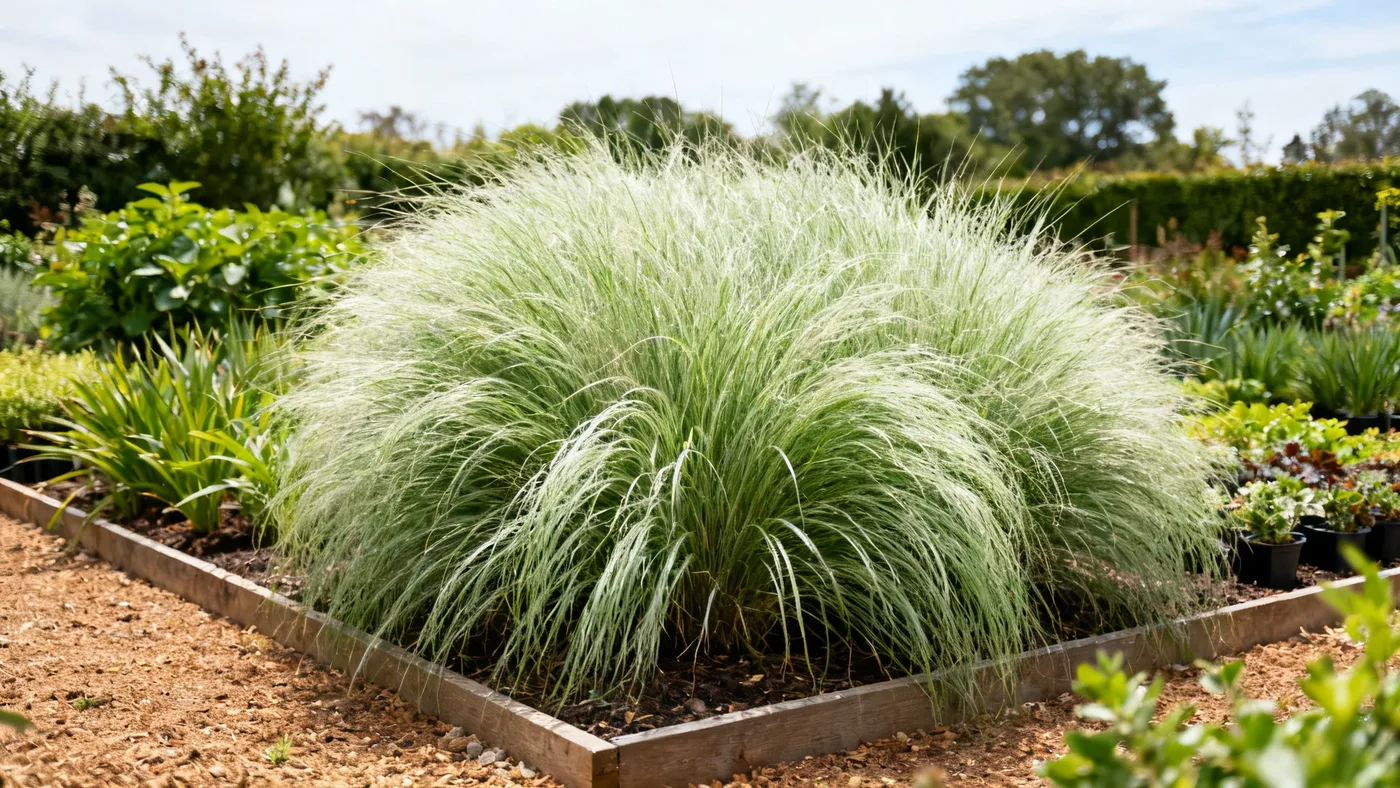
White Cloud Muhly Grass
If your border gets six hours of sun or more, the muhly gives you movement and an autumn display that a liriope edging never will. Nursery-grown White Cloud Muhly Grass in quart, 2 gallon and 3 gallon sizes from $39.99, shipped in its container with our planting and care guides.
The short version for a reader in a hurry: measure the light. Six hours of direct sun or more, and White Cloud Muhly Grass is the better plant by a wide margin. Deep shade under a mature tree canopy, and the muhly will survive but refuse to flower, which defeats the point of growing it.
At a Glance: Quick Comparison
| Attribute | White Cloud Muhly Grass | Liriope (Monkey Grass) |
|---|---|---|
| Botanical Name | Muhlenbergia capillaris 'White Cloud' | Liriope muscari (clumping) or Liriope spicata (creeping) |
| Plant Type | True warm-season ornamental grass | Broadleaf evergreen perennial, not a grass |
| Mature Height | 3-4 ft with plumes; foliage clump 2-3 ft | 1-1.5 ft |
| Mature Width | 2-4 ft | 1-1.5 ft for L. muscari; L. spicata runs indefinitely |
| USDA Zones | 6-9 (some sources list 5-9) | 5-10 |
| Light | Full sun for bloom; part shade cuts flowering sharply | Full sun to partial shade; tolerates nearly full shade |
| Winter Appearance | Dies back; dried plumes and tan foliage stand for structure | Evergreen foliage plus shiny black berries |
| Flower | White airy plumes, September to November | Purple spikes 6-8 in tall, August to September |
| Leaf | Fine, thread-like blades | Strap-shaped, roughly an inch wide, glossy |
| Foot Traffic | None; it is a specimen and mass plant | Tolerates being brushed past as a path edging |
| Annual Cut-Back | February or March | February, before new growth |
| Deer Resistance | High | Deer and rabbit resistant |
Light Is the Deciding Factor
White Cloud Muhly Grass needs full sun, meaning six or more hours of direct light, to set a full crop of plumes. It will live in partial shade and keep green foliage, but flowering falls off fast, and a muhly that does not bloom is just a mound of thin green leaves. Since the plumes are the entire reason to grow it, shade is not a compromise you can make halfway. Our guide to sun requirements for White Cloud Muhly Grass walks through how to audit a spot across a day, and why a muhly stops blooming covers shade as the leading cause.
Liriope is the opposite case. It grows in full sun through partial shade and tolerates close to full shade, where growth simply slows and leaves elongate. That tolerance is the whole reason it is planted under trees, along north-facing foundations and in the dry shade at the base of a wall, places where nothing with a flower show will work.
So the honest sorting rule is light, not taste. Sunny front bed: muhly. Dry shade under a maple: liriope. A spot getting four or five hours of morning sun: liriope will look better, and a muhly there will disappoint you every October.
Scale: A Border Plant Versus an Edging Plant
Liriope tops out around 1 to 1.5 feet tall and wide, with the flower spikes adding 6 to 8 inches. That is edging scale. It defines a bed line, runs along a walk, fills a strip between driveway and lawn, and stays legible at that size for decades.
White Cloud Muhly Grass is a different order of plant: a 2 to 3 foot foliage clump spreading 2 to 4 feet, reaching 3 to 4 feet when the autumn plumes are up. Used as a border it is a statement border, the kind that hides the bed behind it. Used along a walk it will lean into the walk by year three unless you set it back. Our guide to how big White Cloud Muhly Grass really gets has the growth-rate numbers, and spacing for hedges, borders and mass plantings covers the setback.
If what you actually need is a 12 inch line that never grows into the path, the muhly is the wrong tool regardless of light. If you want the bed edge to have height, movement and a season of its own, liriope cannot deliver that at any spacing.
Winter: Evergreen Versus Standing Structure
This is where the two plants give you genuinely different Januarys.
Liriope is a broadleaf evergreen. Its glossy strap leaves hold through winter, and the purple flower spikes of August and September are followed by round shiny black berries that persist into the cold months. In February you shear the old foliage off, and fresh growth follows. In a front-of-house planting seen from the street year round, that continuity is worth a lot.
White Cloud Muhly Grass dies back. The foliage takes on a bronze or tan cast in late autumn, the plumes dry to buff, and the whole clump stands as pale structure and movement through winter before being cut to a few inches in February or March. It is not green, but it is not absent either, and it catches low winter light in a way evergreen foliage does not. Our guide on whether White Cloud Muhly Grass dies back in winter explains why leaving it standing matters for the crown.
Neither answer is wrong. It depends on whether you want the bed to read as furnished in January or as a winter landscape with texture in it.
The Liriope Species Trap
If you do choose liriope for a shaded stretch, the species matters more than the label on the pot. Liriope muscari is a true clumper: it thickens outward from its crown and stays roughly 1 to 1.5 feet across. Liriope spicata spreads by underground rhizomes and will keep going, which is why it is flagged as a problem groundcover in a number of southeastern states and why it should not be planted anywhere it can reach a woodland edge.
Both get sold as monkey grass, sometimes interchangeably. Check the botanical name before buying.
White Cloud Muhly Grass has no equivalent trap. It is a clump-forming grass with no rhizomes and no stolons, and it is not listed as invasive or noxious anywhere. What it does is thicken in place. Our article on whether White Cloud Muhly Grass spreads covers that in full.
Maintenance Compared
Both are low-maintenance plants with the same annual rhythm: one cut-back in late winter before new growth starts, February for liriope and February or March for the muhly.
Liriope's usual problems are slugs and snails chewing the leaves, plus leaf rot, crown rot and anthracnose in wet, crowded conditions. It also needs dividing eventually as clumps thicken.
White Cloud Muhly Grass is generally pest-free, with mealybug and occasional scale showing up on stressed plants and rust appearing in humid weather when air circulation is poor. Its real failure mode is not a pest at all: wet soil at the crown over winter. Give it drainage and full sun and it asks for almost nothing, including no fertilizer in reasonable soil.
Pros and Cons
White Cloud Muhly Grass
Pros:
- A genuine autumn display: white plumes from September into November.
- Height and movement that an edging plant cannot provide.
- Clumping habit with no rhizomes, so it will not run into the lawn.
- Highly drought tolerant once established, and highly salt tolerant.
- Highly deer resistant.
- Standing winter structure that catches low light.
- One cut-back a year and no fertilizer needed in decent soil.
Cons:
- Needs six or more hours of direct sun or it will not bloom.
- Too large for a narrow edging strip at 2 to 4 feet wide.
- Not evergreen; the bed goes tan in winter and bare after the February cut.
- Cannot take foot traffic or being brushed past in a tight path.
- Needs well-drained soil, particularly over winter.
Liriope
Pros:
- Grows in full sun through nearly full shade, including dry shade under trees.
- Evergreen strap foliage keeps a bed edge furnished all winter.
- Purple August flower spikes followed by black berries that persist.
- Stays at edging scale, roughly 1 to 1.5 feet, for the life of the planting.
- Hardy to zone 5 and tolerant down through zone 10.
- Deer and rabbit resistant, and tolerant of being brushed past along a walk.
Cons:
- No movement and no seasonal drama; it is a texture plant, not a display plant.
- Liriope spicata spreads aggressively by rhizomes and is flagged in several southeastern states.
- Slugs, snails, leaf rot, crown rot and anthracnose are all on its problem list.
- Needs dividing as clumps thicken.
- Cannot give a bed any height.
Best For: Use Cases
Choose White Cloud Muhly Grass if you:
- Have six hours or more of direct sun on the bed.
- Want the border itself to be the feature in autumn rather than a frame for something else.
- Have room for a plant 2 to 4 feet wide, set back from the path.
- Want movement in wind, which liriope does not provide.
- Garden on the coast or where salt reaches the bed.
- Prefer one annual cut-back over dividing and slug patrol.
Choose liriope if you:
- Are edging a shaded walk or planting the dry shade under a mature tree.
- Need the bed edge to stay green and furnished through winter.
- Have a strip narrower than about 18 inches to fill.
- Need a plant that tolerates being brushed past along a tight path.
- Garden in zone 5, or in zone 10 where the muhly is out of range.
The Verdict
These plants are not really competing for the same job, and the comparison gets clearer once you stop thinking of liriope as a grass. Liriope is a shade-tolerant evergreen groundcover that happens to have narrow leaves. White Cloud Muhly Grass is a sun-loving ornamental grass grown for an autumn flower display.
If your bed is sunny, plant the muhly and get a plant that does something in October instead of one that simply holds the line. If your bed is shaded, plant liriope and put the muhly somewhere it can perform. Many properties have both conditions, and there is no reason the front walk cannot be liriope while the sunny corner by the drive carries a mass of white plumes.
For ideas on what to put around a muhly planting, see our landscaping ideas and companion plants guide.
White Cloud Muhly Grass
Leave the shade to the liriope and give the sunny bed something that blooms. Order nursery-grown White Cloud Muhly Grass in quart, 2 gallon or 3 gallon sizes, shipped in its nursery container with growing guides included.
Quick Reference
| Factor | White Cloud Muhly | Liriope | Advantage |
|---|---|---|---|
| Light needed | 6+ hours direct sun | Sun to nearly full shade | Liriope for shade |
| Height | 3-4 ft in bloom | 1-1.5 ft | Depends on the role |
| Width | 2-4 ft | 1-1.5 ft clumping | Liriope for narrow strips |
| Winter foliage | Tan, standing, then cut back | Evergreen | Liriope |
| Flower show | White plume cloud, Sept-Nov | Purple spikes, Aug-Sept | Muhly |
| Movement in wind | Yes, its main appeal | Essentially none | Muhly |
| Spreading risk | None; no rhizomes | L. spicata runs; L. muscari clumps | Muhly |
| Hardiness | Zones 6-9 | Zones 5-10 | Liriope |
| Drought tolerance | High once established | Good once established | Muhly |
| Path edging | Needs a setback | Purpose-built for it | Liriope |