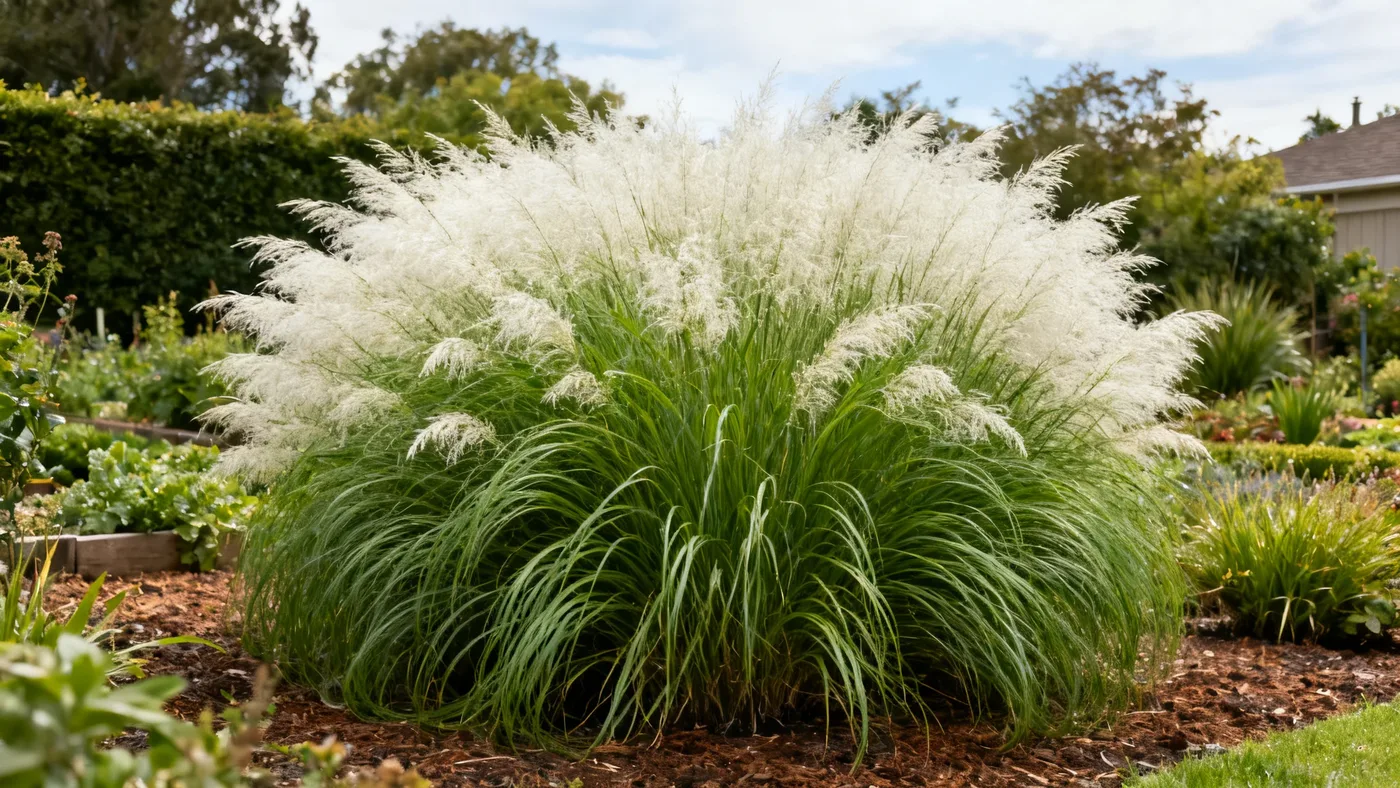
White Cloud Muhly Grass vs Blue Fescue: Which Fits Your Rock Garden?
If the question is which one belongs in a rock garden, blue fescue wins on size and loses on longevity. Festuca glauca is a 9 to 12 inch blue-gray dome that fits between boulders and along a gravel edge, but it is a short-lived cool-season grass that typically needs dividing every two to three years as its center thins and browns out. White Cloud Muhly Grass is a 3 to 4 foot warm-season plant that will overwhelm a small rockery, and it is also a plant you set once and leave alone for a decade. Which matters more depends on the size of the space and how much replanting you are willing to do.
White Cloud Muhly Grass
For a dry, sunny bed with room for a real plant rather than a 10 inch tuft, this is the low-water grass that actually puts on a show. Nursery-grown White Cloud Muhly Grass in quart, 2 gallon and 3 gallon sizes from $39.99, shipped in its container with our planting and care guides.
There is a second split that gets less attention and causes more failed plantings: climate. Blue fescue runs zones 4 to 8 and performs poorly in hot, humid conditions. White Cloud Muhly Grass runs zones 6 to 9 and is native to the humid Southeast. Across a wide band of the country, only one of these two is going to look good in August.
At a Glance: Quick Comparison
| Attribute | White Cloud Muhly Grass | Blue Fescue |
|---|---|---|
| Botanical Name | Muhlenbergia capillaris 'White Cloud' | Festuca glauca |
| Season Type | Warm-season; grows through summer heat | Cool-season; grows in spring and fall |
| Mature Height | 3-4 ft with plumes; foliage clump 2-3 ft | 9-12 in; flower stems reach 14-18 in |
| Mature Width | 2-4 ft | 12-18 in |
| USDA Zones | 6-9 (some sources list 5-9) | 4-8 |
| Foliage Color | Green through summer, bronze to tan in fall | Blue-gray, needle-fine, year round |
| Flower | White airy plumes, September to November | Green, purple-tinted panicles, June to July |
| Grown For | Autumn bloom display | Foliage color and form |
| Lifespan | Long-lived; a clump peaks around year three and holds | Short-lived; divide every 2-3 years |
| Heat and Humidity | Native to the humid Southeast; thrives | Poor performer in hot, humid summers |
| Deer and Rabbits | Highly resistant | Deer and rabbits graze the foliage |
| Evergreen | No; dies back and is cut in late winter | Semi-evergreen; may brown in hard winters |
Scale: The Rock Garden Question
A rock garden is a scale exercise. The stone has to stay visible, and plants that swallow it defeat the design. Blue fescue is built for that job: 9 to 12 inches tall, 12 to 18 inches wide, a tight dome of needle-fine blades that sits between rocks the way a cushion plant does, and stays that size.
White Cloud Muhly Grass will not do that. The foliage clump alone reaches 2 to 3 feet and spreads 2 to 4 feet wide, and the plumes lift it to 3 to 4 feet in autumn. In a small rockery it becomes the whole composition within two seasons. Our guide to how big White Cloud Muhly Grass really gets has the year-by-year progression.
That said, plenty of what gets called a rock garden is really a large dry, sunny, gravel-mulched bed, and at that scale a muhly is not an intruder but the anchor the bed was missing. One mature clump behind a drift of low blue mounds gives the planting a vertical element and a season. The test is simple: if the bed is under about 60 square feet, keep everything small. If it is bigger than that, it can carry a 4 foot grass.
Two Opposite Growing Calendars
Blue fescue is a cool-season grass. It grows in the mild weather of spring and fall, looks its best in those seasons, and slows or sulks in midsummer heat. Its flowers come in June and July, and many gardeners shear them off because the green, purple-tinted panicles on 14 to 18 inch stems are considered a distraction from the foliage.
White Cloud Muhly Grass is a warm-season grass. It waits for soil around 60 to 65 degrees Fahrenheit before moving in spring, which makes it noticeably late to green up, then grows steadily through the heat that stalls the fescue. Its flowers come in September and run into November, and they are the entire point of the plant.
Side by side in the same bed, they cover opposite halves of the year, which is a legitimate reason to grow both. The blue mounds carry spring and early summer while the muhly is still waking up; the muhly carries September through November when the fescue is winding down.
Color: Blue Foliage Versus White Flower
Blue fescue's value is its color, and the color is constant. Fine blue-gray blades read as a cool, silvery cushion from the moment the plant leafs out, and dry soil intensifies the blue. It does not depend on a bloom season, which is why it works as a repeating element through a long planting.
White Cloud Muhly Grass is green for most of the year and spectacular for two months. Its foliage is a neutral backdrop from spring through August, then the plumes open into a white haze up to about a foot long that persists into November before drying to buff. Our guide to White Cloud Muhly Grass fall color covers what the foliage does alongside the plumes.
They pair well for exactly that reason. Blue-gray foliage under white plumes is a cool, coherent combination, and the fescue keeps the front of the bed interesting during the muhly's quiet months.
Longevity and the Division Chore
This is the difference that shows up in year four.
Blue fescue is a short-lived perennial. Clumps look good for roughly two to four years, then the center crowds, thins and browns while the edges keep growing, leaving a doughnut. The standard fix is lifting and dividing every two to three years, discarding the dead center and replanting the vigorous outer pieces. In a bed with thirty fescues, that is a real recurring job.
White Cloud Muhly Grass is long-lived. A clump reaches full size in two to three seasons and then holds, and while dividing is an option for propagation or to rejuvenate a very old clump, it is not a scheduled chore. Our guide on how long White Cloud Muhly Grass lives explains when a clump actually needs attention, and dividing and propagating covers the method if you want more plants.
Drought Tolerance: Both Good, One Better in Heat
Both plants earn the low-water label, and both fail the same way, which is wet feet rather than dry ones.
Blue fescue wants medium-moist to dry, well-drained soil and cannot handle wet or poorly drained conditions. It is genuinely drought tolerant once established, and drier soil actually improves the foliage color. Its weakness is not drought but the combination of heat and humidity, where it declines regardless of how the watering is managed. Gray snow mold is a cold-climate problem for it as well.
White Cloud Muhly Grass is drought tolerant once established and adapts to sandy, loamy or clay soils across a wide pH range, with drainage as the one firm requirement, especially over winter. Heat and humidity are not stresses for it at all. It is also highly salt tolerant, which blue fescue is not noted for. Our guide on whether White Cloud Muhly Grass is drought tolerant has the establishment watering schedule, and xeriscaping with White Cloud Muhly Grass covers low-water bed design.
Wildlife: One Gets Eaten
Worth knowing before you plant a row of either in deer country. White Cloud Muhly Grass is highly resistant to deer grazing, and it is not a rabbit target. Blue fescue is not in that category: deer and rabbits will graze its foliage. On a suburban lot with regular deer pressure, a bed of blue fescue can be chewed to stubs while the muhly next to it stays untouched. Our guide on deer and rabbit resistance explains what makes the muhly unappealing to browsers.
Pros and Cons
White Cloud Muhly Grass
Pros:
- A real autumn display: white plumes from September into November.
- Long-lived, with no scheduled division chore.
- Thrives in heat and humidity where blue fescue declines.
- Highly deer and rabbit resistant.
- Highly salt tolerant, so it works in coastal and roadside beds.
- Gives a dry, gravel-mulched bed the height and movement it otherwise lacks.
- Standing winter structure, cut back once in February or March.
Cons:
- Far too large for a small rock garden or a tight edging strip.
- No standout foliage color during spring and summer.
- Late to green up because it is a warm-season grass.
- Not hardy below zone 6 in most listings, where fescue reaches zone 4.
Blue Fescue
Pros:
- Compact at 9 to 12 inches, true rock-garden and edging scale.
- Blue-gray foliage color that holds all season and intensifies in dry soil.
- Semi-evergreen, so it keeps some presence through winter.
- Hardy to zone 4, well north of the muhly's range.
- Looks its best in spring and fall, complementing warm-season grasses.
- Drought tolerant and happy in lean, gritty soil.
Cons:
- Short-lived, needing division every two to three years as the center dies out.
- Poor performer in hot, humid summers, which rules out much of the Southeast.
- Deer and rabbits graze the foliage.
- Flowers are usually sheared off rather than enjoyed.
- Susceptible to gray snow mold in cold-winter regions.
- Cannot give a bed any height or seasonal drama.
Best For: Use Cases
Choose White Cloud Muhly Grass if you:
- Have a dry, sunny bed larger than a true rockery and want an anchor plant in it.
- Garden anywhere with hot, humid summers, from the Gulf Coast to the mid-Atlantic.
- Want to plant once and not divide on a schedule.
- Need autumn interest rather than spring foliage color.
- Have deer or rabbit pressure.
- Garden near salt spray or salted pavement.
Choose blue fescue if you:
- Are planting a genuine rock garden where every plant must stay under a foot.
- Want constant blue-gray foliage color rather than a seasonal flower.
- Garden in zone 4 or 5 with cool summers.
- Need a low repeating element along a gravel path or a bed edge.
- Do not mind lifting and dividing every few years.
The Verdict
For a small, formal rock garden, blue fescue is the right scale and the muhly is not, and no amount of pruning changes that. Go in knowing it is a short-lived plant you will be dividing every two to three years, and that it will struggle if your summers are hot and humid.
For anything larger, a gravel bed, a dry border, a low-water front yard, White Cloud Muhly Grass is the stronger plant: it lives for years without intervention, it takes the heat and humidity that defeat the fescue, deer leave it alone, and it produces a display in October that a foliage plant cannot match. The best version of this comparison for many gardens is not either-or at all: low blue mounds at the front, white plumes behind them, each covering the season the other misses.
Ready to site one? See how to plant White Cloud Muhly Grass for best results for timing, depth and first-season watering.
White Cloud Muhly Grass
Low blue mounds need something behind them. Order nursery-grown White Cloud Muhly Grass in quart, 2 gallon or 3 gallon sizes, shipped in its nursery container with growing guides included, and plant it this spring or early fall.
Quick Reference
| Factor | White Cloud Muhly | Blue Fescue | Advantage |
|---|---|---|---|
| Height | 3-4 ft in bloom | 9-12 in | Fescue for small spaces |
| Width | 2-4 ft | 12-18 in | Fescue for tight beds |
| Main attraction | White autumn plumes | Blue-gray foliage | Depends on the goal |
| Peak season | September to November | Spring and fall | Complementary |
| Lifespan | Long-lived | Short-lived, divide every 2-3 years | Muhly |
| Hot humid summers | Thrives | Declines | Muhly |
| Cold hardiness | Zones 6-9 | Zones 4-8 | Fescue |
| Deer and rabbits | Highly resistant | Grazed | Muhly |
| Drought tolerance | High once established | High once established | Even |
| Salt tolerance | High | Not noted | Muhly |
| Winter presence | Tan standing structure | Semi-evergreen tuft | Even |