How Long Does White Cloud Muhly Grass Live?
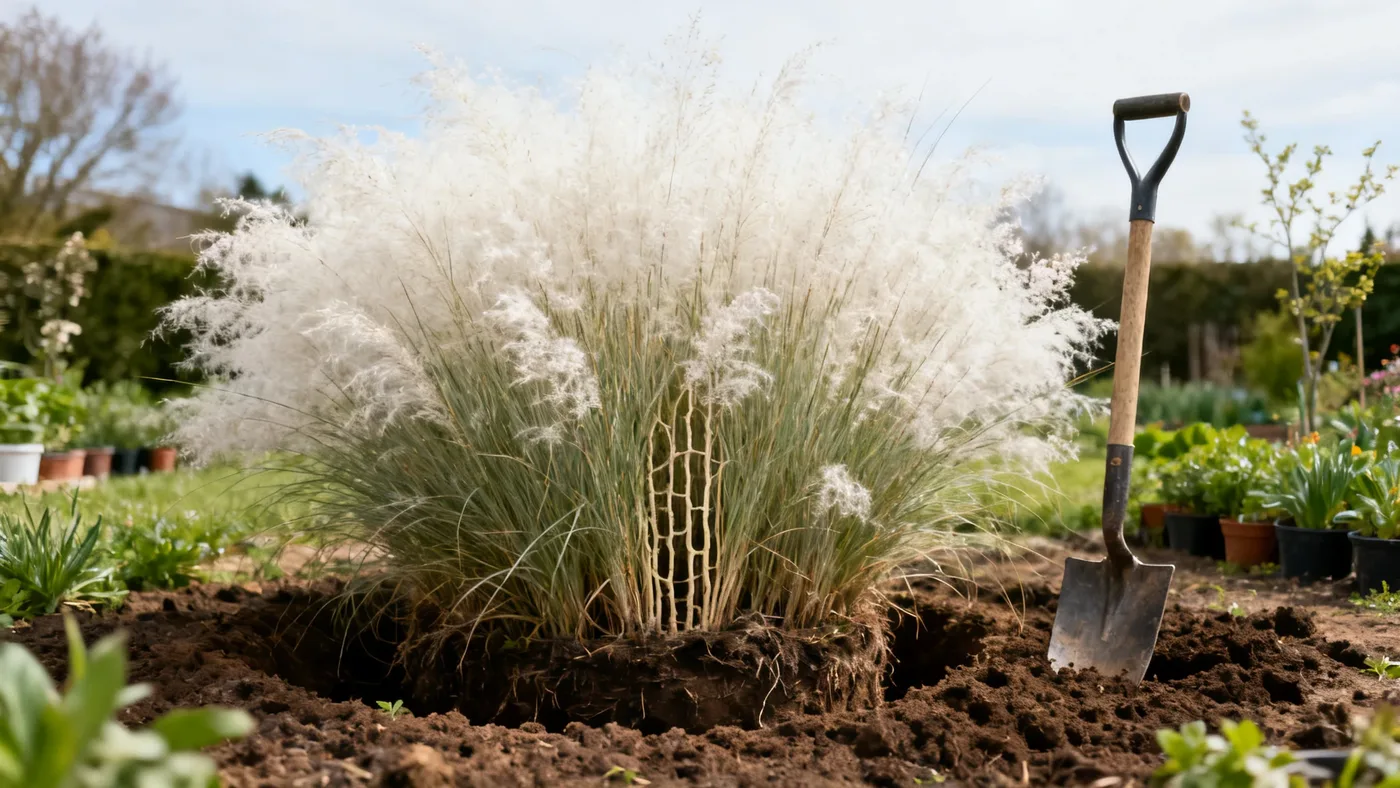
White Cloud Muhly Grass is classified as a long-lived perennial, and in practice that means a planting can outlast the gardener who installed it. But the useful answer is not a single number. An individual clump reaches full size in 2 to 3 seasons, holds peak form for several years after that, and then begins to congest and hollow out in the middle. At that point the clump has not reached the end of its life; it has reached the point where it needs dividing. Divide it every few years and the planting is effectively perpetual. Never divide it and a clump will usually look tired somewhere between years 5 and 10, even in a good site.
White Cloud Muhly Grass
The fastest way to extend a planting is to add to it: new clumps in their prime alongside the ones you are about to divide. Nursery-grown White Cloud Muhly Grass in quart, 2 gallon and 3 gallon sizes from $39.99, shipped in its container with our planting and care guides.
This guide is about longevity and the signs of age. For how big the plant gets on the way there, see how big White Cloud Muhly Grass really gets, which covers mature dimensions rather than mature age.
The Honest Answer: Two Different Lifespans
Two things are being measured when people ask how long this grass lives, and they give very different answers.
The lifespan of one undivided clump. Extension guidance for ornamental grasses generally is that most need dividing every 3 to 4 years, because clumps that are never divided thin out and eventually die in the center. Left alone entirely, a clump keeps expanding outward while the oldest growth at the middle declines, and the decorative quality drops long before the plant actually dies. Many gardeners report clumps looking good for a decade in well-drained soil, and the species is repeatedly described in botanical records as long-lived, but a clump that is never touched is on a slow decline from roughly year 5.
The lifespan of the planting. Unlimited, for practical purposes. Every division resets the clock: you remove the exhausted center and replant vigorous outer growth, which is genetically the same plant at a much younger physiological stage. A muhly bed maintained this way persists indefinitely. Florida native plant records also note that the species readily self seeds, and seedlings sometimes appear in pavement cracks and gravel, so a planting can also renew itself without your help. That is why the answer to how long it lives depends on your maintenance habits more than on the plant.
Year by Year: What to Expect
| Age | What the clump is doing |
|---|---|
| Year 1 | Root establishment. Growth of roughly 1 to 2 feet, often a light first bloom or none. Needs water it will never need again. |
| Years 2 to 3 | Reaches mature size, 2 to 3 feet of foliage and 2 to 4 feet wide. Full plume display arrives. Drought tolerance becomes real. |
| Years 3 to 5 | Peak form. Dense, upright, self-supporting, heaviest bloom. Nothing needed beyond one cut back a year. |
| Years 4 to 6 | The division window opens. The clump is still handsome but large, and dividing now is far easier than dividing later. |
| Years 5 to 8 | Congestion sets in on most clumps: the center thins, plume count drops, outer growth leans. |
| Year 8 and beyond | Either a divided and renewed planting in peak form, or a ring of living growth around a dead middle. |
Treat those years as a range, not a schedule. Clumps in full sun on sandy, well-drained ground move through it slowly and can look excellent well past year five. Clumps in richer soil, in part shade, or getting irrigation they do not need move through it faster, because the same conditions that push soft growth also push congestion.
The Five Signs of an Aging Clump
You do not need to count years. The plant tells you, and these are the signals in the order they usually appear.
1. Fewer plumes on a plant that used to be covered. A gradual decline in bloom count across two or three autumns, with no change in light or feeding, is the earliest honest sign of a congested crown. Do not confuse it with a plant that has never bloomed well, which is almost always a light problem instead. Our guide to why White Cloud Muhly Grass is not blooming separates the two causes.
2. Thinning at the center of the clump. Part the foliage in early summer and look straight down at the crown. A healthy clump is dense with new shoots across its whole diameter. An aging clump has fewer, weaker shoots in the middle and the strongest growth around the rim.
3. A dead or hollow middle with a living ring. The unmistakable stage. Old woody crown tissue in the center has stopped producing shoots, and all the vigor sits in a doughnut around it. This is the classic end point for an undivided ornamental grass, and it is fixable in one afternoon.
4. Outward lean and a splitting clump. As the center empties, the surrounding growth has nothing to lean against and falls outward, so the clump looks like it is opening up. Read this carefully, because floppy growth also comes from too much shade, too much water or too much nitrogen. If the plant is in full sun, unfed, and the flop starts from an empty center rather than at the base of every blade, age is the cause.
5. The crown sitting proud of the soil. Some clumps gradually build up above grade as old crown tissue accumulates, which exposes the growing points and dries them out. It is less common on this grass than on some, and it is another reason to lift and reset rather than to keep topdressing.
Division Is the Life Extension, and It Has a Narrow Window
Dividing is not a rescue operation, it is routine maintenance, and the single most important detail is when. This is a warm-season grass, so it has to be divided while it is actively growing and able to regenerate roots. USDA guidance for the species is to propagate by dividing existing clumps in early spring and summer, and explicitly not during the flowering stage. Because 'White Cloud' blooms later than the pink species, roughly September through November, that rules out the entire autumn.
Plan on early spring, once new growth is a few inches tall. The full method, including how large to keep each piece and what to do with the dead middle, is in our guide to dividing and propagating White Cloud Muhly Grass. If the clump also needs to move, our guide to transplanting an established White Cloud Muhly Grass handles both jobs in one lift.
What Actually Cuts a Clump's Life Short
Old age is rarely what kills this plant. These are, in rough order of how often they are responsible.
- Wet soil. Crown and root rot from ground that stays saturated is the usual cause of an early death, and once the crown is soft the plant is normally beyond saving. The species wants well-drained ground; it tolerates sand, loam, clay and shallow rocky soil, but not standing water at the crown. Our guide to the best soil for White Cloud Muhly Grass covers how to test the site before you plant.
- Planting too deep. A crown set below grade rots. This is a five-second decision at planting that determines whether you get one year or twenty. See how to plant White Cloud Muhly Grass for best results.
- Dividing or moving at the wrong time of year. Cut roots cannot regrow in cold soil. A clump split in late winter or in bloom is the standard loss, and in zones 6 and 7 a late-season division often does not survive the following winter.
- Too much nitrogen. Feeding produces soft growth that lodges, blooms poorly and is more disease-prone. It shortens the useful life of a clump rather than extending it.
- Container confinement. A clump in a pot exhausts its root run in a fraction of the time it would in the ground, and its roots are far more exposed to cold. Container plants need dividing or potting on much sooner than in-ground clumps. Our guide to growing White Cloud Muhly Grass in pots and containers long-term covers the intervals.
The Annual Habit That Keeps a Clump Young
One job a year, done at the right time, does most of the work of keeping a clump vigorous: remove last season's dead residue before new growth starts. USDA management guidance for stands of this species is to mow or burn in late winter to clear the old residue, and the garden-scale version is a hard cut back in February or March, before shoots emerge.
Skipping it for a year or two will not kill the plant, but the accumulating thatch at the crown shades the new shoots, traps moisture against the exact tissue that rots, and accelerates the thinning you are trying to avoid. Our guide to when and how to cut back White Cloud Muhly Grass has the timing and the method, and winter care for White Cloud Muhly Grass explains why the foliage stays on the plant until then.
Quick Reference: Longevity
| Item | Detail |
|---|---|
| Life cycle | Long-lived herbaceous perennial, warm-season |
| Time to mature size | 2 to 3 growing seasons |
| Peak ornamental years | Roughly years 3 to 5 after planting |
| Division interval | Every 3 to 4 years for ornamental grasses generally; on this plant, when the center thins |
| Lifespan without division | Often a decade in well-drained soil, with declining bloom from roughly year 5 |
| Lifespan with division | Effectively indefinite; each division renews the planting |
| Division timing | Early spring into summer, never during bloom |
| Annual maintenance | One cut back in late winter to remove old residue |
| Most common early killer | Crown and root rot in poorly drained soil |
| Self-renewal | Readily self seeds; volunteer seedlings are common |
| Container lifespan | Shorter; needs dividing or potting on sooner than in-ground clumps |
So: expect a clump to look its best from its third autumn, plan to lift and split it somewhere around its fifth, and understand that the planting itself has no expiry date as long as you keep doing that. For the ongoing routine in between, see our complete White Cloud Muhly Grass care guide.
White Cloud Muhly Grass
Whether you are replacing a clump that sat too wet or extending a bed before the oldest plants need splitting, order nursery-grown White Cloud Muhly Grass in quart, 2 gallon or 3 gallon sizes, shipped in its nursery container with growing guides included.