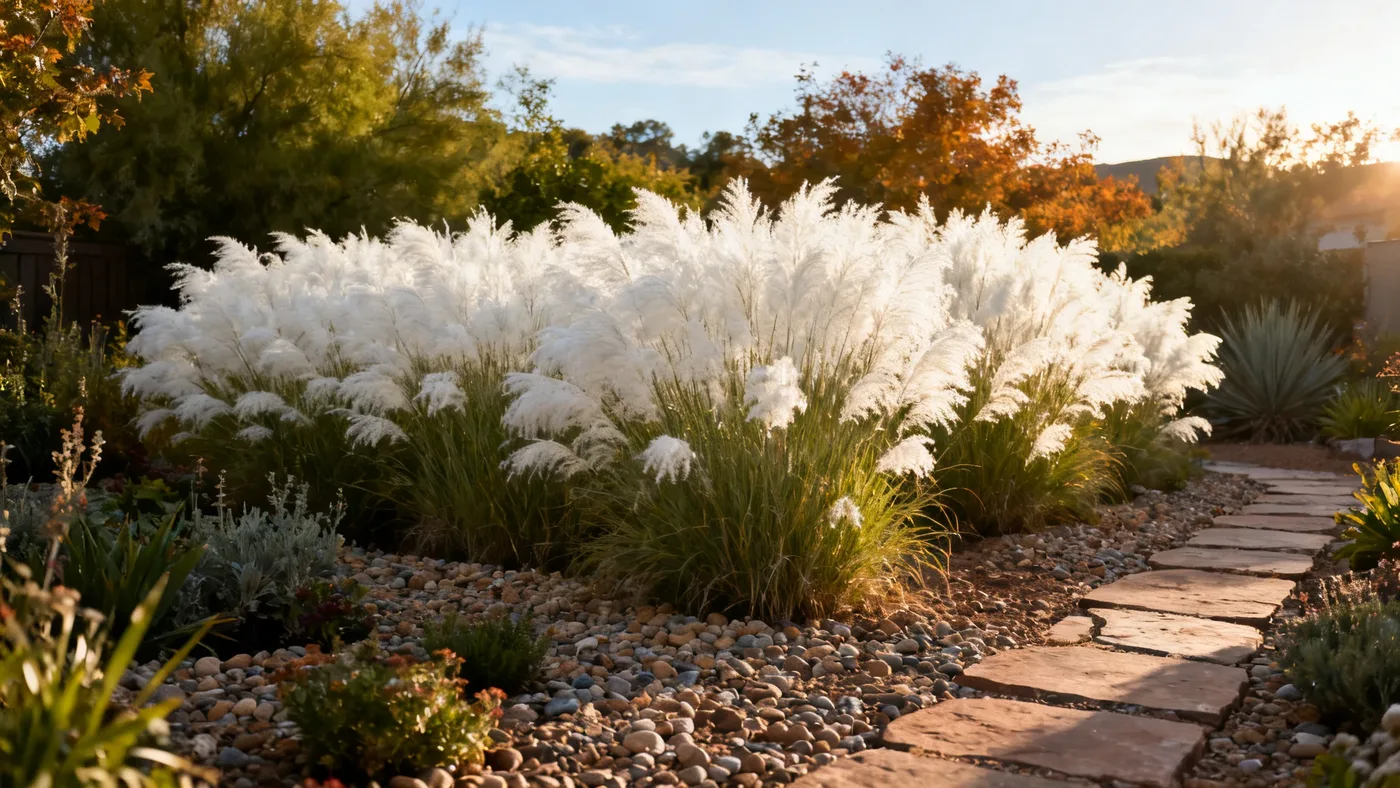
Xeriscaping With White Cloud Muhly Grass
White Cloud Muhly Grass is one of the few ornamental grasses that earns a place in a xeriscape on more than drought tolerance alone. The USDA photographs hairawn muhly in a xeric landscape setting and lists it as drought tolerant and low maintenance; extension plant records name xeriscape among its recommended uses. What makes it genuinely valuable in this style of garden is timing: it blooms September through November, when most water-wise perennials have finished, and then holds copper foliage through winter. A xeriscape's usual weakness is a flat, over-by-August season, and this plant fixes exactly that.
White Cloud Muhly Grass
Xeriscape beds are built in drifts, not single plants: three, five or seven clumps repeated down a bed. Nursery-grown White Cloud Muhly Grass in quart, 2 gallon and 3 gallon sizes from $39.99, shipped in its container with our planting and care guides.
This is a design guide. For the yes-or-no fact check on water needs, see whether White Cloud Muhly Grass is drought tolerant, and for combinations in a conventional bed, landscaping ideas for White Cloud Muhly Grass and companion plants.
What Xeriscape Actually Means
The word was coined by Denver Water in 1981 from "landscape" and the Greek xeros, meaning dry. It describes a landscape that needs little supplemental water. It does not mean a gravel lot with three yuccas in it, and it is not a no-maintenance landscape; the maintenance is simply different and much lighter.
The method is a set of seven principles, and the useful way to plan a muhly planting is to walk through them and decide what this specific plant needs from each. That is what the rest of this guide does.
1. Planning and Design: Give It the Late Season
Start with a base plan drawn to scale showing property lines, buildings, existing plants and the direction water moves across the site. Then assign each plant a job rather than a spot.
Muhly's jobs in a xeriscape are specific:
- The late act. Bloom runs roughly September through November. Plan the bed so something carries spring and midsummer and let muhly own autumn, rather than expecting all-season performance from every plant.
- Movement. Fine-textured foliage and airy plumes read as motion next to the static, sculptural forms that dominate dry gardens. The contrast is the point.
- Winter structure. Foliage turns copper in fall and the dried plumes persist, so the bed has presence in January. Leave it standing; see winter care for White Cloud Muhly Grass.
- Backlight. The white plumes are at their best with low sun behind them. Site drifts on the west or south side of a path or seating area, so late afternoon light passes through them rather than falling on them. This single placement decision changes the plant more than anything else you can do.
Plan for mature size, not nursery size: 2 to 3 feet of foliage, 3 to 4 feet with plumes, and 2 to 4 feet wide within two to three seasons. Our guide to how big White Cloud Muhly Grass really gets has the growth curve.
2. Soil: Amend for Structure, Never for Moisture at the Crown
Standard xeriscape advice is to work 1 to 2 inches of organic matter into the top 6 inches of soil to help it hold and release water. For most plants in most soils that is right. For this one it needs a caveat, because it is the point where xeriscape convention and muhly's actual preferences diverge.
Hairawn muhly prefers neutral to slightly acidic soil, tolerates sand, loam, clay and shallow rocky ground, has a high tolerance for salinity and a low tolerance for high pH, and above all wants drainage. On sandy or rocky ground, adding compost around the root ball can do harm rather than good: it creates a pocket that holds water against the crown in the one place the plant needs water to leave quickly. Our guides to the best soil for White Cloud Muhly Grass and to transplanting an established clump both come down on unamended native backfill for sandy sites.
The resolution is to separate the two jobs. Improve the bed broadly before planting if the soil is genuinely poor, so the whole profile drains and roots can run. Do not build a compost-lined hole for the individual plant. And if your soil is already alkaline, skip the gravel mulch here, because rock can push pH further in the direction this species tolerates least.
3. Efficient Irrigation: Deep, Infrequent, and at the Soil
Of all seven principles, watering efficiently has the largest water-saving potential, because the average homeowner applies about twice what a landscape needs. For muhly the specifics are straightforward.
- Drip emitters, not sprinklers. Standard xeriscape practice for shrubs and perennials, and it has a second benefit here: dry foliage resists the fungal spotting that needs leaf wetness to establish. See rust and fungal diseases in White Cloud Muhly Grass.
- Not between 10 a.m. and 6 p.m. Evaporation losses are highest in that window. Early morning is the right slot, and it also lets any splashed foliage dry fast.
- Deep and infrequent from the start. Establishment takes a full growing season, and drought tolerance is a mature-plant trait that develops fully over two to three years. Plan to water the first season, then stop. Our guide to watering White Cloud Muhly Grass from new plant to established has the taper.
- Design the irrigation so it can be turned off. Put the muhly zone on its own valve. A dry-garden plant on a shared circuit with thirsty neighbors gets watered for the rest of its life.
4. Plant Zones: Hydrozoning Is the Principle That Saves This Plant
Hydrozoning means grouping plants by water and light needs so each zone can be irrigated correctly. On most plants this is an efficiency measure. On muhly it is a survival measure, and it is the most important idea in this guide.
The commonest way a well-sited White Cloud Muhly Grass dies is not drought and not cold. It is the irrigation intended for whatever is planted next to it. Crown and root rot from soil that stays wet is the standard cause of death, and a clump placed in a border that receives weekly irrigation all summer is sitting in those conditions on purpose. Put it in the low-water zone with other plants that want to dry out between waterings, in full sun, and the whole maintenance problem disappears.
Two corollaries worth designing around:
- Do not plant it at the bottom of a slope or in a swale where the zone's runoff collects. The face of a bank and the berm above a basin are the right positions; see White Cloud Muhly Grass for erosion control on slopes.
- Full sun is part of the hydrozone. Shade produces floppy growth and few plumes, and it slows foliage drying. Six to eight hours of direct sun is the target; see sun requirements for White Cloud Muhly Grass explained.
5. Mulch: Which Number Applies Where
Xeriscape guidance calls for organic mulches at least 4 inches deep and inorganic mulches at least 2 inches, to stop the soil surface crusting and to cut evaporation. Those figures are written for coarse mulches over open ground in a semi-arid climate, and they need two adjustments for this plant.
First, depth depends on texture: coarse bark nuggets tolerate 4 inches, but fine-textured wood and bark mulches must stop at 2 to 3 inches or they suffocate roots. Second, and non-negotiable, none of it touches the crown. Keep a 3 to 4 inch ring of bare soil around the base of every clump, whatever the mulch. Our guide to the best mulch for White Cloud Muhly Grass compares pine straw, bark, hardwood and gravel for this specific plant.
In a gravel-dominated xeriscape, 2 inches of angular stone with a clean crown ring works and looks right, with the pH caution above in mind. Pine straw is the better choice where the style allows it.
6. Turf Alternatives: Replacing Lawn With a Muhly Mass
Reducing turf to the areas that actually get used is the principle with the most visible effect on a water bill, and a drift of muhly is one of the more convincing replacements for an unused front strip, because it has real seasonal drama rather than just being not-lawn.
Plant counts for a mass planting, using staggered triangular spacing:
| On-center spacing | Area per plant | Plants per 100 sq ft | Effect |
|---|---|---|---|
| 24 inches | about 3.5 sq ft | about 29 | Closes into a continuous mass by year 2 to 3. Best for slopes and full coverage. |
| 30 inches | about 5.4 sq ft | about 19 | Clumps touch at maturity but stay readable. The usual choice for a lawn replacement. |
| 36 inches | about 7.8 sq ft | about 13 | Each clump stands alone with gravel or mulch between. Most airflow, slowest to fill. |
Wider spacing means more mulch or gravel to buy and more weeding in years one and two; tighter spacing costs more in plants and gives less air movement. Our guide to spacing White Cloud Muhly Grass for hedges, borders and mass plantings works through the trade-off. Design-wise, odd-numbered drifts of three, five or seven repeated along a bed read as intentional; a single row of evenly spaced clumps reads as a fence.
7. Maintenance: One Job a Year
Xeriscape maintenance is lighter than conventional gardening but it is not zero, and it decreases as plantings mature. For muhly the annual list is genuinely short.
- One cut back in late winter. February or March, before new growth emerges, down to a few inches. USDA management guidance for stands of this species is to mow or burn in late winter to remove the old residue, and this is the garden version. See when and how to cut back White Cloud Muhly Grass.
- No fertilizer. Feeding produces soft growth that flops and blooms poorly. See do you need to fertilize White Cloud Muhly Grass.
- Divide when the center thins. Every few years, in early spring and never during bloom. See dividing and propagating White Cloud Muhly Grass and how long White Cloud Muhly Grass lives.
- Top up mulch, do not rebuild it. Check depth, rake any crust, add only what is missing.
Regional Reality Check
This is a native of the southeastern and south-central United States, and its documented drought and heat tolerance is high. That makes it a natural fit for water-wise gardens across zones 6 through 9, and Florida extension guidance treats it as a standard low-maintenance choice for roadside and median plantings, which is about as demanding a dry site as a landscape plant gets.
Two honest regional notes. In a genuinely arid western xeriscape, low humidity and high evaporation raise water demand, so plan on a full establishment season of irrigation and excellent drainage, and expect to check soil moisture more often in the first year than a plant label implies. And in humid southeastern gardens the constraint is the opposite: the plant will sail through the drought and struggle only where air does not move, so space for airflow and keep it out of the low, damp corner of the yard. Our guide to White Cloud Muhly Grass hardiness zones covers the cold end.
Quick Reference: The Seven Principles Applied
| Principle | What to do with muhly |
|---|---|
| Planning and design | Assign it autumn and winter interest; site drifts where low sun backlights the plumes |
| Soil improvement | Improve the bed for drainage; do not amend the individual planting hole on sandy soil |
| Efficient irrigation | Drip, early morning, deep and infrequent; establishment season only, then off |
| Plant zones | Low-water zone, full sun, on its own valve; never share a circuit with thirsty plants |
| Mulch | 2 to 3 inches fine, up to 4 coarse, 2 inches of gravel; 3 to 4 inch clear ring at the crown |
| Turf alternatives | Mass at 30 inches on center, about 19 plants per 100 sq ft, in odd-numbered drifts |
| Maintenance | One late-winter cut back, no fertilizer, divide when the center thins |
A xeriscape built this way asks for water in its first season and very little after that, and it does something most dry gardens fail to do: it peaks in October. For the complete growing routine, see our complete White Cloud Muhly Grass care guide.
White Cloud Muhly Grass
Work out your area, divide by the square feet per plant in the table above, and order nursery-grown White Cloud Muhly Grass in quart, 2 gallon or 3 gallon sizes. Quart plants are the economical way to buy a mass planting; larger sizes give immediate presence. Every order ships in its nursery container with growing guides included.