White Cloud Muhly Grass vs Blue Oat Grass: Evergreen Structure or Seasonal Plumes?
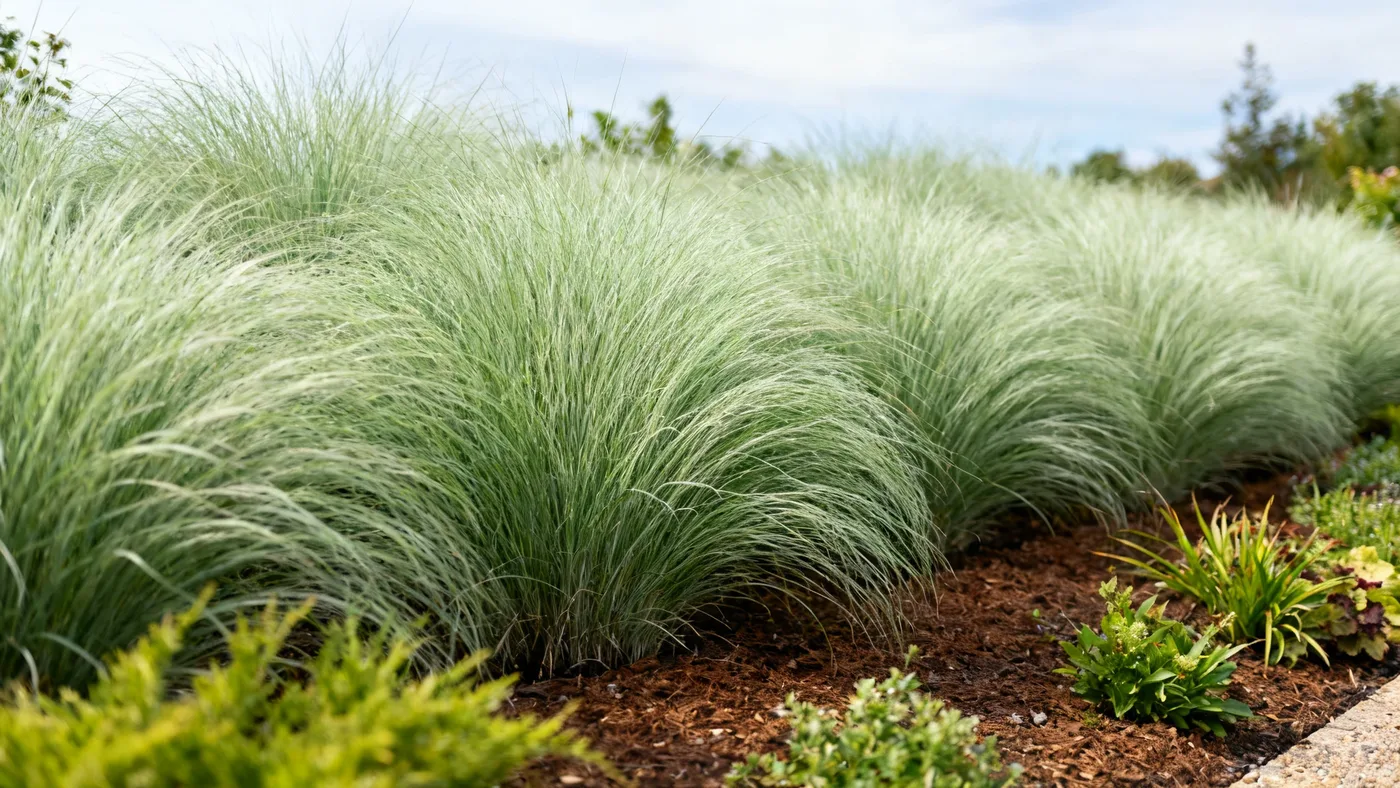
The choice here is a clean one, which is rare in plant comparisons. Blue oat grass (Helictotrichon sempervirens) is grown for foliage that is there all year: silvery-blue arching blades that stay evergreen in mild climates and semi-evergreen in cold ones, holding a bed together in February. White Cloud Muhly Grass is grown for a flower display that is there for two months: a white plume cloud from September into November, on a plant that goes tan and then gets cut to the ground. One gives you constant structure, the other gives you a season you plan the year around.
White Cloud Muhly Grass
If your border already has plenty of year-round green and nothing that happens in October, this is the plant that fixes it. Nursery-grown White Cloud Muhly Grass in quart, 2 gallon and 3 gallon sizes from $39.99, shipped in its container with our planting and care guides.
Before the aesthetics, there is a climate filter that settles the question for a large part of the country. Blue oat grass is hardy in zones 4 to 8 and performs poorly in high heat and humidity, with reduced flowering in muggy summers and rust appearing in wet, humid conditions. White Cloud Muhly Grass runs zones 6 to 9 and is native to the humid central and eastern United States. Across the humid Southeast, one of these is a reliable plant and one is a gamble.
At a Glance: Quick Comparison
| Attribute | White Cloud Muhly Grass | Blue Oat Grass |
|---|---|---|
| Botanical Name | Muhlenbergia capillaris 'White Cloud' | Helictotrichon sempervirens |
| Season Type | Warm-season; grows through summer heat | Cool-season; grows in spring and fall |
| Winter Foliage | Dies back; tan structure stands until cut | Evergreen in mild climates, semi-evergreen in cold |
| Mature Height | 3-4 ft with plumes; foliage clump 2-3 ft | 2-3 ft; blades 18-24 in |
| Mature Width | 2-4 ft | 1-2.5 ft |
| USDA Zones | 6-9 (some sources list 5-9) | 4-8 |
| Foliage Color | Green in summer, bronze to tan in fall | Silvery-blue year round |
| Flower | White airy plumes to about 12 in, September to November | Bluish-brown panicles, mid to late summer, aging golden-tan |
| Soil pH Preference | Adaptable: acid, neutral or alkaline | Neutral to alkaline |
| Heat and Humidity | Native to the humid Southeast; thrives | Poor; flowering reduced, rust risk rises |
| Annual Maintenance | Cut back hard in February or March | Comb out dead foliage in spring; never shear hard |
| Deer Resistance | High | Deer and rabbit resistant |
| Salt Tolerance | High | Tolerant |
Evergreen Structure: What Blue Oat Grass Actually Delivers
The evergreen claim needs a qualifier, because it is the source of most disappointment with this plant. Blue oat grass is evergreen in mild-winter climates. In colder regions it declines through the cold months and behaves as a semi-evergreen, holding its form but losing crispness, with a share of the blades browning off by late winter.
Where it does hold, the effect is genuinely useful: a tight 2 to 3 foot dome of silvery-blue arching blades, 18 to 24 inches long, that reads as a cool architectural mound in a winter bed. Drier soil deepens the blue. It is one of the few ornamental grasses that gives a border a shape in January rather than a silhouette.
Its flowers are a secondary feature. Bluish-brown panicles appear in mid to late summer, held above the foliage, and age to golden-tan. They are quiet, and in humid summers they may be sparse.
Seasonal Plumes: What the Muhly Delivers
White Cloud Muhly Grass makes no claim on winter greenery. It is a warm-season grass: late to green up in spring, green and unremarkable through summer, then in September the panicles open into a white haze up to about a foot long that holds into November. After the plumes dry to buff, the foliage takes a bronze or tan cast and the whole clump stands as pale winter structure until it is cut to a few inches in February or March.
So it does have winter presence, just a different kind. Blue oat grass gives you a blue shape; the muhly gives you a translucent tan one that catches low sun and moves in wind. Our guide on whether White Cloud Muhly Grass dies back in winter explains why leaving that standing matters for the crown, and what to expect from its fall color covers the foliage transition.
The two-month bloom window is the trade. If a garden needs one thing to happen every year that people remark on, this is the plant. If a garden needs to look composed on a grey Tuesday in January, it is not.
Climate: The Filter That Decides It
Blue oat grass runs zones 4 to 8. It prefers full sun, medium to dry well-drained loamy or sandy soil, and a neutral to alkaline pH. Its stated weakness is high heat and humidity, where flowering is reduced and performance drops. Wet, humid conditions also bring on rust, and wet soil, particularly over winter, brings crown rot. It needs good air circulation.
White Cloud Muhly Grass runs zones 6 to 9, with the species listed to zone 5 by some sources. It adapts to clay, loam or sandy soil and to acid, alkaline or neutral pH, and its native range covers the central and eastern United States including the humid Gulf and Atlantic coasts. Humidity is not a stress. Its own limit is drainage over winter, the same failure mode blue oat grass has, and it can also show rust when crowded in humid weather. Our guide to rust and fungal diseases covers the spacing that prevents it.
Read together: in the upper Midwest, the Northeast and the cooler West, blue oat grass is at home and the muhly is at or past its cold limit. From the mid-Atlantic south and across the Gulf states, the muhly is native and the oat grass is fighting the climate. The overlap band, roughly zones 6 to 8 without oppressive summers, is where you get a real choice. Our hardiness zone guide covers the regional detail.
Maintenance: Two Different Spring Jobs
This catches people who treat all ornamental grasses the same, and it is worth getting right because the wrong treatment ruins a blue oat grass.
Blue oat grass should not be sheared to the ground. Because it is evergreen or semi-evergreen and cool-season, cutting it hard removes living foliage it needs. The correct spring job is to remove dead blades and spent flower stems, essentially combing or raking the clump out by hand, leaving the healthy blue foliage intact.
White Cloud Muhly Grass is the opposite. It is deciduous and warm-season, and the entire clump should be cut back to a few inches in February or March, before new growth pushes. Doing it earlier costs you the winter structure; doing it later risks cutting into new growth. Our guide on when and how to cut back White Cloud Muhly Grass has the timing and tools.
Beyond that annual job, both are low input. Neither needs fertilizer in reasonable soil, both are drought tolerant once established, and both are deer and rabbit resistant.
Using Them Together
The seasons these two occupy are complementary rather than competing, which is the strongest argument for not choosing at all if your climate supports both.
Blue oat grass carries winter and spring with cool blue structure. The muhly is invisible in that stretch. From September through November the muhly is the feature, and blue-gray foliage underneath it is one of the better backdrops for white plumes, since both sit in the cool half of the palette. In a zone 6 to 8 garden with well-drained soil and summers that are warm rather than steaming, a planting of low blue oat grass domes in front of a mass of muhly covers the whole year on two plants.
For more combinations, see our landscaping ideas and companion plants guide.
Pros and Cons
White Cloud Muhly Grass
Pros:
- A genuine autumn event: white plumes from September into November.
- Thrives in heat and humidity, where blue oat grass falters.
- Adapts to acid, neutral or alkaline soil and to clay, loam or sand.
- Highly salt tolerant and highly deer resistant.
- Standing tan winter structure that catches low light and moves in wind.
- One straightforward annual job: cut it all back in late winter.
- Long-lived, reaching full size in two to three seasons and holding.
Cons:
- No foliage color to speak of from spring through August.
- Not evergreen; the bed is bare after the February or March cut-back.
- Late to green up in spring.
- Not hardy below zone 6 in most listings.
- Wider at 2 to 4 feet than the tidier oat grass mound.
Blue Oat Grass
Pros:
- Silvery-blue foliage all year, evergreen in mild climates.
- Tidy 2 to 3 foot dome that holds a crisp architectural shape.
- Hardy to zone 4, well north of the muhly's range.
- Drought tolerant, and drier soil deepens the blue color.
- Deer, rabbit, salt and black walnut tolerant.
- Works as a repeating structural element through a long border.
Cons:
- Poor performer in high heat and humidity, with reduced flowering.
- Rust in wet, humid conditions; crown rot in wet soil.
- Only semi-evergreen in cold regions, where it browns off in late winter.
- Flowers are quiet and easy to miss.
- Prefers neutral to alkaline soil, so acid-soil gardens need amendment.
- Must not be sheared hard, which makes its spring care less intuitive.
Best For: Use Cases
Choose White Cloud Muhly Grass if you:
- Want a border with a season that people notice rather than constant texture.
- Garden anywhere hot and humid, from the Gulf Coast to the mid-Atlantic.
- Have acid soil, or clay, and do not want to amend for pH.
- Need a plant 3 to 4 feet tall for the middle or back of a bed.
- Garden near salt spray or salted pavement.
- Prefer one simple annual cut-back to a more nuanced grooming routine.
Choose blue oat grass if you:
- Need the bed to have a defined shape through winter and early spring.
- Garden in zone 4 or 5, below the muhly's comfortable range.
- Have cool, dry summers rather than humid ones.
- Want blue-gray foliage as a repeating structural color.
- Have neutral to alkaline, sharply drained soil.
The Verdict
Ask what the bed is missing. Most residential borders are over-supplied with things that look the same all year and under-supplied with anything that peaks. If that describes yours, White Cloud Muhly Grass is the answer, and in any climate with real summer humidity it is also the more reliable plant of the two.
Blue oat grass earns its place in a cool-summer garden where winter structure is the design problem, or in zone 4 and 5 where the muhly cannot be grown at all. It is a good plant asked to do a specific job, and it does that job poorly in the Southeast.
Where both will grow, the best answer is usually both, with the blue domes at the front holding the line and the white plumes behind them carrying the autumn.
Ready to plant? See how to plant White Cloud Muhly Grass for best results, or best soil, drainage and pH needs if your bed holds water.
White Cloud Muhly Grass
Structure is easy to buy; an autumn display is not. Order nursery-grown White Cloud Muhly Grass in quart, 2 gallon or 3 gallon sizes, shipped in its nursery container with growing guides included, and plant it this spring or early fall.
Quick Reference
| Factor | White Cloud Muhly | Blue Oat Grass | Advantage |
|---|---|---|---|
| Winter foliage | Dies back to tan structure | Evergreen to semi-evergreen blue | Blue oat grass |
| Flower display | White plume cloud, Sept-Nov | Quiet bluish-brown panicles | Muhly |
| Height | 3-4 ft in bloom | 2-3 ft | Muhly for back of border |
| Hot humid summers | Thrives | Declines, rust risk | Muhly |
| Cold hardiness | Zones 6-9 | Zones 4-8 | Blue oat grass |
| Soil pH | Acid, neutral or alkaline | Neutral to alkaline | Muhly |
| Spring job | Cut the whole clump back | Comb out dead blades only | Muhly, for simplicity |
| Drought tolerance | High once established | High once established | Even |
| Deer and rabbits | Highly resistant | Resistant | Even |
| Salt tolerance | High | Tolerant | Muhly |