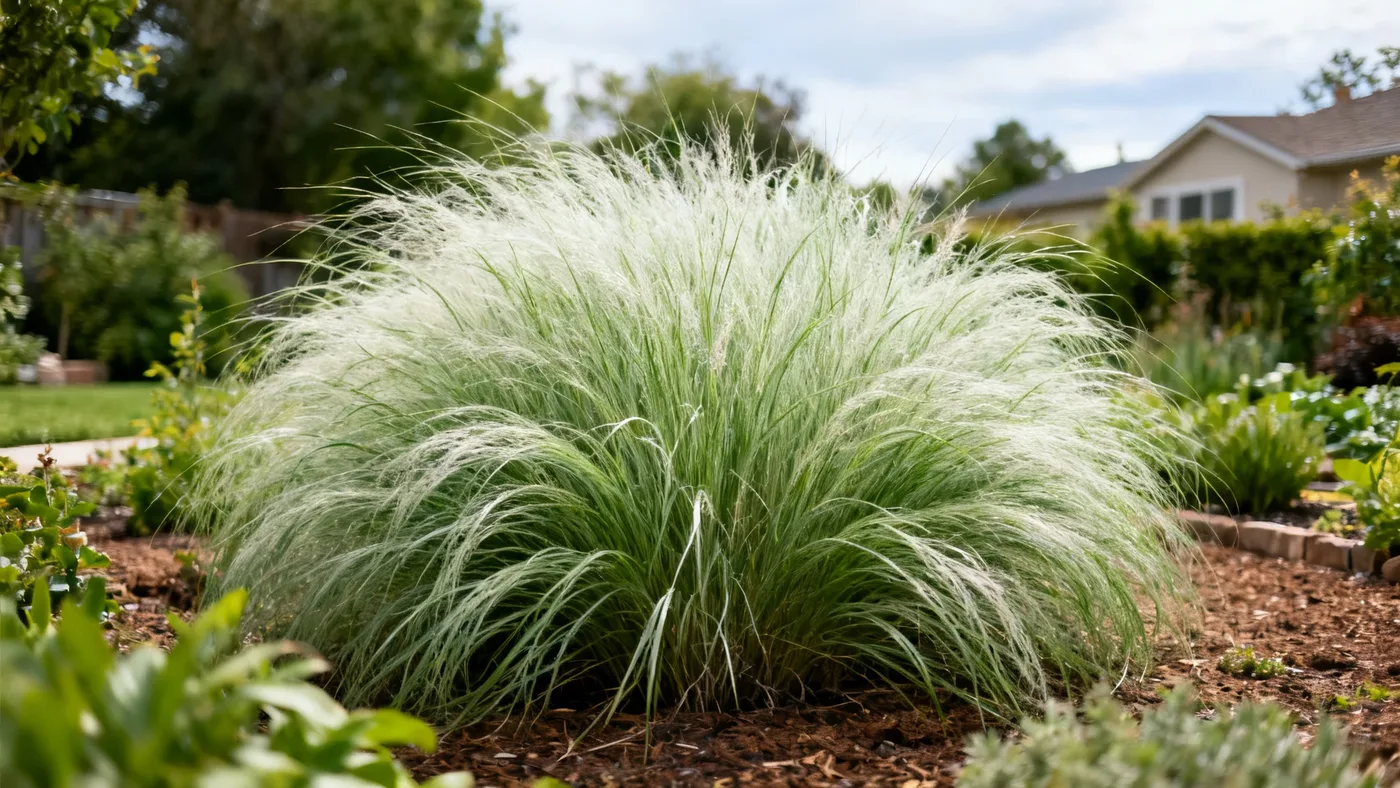
White Cloud Muhly Grass vs Mexican Feather Grass: Which Fine-Textured Grass Wins?
These two grasses land on the same shortlist because both read as fine, hair-thin and cloud-like from ten feet away. The decision between them usually gets settled before anyone talks about looks. Mexican feather grass (Nassella tenuissima, still sold under its old name Stipa tenuissima) produces thousands of seeds per plant, and the California Invasive Plant Council has moved it off its earlier Watch listing to a Limited invasiveness rating after it kept establishing itself outside the beds it was planted in. White Cloud Muhly Grass is a clump-forming selection of Muhlenbergia capillaris, a species native to the central and eastern United States, and it has no rhizomes, no stolons and no self-sowing reputation that needs managing.
White Cloud Muhly Grass
If the airy, fine-bladed look is what you are after and you would rather not inherit a seeding problem, this is the plant. Nursery-grown White Cloud Muhly Grass in quart, 2 gallon and 3 gallon sizes from $39.99, shipped in its container with our planting and care guides.
Past the seeding question they are not close substitutes at all. One is a knee-high cool-season mound that looks its best in spring and browns out in midsummer heat. The other is a chest-high warm-season grass that spends the summer green and does its entire show in autumn. Sizing one in where you planned the other will leave a hole in the bed.
At a Glance: Quick Comparison
| Attribute | White Cloud Muhly Grass | Mexican Feather Grass |
|---|---|---|
| Botanical Name | Muhlenbergia capillaris 'White Cloud' | Nassella tenuissima (formerly Stipa tenuissima) |
| Season Type | Warm-season; grows in summer heat | Cool-season; can go dormant in extreme heat and drought |
| Mature Height | 3-4 ft with plumes; foliage clump 2-3 ft | 1-2 ft |
| Mature Width | 2-4 ft | 1-2 ft |
| USDA Zones | 6-9 (some sources list 5-9) | 7-10 |
| Plume Color | White, airy, up to about 12 in long | Silvery-yellow, ripening to tan seed heads |
| Bloom Time | September through November | Summer into fall |
| Reseeding | Minimal; clumping habit, no runners | Prolific; thousands of seeds per plant |
| Regulatory Status | Not listed as invasive or noxious | Cal-IPC rating of Limited; on PlantRight's do-not-plant list in California |
| Humid Southeast | Native range includes the Southeast; thrives there | Performs poorly in hot, humid conditions |
| Salt Tolerance | High | Not noted for salt tolerance |
| Deer Resistance | High | Good |
The Seeding Question, and Why It Settles Most of This
Mexican feather grass reproduces by seed, in volume, and the seeds travel. They catch on clothing and animal fur, blow on the wind, move in runoff and ride out of a site in soil and on vehicles. That combination is why a plant popular in nurseries for decades has been reassessed: the California Invasive Plant Council raised it from Watch to a Limited rating, and PlantRight lists it as a do-not-plant species in California. It is also listed as invasive in Australia, where it took hold in grazing country.
The practical version for a home gardener outside a regulated area is this. A single Mexican feather grass in a gravel garden will seed itself into the gravel, the cracks in the patio, the neighbor's bed and the road verge. Those volunteers come out easily when they are young, but the job repeats every spring, and it repeats for as long as the parent plant is alive.
White Cloud Muhly Grass sits at the opposite end. It is a true clumper: the crown thickens outward year by year and stays where you put it. It sets seed, but 'White Cloud' is a selected white-flowered form of a pink-flowering species, so any seedling you do get is a genetic reshuffle rather than a copy, and the volunteers are few enough that most gardeners never notice them. Our full write-up on whether White Cloud Muhly Grass spreads covers what a volunteer looks like and how to get to zero of them if you want to.
Height and Scale: These Two Do Not Swap
Mexican feather grass is a 1 to 2 foot plant, tall and wide. It is a front-of-border and rock-garden scale grass, used in drifts where the fine texture reads as a single flowing surface.
White Cloud Muhly Grass carries a foliage clump of 2 to 3 feet and reaches 3 to 4 feet when the autumn plumes are up, spreading 2 to 4 feet. That is a mid-border to back-of-border plant, or a screen when massed. The plumes themselves run up to about a foot long, which is where the cloud effect comes from.
The gap matters most in a small bed. Three Mexican feather grass plants occupy roughly the footprint of one mature muhly. If you have already drawn a plan around a 2 foot mound, dropping in a 4 foot grass will swallow whatever sits behind it. Our guide to how big White Cloud Muhly Grass really gets has the year-by-year numbers.
Two Different Calendars
This is the difference most comparisons miss, and it changes what your garden looks like in July.
Mexican feather grass is a cool-season grass. It does its growing when the weather is mild, looks its best in spring and early summer, and in hot or dry regions it can shut down and go dormant through the peak of summer, turning straw-colored until conditions ease. Gardeners in Texas and the Southwest know this cycle well and plan around it.
White Cloud Muhly Grass is a warm-season grass. It waits for soil temperatures around 60 to 65 degrees Fahrenheit before it moves in spring, which means it is late to green up, then grows steadily right through the heat that stalls its cool-season counterpart. It holds green foliage all summer and opens its plumes from September into November, dries to a buff tone and stands through winter until it is cut back in February or March.
So the two plants cover opposite halves of the year. If your beds already look full in May and empty in October, the muhly is the one filling the gap.
Climate: Where Each One Actually Works
Mexican feather grass is hardy in roughly zones 7 to 10 and comes from the south-central United States, Mexico and Argentina. It wants heat and dryness. The North Carolina Extension Gardener Plant Toolbox is blunt about its limits in the humid East: it does not do well in the hot, humid conditions of the Southeast.
White Cloud Muhly Grass runs zones 6 to 9, with some sources extending the species to zone 5, and its native range covers the central and eastern United States including the humid Gulf and Atlantic coasts. Humidity is not a stress for it. Its one real requirement is drainage, particularly in winter, and full sun for a heavy plume set. It is also highly salt tolerant, which makes it a workable coastal plant where Mexican feather grass is not a natural fit.
If you garden in a dry western climate, both will physically grow. If you garden anywhere from Virginia to Texas along the humid belt, only one of them is going to look good in August. Our hardiness zone guide breaks down the regional picture.
Texture and Movement in the Border
Both grasses move in wind, which is most of their appeal. They move differently.
Mexican feather grass moves as a mass. The blades are hair-thin and the whole mound ripples like water at the slightest breeze, which is why it gets planted in sweeps along paths where people brush past it.
White Cloud Muhly Grass moves in two layers. The foliage is stiffer and holds its shape, while the flower panicles float above it on fine stems. From September on, the effect is a solid green base with a white haze suspended a foot above it, and low-angle morning or late-afternoon sun lights the haze from behind. That backlighting is the reason to site it on the west or south side of a seating area rather than behind you.
Maintenance Compared
White Cloud Muhly Grass has one annual job: cut the whole clump back to a few inches in late winter, February or March, before new growth pushes. Leave the dried plumes standing through the cold months for winter structure. Beyond that it wants no fertilizer in reasonable soil and no supplemental water once established. Our guide on when and how to cut it back covers the timing and the tools.
Mexican feather grass has the same annual cut-back, plus a recurring job the muhly does not create: pulling seedlings. In a gravel or decomposed-granite garden, which is exactly where it tends to be planted, that means going over the surface each spring. Shearing the seed heads before they ripen reduces it, but on a plant that flowers from summer into fall, that is several passes a season rather than one.
Pros and Cons
White Cloud Muhly Grass
Pros:
- Clumping habit with no rhizomes or stolons, so it stays where it is planted.
- Not listed as invasive or noxious, with no seeding problem to manage each spring.
- Handles humidity and heat, with a native range across the central and eastern United States.
- Autumn plumes fill the season when most perennial borders have gone quiet.
- High salt tolerance suits coastal and roadside plantings.
- One maintenance task a year: a late-winter cut-back.
- Enough height, at 3 to 4 feet in bloom, to work as a mid-border plant or a soft screen.
Cons:
- Too big for a small rock garden or a narrow edging strip.
- Late to green up in spring because it is a warm-season grass.
- Needs full sun for a full plume set; shade cuts flowering sharply.
- Takes 2 to 3 seasons to reach full mature size.
Mexican Feather Grass
Pros:
- Very fine texture and the most fluid movement of any common ornamental grass.
- Small scale suits rock gardens, containers and tight front-of-border spaces.
- Looks its best in spring, when warm-season grasses are still waking up.
- Drought tolerant and comfortable in dry western climates.
Cons:
- Produces thousands of seeds per plant and escapes cultivation readily.
- Carries a Cal-IPC rating of Limited and a PlantRight do-not-plant listing in California.
- Performs poorly in the hot, humid conditions of the Southeast.
- May go dormant and turn straw-colored in peak summer heat and drought.
- Requires repeated seedling removal for as long as the plant is in the ground.
Best For: Use Cases
Choose White Cloud Muhly Grass if you:
- Want fine texture without inheriting an annual seedling-pulling chore.
- Garden anywhere humid, from the Gulf Coast to the mid-Atlantic, where feather grass struggles.
- Need autumn interest rather than spring interest, or want both across two plants.
- Have a mid-border, a mass planting or a soft screen to fill at 3 to 4 feet.
- Garden near salt spray or salted pavement.
- Live in California or anywhere else where Mexican feather grass is discouraged.
Mexican feather grass may suit you if you:
- Garden in an arid western climate well outside the regions where it is flagged.
- Need a grass under 2 feet for a rock garden and have a plan for the seedlings.
- Want peak interest in spring rather than fall.
The Verdict
For most gardens, White Cloud Muhly Grass is the better version of what people want when they reach for Mexican feather grass. The fine-textured, wind-moved, cloud-like quality is there, at a larger and more useful scale, with a color show in the season when it counts most, and without the seeding behavior that has put the other plant on watch lists and do-not-plant lists.
The honest case for Mexican feather grass is scale. If you need a 1 to 2 foot grass and nothing taller will do, the muhly is not a substitute, and a dwarf-scale planting is a different design problem. But if the bed has room for a 3 to 4 foot plant, the muhly does everything the feather grass does and then keeps going into November.
Ready to plant? See how to plant White Cloud Muhly Grass for best results for spacing, timing and first-season care.
White Cloud Muhly Grass
Spring and early fall are both good planting windows, and a plant set out now blooms its first autumn. Order nursery-grown White Cloud Muhly Grass in quart, 2 gallon or 3 gallon sizes, shipped in its nursery container with growing guides included.
Quick Reference
| Factor | White Cloud Muhly | Mexican Feather Grass | Advantage |
|---|---|---|---|
| Height in bloom | 3-4 ft | 1-2 ft | Depends on bed scale |
| Peak season | September to November | Spring to early summer | Muhly for fall interest |
| Summer appearance | Green and growing | May brown out and go dormant | Muhly |
| Reseeding | Minimal | Thousands of seeds per plant | Muhly |
| Invasive listings | None | Cal-IPC Limited; PlantRight do-not-plant | Muhly |
| Humid climates | Native and thriving | Poor performer | Muhly |
| Hardiness | Zones 6-9 | Zones 7-10 | Muhly, by one zone colder |
| Salt tolerance | High | Not noted | Muhly |
| Annual maintenance | One late-winter cut-back | Cut-back plus seedling removal | Muhly |
| Fine-textured movement | Airy plumes above stiffer foliage | Whole mound ripples | Feather grass, marginally |